

Key takeaways
- MiCA creates a user understanding problem, not only a licensing problem.
- Regulated and unregulated crypto services must be explained at product level.
- Education flows can reduce support pressure and prevent avoidable churn.
- Product teams should turn regulatory communication into guided product education.
MiCA moves the risk into the product
MiCA is often treated as a legal workstream. That is too narrow. The 30 June 2026 cutoff was the last practical day before the final transition ended, while the legal consequence lands on 1 July 2026. From that point, a user does not only ask whether a platform has a licence. They ask what they can still do, which entity serves them, which protections apply, and whether they need to move assets now.
The deadline is real, not theoretical. Reuters reported that Conio secured an Italian MiCAR licence shortly before the transition ended, while the French AMF warned that unauthorised providers in France must cease activity from 1 July 2026 and could face enforcement, blacklisting, website blocking, fines, or prosecution. For users, this becomes a product experience before it becomes a regulatory footnote.
Legal notice is too thin for this job
A legal email can inform. It rarely teaches. MiCA customer education must explain status, scope, limits and next steps in a way users can act on. This matters because ESMA has already warned about the halo effect around regulated crypto entities: a regulated brand may still offer products or services that are not regulated in the same way, and users may wrongly assume protection covers everything.
Wind-down creates an even sharper communication problem. In its 23 June 2026 public statement, ESMA said unauthorised CASPs must stop onboarding new EU clients, limit services to actions needed to sell, transfer, reallocate, or close positions, and communicate clearly, promptly and repeatedly with clients. Those are product state changes, not only compliance duties.
Users need a decision path
A user does not need a policy essay at the moment of action. They need a decision path inside the product.
- Which legal entity am I contracted with.
- Whether that entity is authorised under MiCA.
- Which services are covered and which are not.
- What has changed in deposits, trading, custody, transfers, staking, lending, rewards, stablecoins, or withdrawals.
- What deadline applies to my account or position.
- What action is safest if I do nothing, transfer, sell, or move to self-custody.
This is where crypto regulation communication becomes product design. The explanation should appear where the user is confused: the blocked deposit, the withdrawal screen, the migration prompt, the asset detail page, the onboarding flow, the support deflection step. If education sits in a PDF, most users will meet the answer too late.
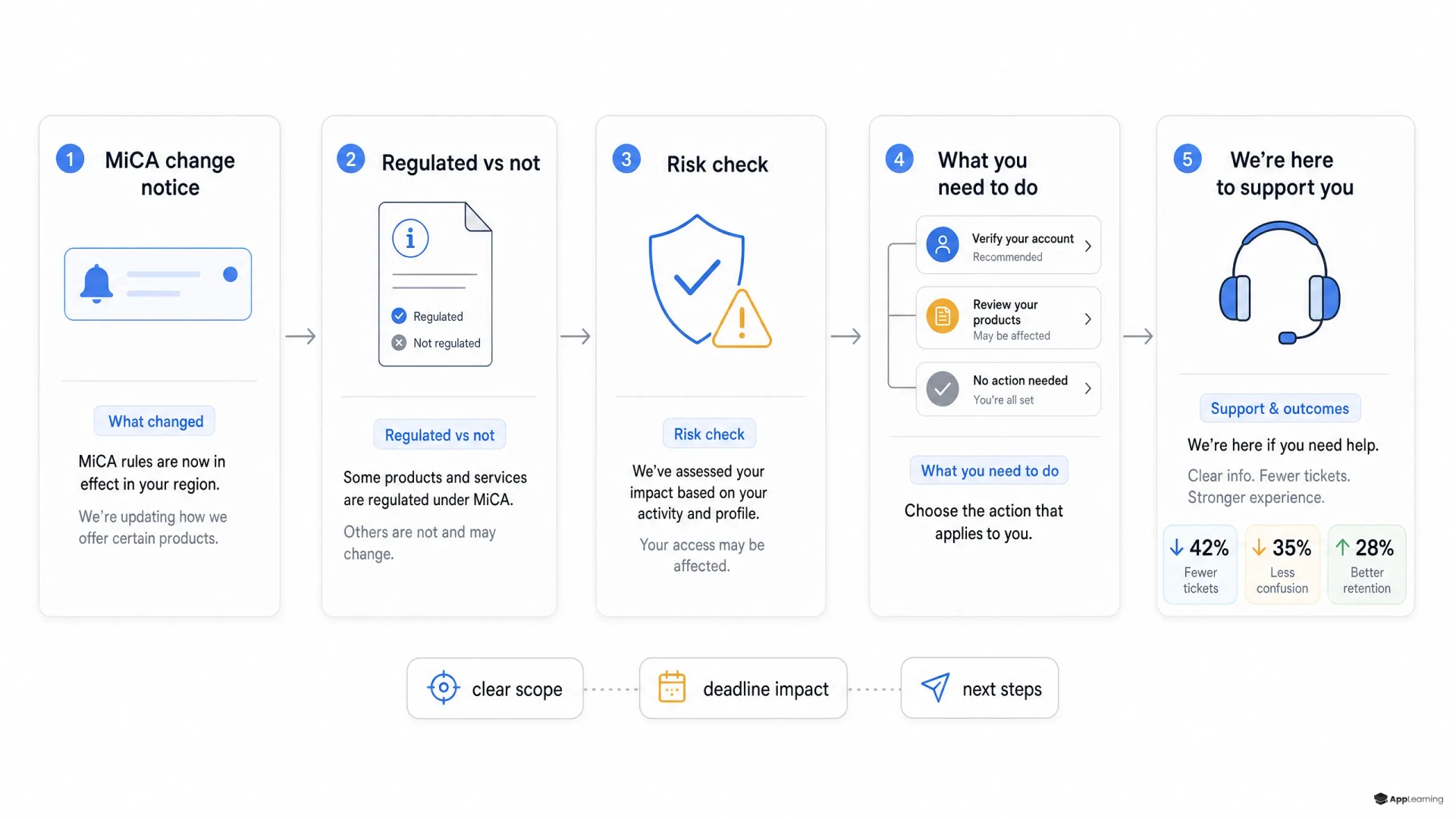
Education becomes part of the operating system
In-app crypto education changes the sequence. Instead of sending a notice and waiting for tickets, the platform can guide the user through short modules, confirmations and knowledge checks before the next regulated action. Crypto onboarding education should show the user how the product now works, not only what the law says.
The goal is not gamification for its own sake. A quiz can confirm that the user understands the difference between an authorised EU entity and a non-EU affiliate. A progress step can show what remains before migration is complete. A lifecycle message can separate urgent action from noise. Learning analytics can show where users misunderstand product status by market, language, asset or feature.
At App-Learning, we treat this as a product system problem. The education layer must sit where behaviour happens. It has to work on mobile, match the brand, scale across languages and give product teams insight without pulling engineers and compliance teams into endless content production.
Good to know
Is MiCA only a compliance issue for crypto platforms?
No. Licensing is the formal requirement, but users experience MiCA through account changes, product restrictions, migration prompts, withdrawal paths and support interactions.
Why are legal notices not enough for MiCA communication?
Legal notices usually explain obligations once. Users need contextual guidance at the moment they decide whether to deposit, trade, withdraw, migrate or contact support.
Where should MiCA education appear in the product?
It should appear inside onboarding, asset pages, account status screens, blocked-action flows, withdrawal journeys, migration prompts and support deflection flows.
A practical MiCA education checklist
Product, compliance and support need one shared map for MiCA-driven product changes.
- Create a status screen for legal entity, home regulator, authorisation status and covered services.
- Label product-level scope clearly, including MiCA-covered services, unregulated products and products being withdrawn.
- Trigger education from real events such as blocked deposits, withdrawal-only modes, account migration and delisted services.
- Use short checks to confirm users understand deadlines, transfers, self-custody and automatic closure rules.
- Track drop-off, wrong answers and repeated help searches by market, language, product and action.
- Maintain one approved content source with localised variants for each EU market.
Turn MiCA communication into guided in-product education.
PlanThe regulated product still has to be understood
MiCA raises the floor for crypto firms, but users experience that floor through the product. If they cannot tell who they are dealing with, what is protected, what is outside scope, and what happens to their assets, the trust benefit turns into confusion. Platforms that turn crypto regulation communication into guided fintech product education will not remove complexity. They will make it navigable. That is where retention is protected: not by hiding the change, but by teaching the user how to act with confidence.