

Key takeaways
- Interactive content needs product-level QA before release.
- Question type, answer logic, and layout shape learner trust.
- Bad content setup pollutes learning analytics and product decisions.
- An LMS implementation should include review workflows, not only uploads.
Content quality now behaves like release quality
A product education platform is not a document library. It is part of the product experience. Users tap, choose, answer, fail, retry, and make decisions based on what the academy tells them. In fintech, that matters. A learner may be trying to understand account security, Bitcoin withdrawals, card limits, tax reports, staking risks, or a new feature with real financial consequences.
This changes the standard for LMS content quality. A typo is still a typo. But a wrong interaction is more than an editorial defect. It is a product bug. If a quiz accepts the wrong answer, if a button sits too close to another control, or if the image that explains a flow is cropped on mobile, the academy has created product friction.
The technical standards around assessment already show this link between content and system behavior. The 1EdTech QTI specification covers question content, response processing, results data, and interoperability between authoring tools, item banks, delivery systems, and analytics engines. That is the right mental model. Questions are not static text. They are structured product objects.
Small defects create visible learner friction
Recent academy QA work showed the pattern clearly. The content itself was not the only issue. Response setup, visual spacing, and module layout all affected learner clarity. None of these issues looked dramatic in isolation. Together, they changed how trustworthy the learning flow felt.
- A single-choice question built as multiple-choice makes the learner doubt the instruction.
- A correct answer that is not marked correctly turns feedback into misinformation.
- A drag-and-drop task with poor mobile spacing creates accidental errors.
- A chart image with weak cropping hides the part the learner needs to inspect.
- A lesson card with uneven hierarchy makes the next action unclear.
- A translated module with longer text breaks the intended visual rhythm.
These are not cosmetic details. They change behavior. A user who gets a false negative may stop trusting the academy. A user who cannot distinguish a primary action from a secondary action may abandon the flow. A user who sees inconsistent feedback may open a support ticket instead of continuing the journey.
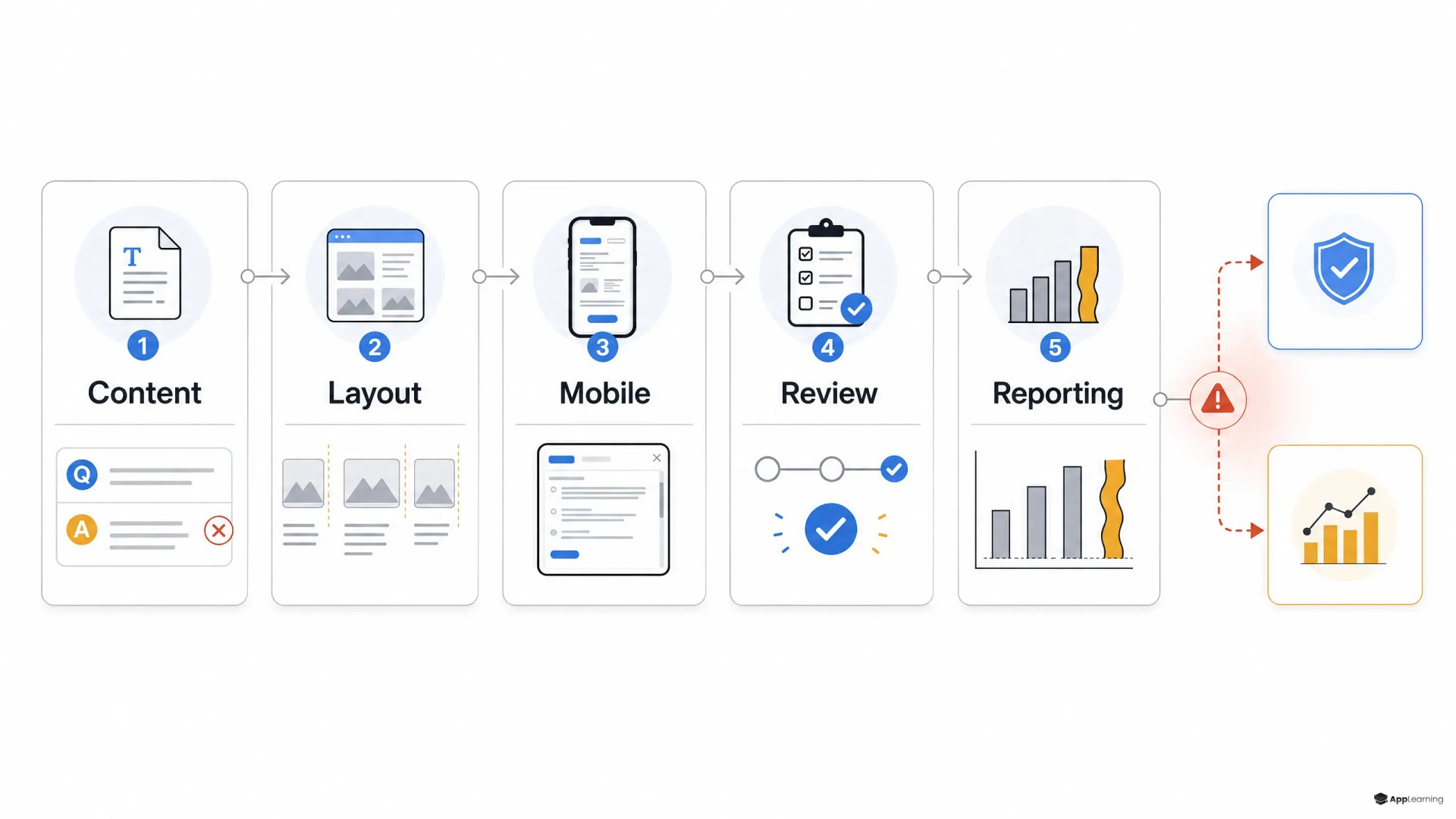
This is why learning content QA belongs inside interactive training design. The review cannot stop at spelling, tone, and legal approval. It must include interaction logic, screen behavior, mobile readability, answer states, completion states, and the way every mistake is explained.
Bad quiz setup creates dirty analytics
Product teams depend on learning analytics to find knowledge gaps and improve activation. But analytics are only useful when the underlying learning events are clean. The 1EdTech Caliper Analytics specification describes how application activity can be passed to aggregators and dashboards. The implication is simple: if the content object is wrong, the signal can be wrong too.
A bad answer key may make capable users look confused. A poorly worded distractor may make a feature look harder than it is. A module with broken layout may reduce completion, but the dashboard may frame it as low motivation. The product team then optimizes against noise.
This is dangerous for a fintech product lead. The academy may be used to answer operational questions: where onboarding fails, which market needs more support, which advanced feature needs education, which users are ready for a next step. If quiz design is weak, those answers become unstable.
Good to know
Why should content QA be treated like product QA in an LMS?
Because interactive content changes user behavior. A broken answer key, unclear question type, or poor mobile layout can confuse learners, damage trust, and distort the analytics that product teams use to improve onboarding and feature adoption.
What does learning content QA include beyond proofreading?
It includes checking question logic, answer states, feedback copy, image layout, mobile spacing, completion rules, gamification triggers, translation fit, and analytics events before a module goes live.
How does this apply to fintech onboarding?
Fintech products often require users to understand complex flows before they can activate or adopt high-value features. If the academy introduces friction, users may misunderstand the product, abandon the journey, or contact support unnecessarily.
How can App-Learning support this workflow?
App-Learning combines content structure, interactive training design, quiz design, review workflows, and learning analytics so product teams can scale education without turning internal experts into full-time content operators.
The QA workflow must mirror the product workflow
A better LMS implementation does not treat publishing as the final step. It treats publishing as a release process. The academy needs a lightweight but strict review workflow that checks content, interaction, and data before learners see it.
- Define the learning objective before building the module.
- Map each question type to the skill being tested.
- Review answer logic, feedback copy, and edge cases.
- Check image spacing, tap targets, and mobile layouts.
- Test completion rules, retries, badges, and unlock logic.
- Validate analytics events against the intended learner behavior.
- Run multilingual checks for overflow, meaning, and local examples.
- Keep a release log for content changes that may affect reports.
Mobile checks deserve special care. The WCAG 2.2 target-size guidance treats control size and spacing as part of accessible interaction. In an academy, the same principle applies to trust. If a learner makes the wrong tap because the interface is cramped, the mistake belongs to the system.
Build learning QA into your academy workflow.
PlanOne operating loop for content, review, and data
App-Learning implementations are built around this loop. Content structure, quiz logic, layout review, and learning analytics are not separate workstreams passed between teams. They are one product workflow. The goal is not to upload more lessons. The goal is to make complex product knowledge easier to understand, easier to test, and easier to improve.
For a fintech team, this reduces hidden execution risk. Internal experts still define what must be true. Product still owns activation and retention goals. The academy workflow turns that knowledge into guided journeys, gamified checks, and measurable learning behavior without asking the core team to run a content factory.
The strongest academies feel simple to the learner because they are strict behind the scenes. Every question has a job. Every screen has a clear action. Every result means what the dashboard says it means. When content mistakes are treated as product bugs, the academy becomes a reliable part of the product instead of a side channel that slowly loses trust.