

Key takeaways
- Reusable learning paths reduce repetitive onboarding and support work.
- Webinars explain change, but they do not create a self-serve system.
- Learning data becomes useful when joined with product and account signals.
- App-Learning suits branded fintech education built around activation and trust.
Best Training Platforms for Customer Success Teams
Customer success teams often become the human layer between a complex product and a customer who needs to act with confidence. They repeat the same product walkthroughs, explain the same terms in calls, and run webinars that answer questions already asked last week. That work is valuable, but it does not scale. The right training platforms for customer success turn recurring explanations into structured learning paths while keeping the account context that makes CS effective.
Manual enablement creates an invisible queue
The issue is not simply that customers need more content. Most already have emails, product tours, release notes, recordings, and a help center. The issue is that these materials do not tell a user what to learn first, what to do next, or whether they understood enough to progress. In fintech, that gap is acute. A user may need to understand identity verification, fees, security settings, or a financial product concept before they can use a feature with confidence.
A customer success training platform should therefore do two jobs. First, it should remove repeatable education from one-to-one calls. Second, it should create visible signals for the team: who started onboarding, where people stopped, what they misunderstood, and which accounts may need a human intervention. Education is not a replacement for customer success. It gives CS a better place to spend its time.
The platform categories solve different problems
Webinars remain useful for launches, complex implementation discussions, and live questions. They are weak as the main onboarding system because attendance is time-bound and the learning sequence is hard to reuse. Help centers are strong for retrieval: a customer knows the problem and searches for an answer. They are weak at guiding a new user through a sequence of decisions.
A conventional LMS can be the right choice when the organisation needs formal governance across employees, partners, and customers. Docebo’s extended enterprise LMS is designed for separate external audiences and configurable learning environments, while LearnUpon’s reporting tools cover progress, assessment, survey, and training-history reporting. These systems fit broad learning operations, but can add more administrative weight than a product-led onboarding journey needs.
A customer academy is a more focused model. Skilljar’s customer education platform centres on academies, in-app education, account-level insights, and connections to customer-facing systems. This category is strongest when the team needs to teach customers at scale, segment by account or role, and connect education to adoption and retention work rather than simply host courses.
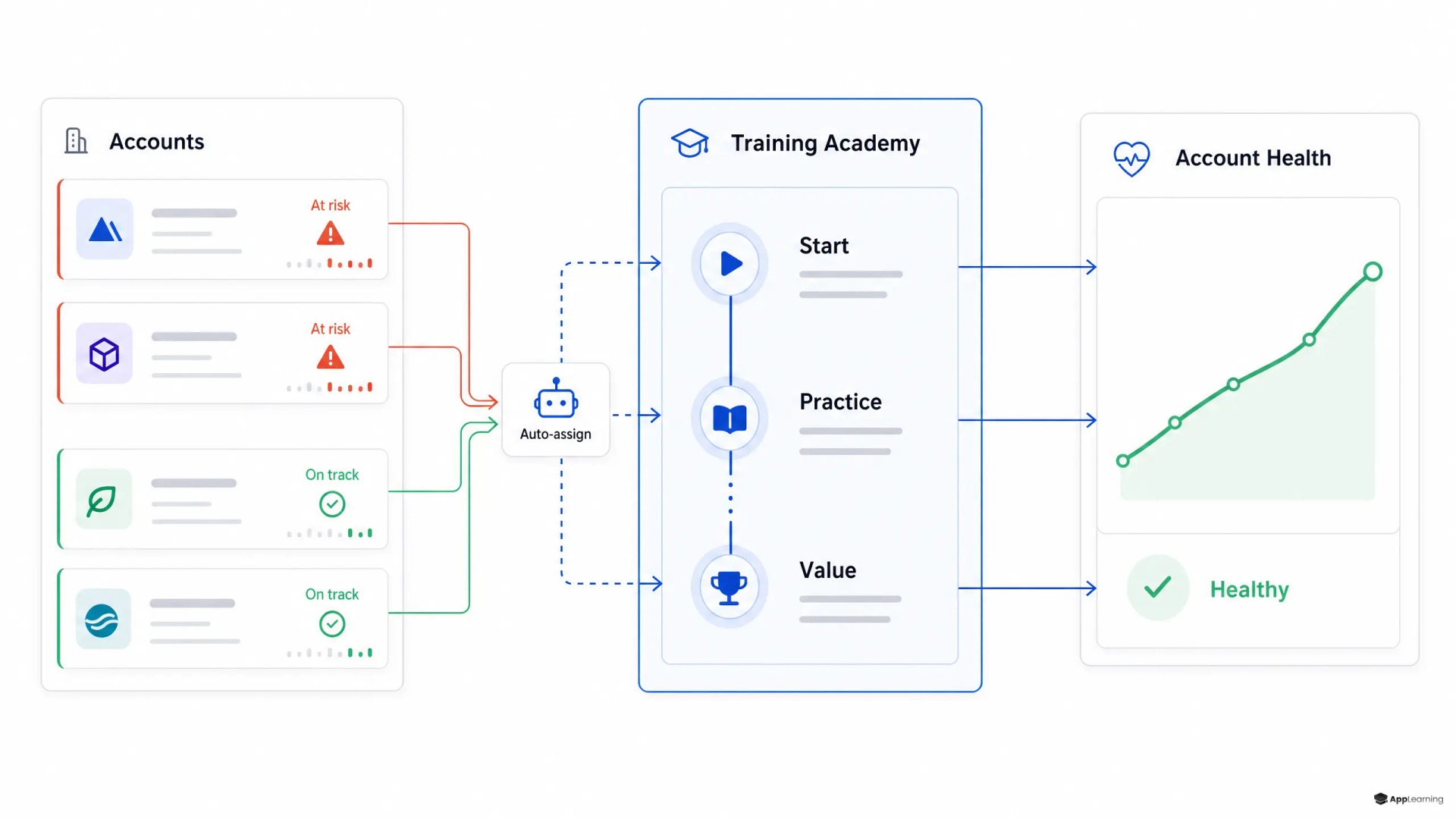
A branded academy closes the product education gap
For fintech product and growth leaders, customer education for customer success should feel like part of the product journey, not a separate course portal. Short modules can prepare users before a risky or unfamiliar step. Quizzes can test understanding before the next action. Role-based paths can separate beginners from experienced users, retail customers from business users, or customers in different lifecycle stages.
App-Learning’s academy platform fits this model with branded web and mobile academies, role-based paths, micro-lessons, quizzes, certificates, and learning analytics. It is a practical fit when the operating problem is not enterprise training administration, but turning complex product knowledge into a repeatable, engaging path to activation. Its content workflow can also turn existing product documents, slides, and expert material into reviewed learning modules instead of asking CS to rebuild every explanation from scratch.
Good to know
Which platform type is best for customer success teams?
Choose a customer academy when scalable product education and account insight are the main goals. Choose a broader LMS when external customer training must share governance, administration, and reporting with employee or partner learning.
Can a help center replace customer education?
No. A help center supports self-service problem solving. Customer education creates a sequence that helps users understand concepts, build confidence, and complete key product actions.
How should fintech teams measure education impact?
Track learning progress and knowledge checks, then compare them with activation, feature adoption, support demand, account health, and retention signals. Treat completion as an input, not proof of business impact.
When is App-Learning the right fit?
App-Learning is a strong fit when a fintech needs branded, engaging microlearning for customer onboarding and product education, with clear paths that support activation, trust, and retention.
Data must trigger a handoff, not decorate a dashboard
Completion rate alone is not an outcome. A customer can finish a course and still fail to activate. Define learning events that matter, then join them to product, support, and account data. Gainsight’s Customer Education integration illustrates the useful pattern: learner progress and activity can sit alongside product usage and support interactions to improve the account view.
Set handoff rules before launch. For example, send a lifecycle message when a user abandons the first learning path. Route an account to CS when several stakeholders complete training but product adoption remains low. Offer an advanced path after a customer uses a core feature successfully. These are operating decisions, not platform features. The platform must make them possible; the team must make them consistent.
Build a customer academy around the moments where users lose confidence.
Talk to usSelection criteria that reflect CS workflows
Use this checklist to assess a customer success training platform against the real workflow, not a generic feature list.
- Reusable paths for onboarding, feature adoption, and renewal readiness
- Segmentation by role, account, lifecycle stage, language, or product access
- Branding, single sign-on, deep links, and low-friction access from product or lifecycle messages
- Short formats that explain one decision or concept at a time
- Knowledge checks that reveal misunderstanding before it becomes a support case
- Account-level analytics that export or connect to CRM, CS, and product data
- Clear ownership for content updates, legal review, and escalation rules
- A launch model that starts with one high-friction customer moment rather than a large course catalogue
The best platform is not the one with the longest feature list. It is the one that makes customer understanding operational. When education sits inside onboarding and lifecycle design, CS stops carrying the full training burden, product teams see where comprehension breaks, and customers get a clearer route from first login to real value.