

Key takeaways
- Understanding determines whether users act, return, and expand.
- Complex products need education inside onboarding and lifecycle journeys.
- Growth teams can improve activation, retention, and trust with one education system.
- Scalable customer education needs measurement, journey design, and shared ownership.
Education moved into the revenue path
Customer education used to mean help centers, release notes, and the occasional onboarding webinar. That model worked when the product was simple and the user already understood the category. It breaks when the product is valuable, regulated, multi-step, or financially sensitive.
In fintech, the user does not only learn where to click. They must understand what an action means. Funding an account, choosing a risk profile, approving a wallet transaction, reading an APY, or using a credit product all require confidence before usage. If that confidence does not arrive, the user pauses. If the pause lasts, activation becomes churn.
This is why customer education is now a growth lever. The 2024 SaaS Benchmarks Report from High Alpha and OpenView frames the broader pressure clearly, with SaaS growth increasingly dependent on retention, expansion, and efficient growth from the existing customer base. Education sits inside that pressure because it helps users reach value, repeat value, and trust the product enough to go deeper.
Understanding is the adoption constraint
Activation is often measured as a completed setup step. That is too thin. A user can create an account, pass KYC, connect a bank, and still not understand why the product matters. Real activation starts when the user understands enough to take the next useful action without fear.
Research on software onboarding supports the same principle from a user-experience angle. A study on onboarding solutions found that onboarding can support new users’ activity and increase product value when it helps people understand how to work with the application, not just move through screens. The point is operational, not academic. Onboarding must reduce uncertainty at the exact moment the user is deciding whether to continue.
Financial products raise the stakes. The OECD’s work on digital financial literacy notes that digital payments are widely used across OECD countries while also exposing consumers to security, spending, and misuse risks. For crypto products, the OECD also argues that higher digital financial literacy can help users engage with crypto-assets according to their risk appetite and with clearer awareness of specific risks. In plain terms, education is part of trust, safety, and adoption.
Education shapes the moments that compound
Growth teams usually see the symptoms before they see the cause. Users sign up but do not fund. They fund but do not transact. They transact once but do not build a habit. They explore a feature but never adopt it. These are not always product defects. Often they are understanding gaps.
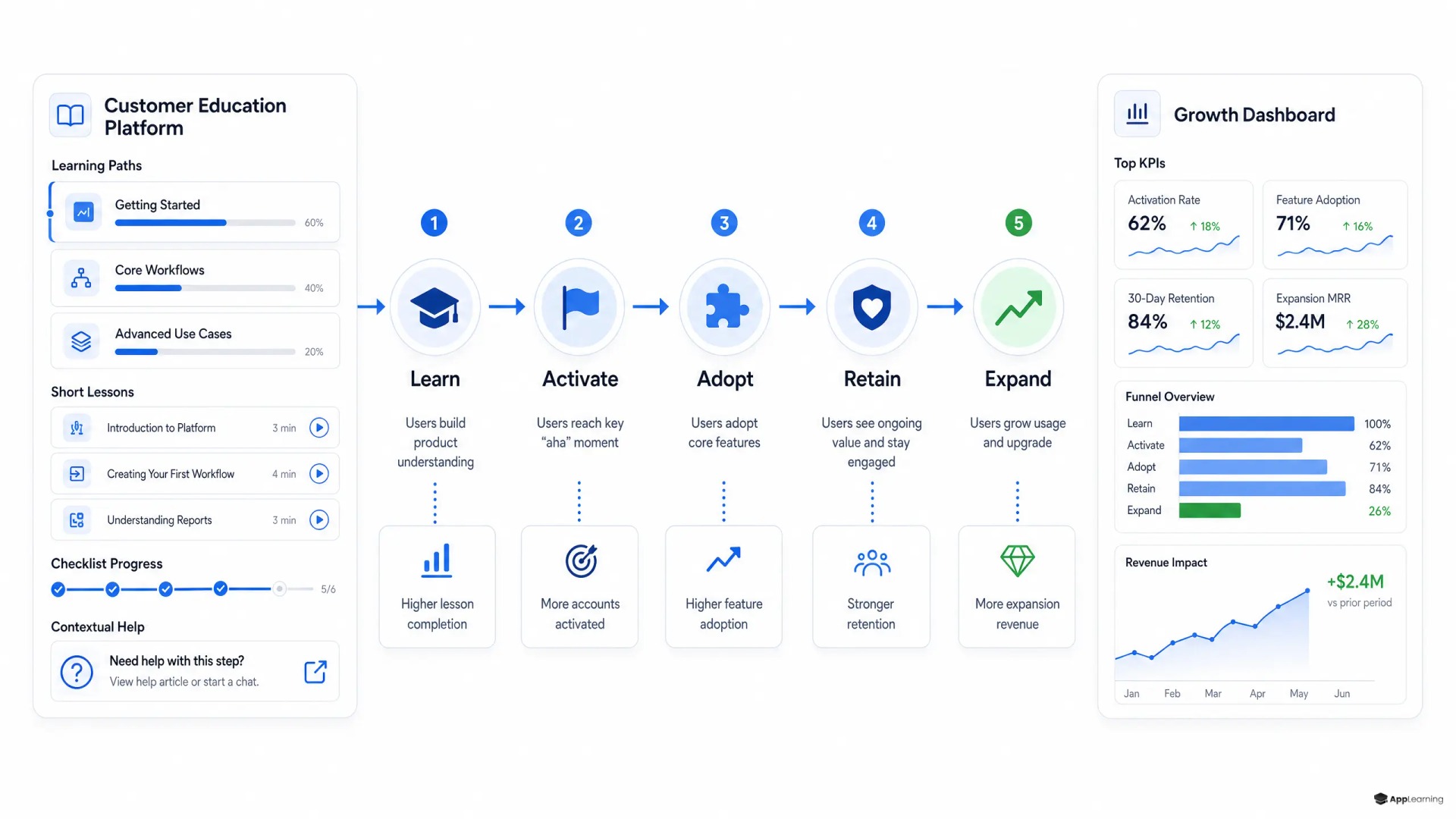
- Activation improves when education gets users to the first meaningful action faster.
- Product adoption improves when users understand which feature fits which job.
- Retention improves when users feel progress and can explain the value they receive.
- Expansion improves when advanced use cases feel safe, relevant, and achievable.
The best customer education systems do not wait for confusion to become a ticket. They predict where confusion will happen and place product education before the drop-off point. That can mean a two-minute lesson before a risky action, a short quiz after onboarding, a guided path for a new feature, or a lifecycle module for users who have stopped short of a key behavior.
The link between education and usage is visible in customer academy examples. Airtable reported more than a 15% increase in customer retention and more than a 20% increase in product usage when customers engaged with its academy and community programs, according to a Gainsight case study on Airtable. That does not mean every academy will create the same lift. It does show the right direction of travel. Education becomes measurable when it is connected to product behavior.
Support content cannot carry the system alone
A help center answers known questions. A customer education strategy changes behavior before the question appears. That difference matters. Support content is reactive. Growth education is designed around the lifecycle.
For a fintech product, the education map should follow the user journey, not the internal content calendar. The first path teaches the minimum needed to reach value. The second path teaches repeat usage. Later paths teach deeper capabilities, risk concepts, security habits, and new product areas. Each path should match the user’s role, maturity, and behavior.
- First-value lessons for new users who have not completed activation.
- Contextual explanations for moments involving money, risk, identity, or permissions.
- Feature-adoption paths tied to product usage signals.
- Lifecycle education for inactive users, expanding users, and high-intent segments.
- Release education that explains what changed and why it matters.
- Measurement that compares educated and non-educated cohorts.
Good to know
How is customer education different from support documentation?
Support documentation answers questions after a user gets stuck. Customer education is designed to prevent confusion, build confidence, and guide users toward valuable behavior across onboarding, adoption, retention, and expansion.
Which metrics show whether customer education affects growth?
Start with activation rate, time to first value, course completion, quiz accuracy, feature adoption, support ticket volume, retention by education cohort, and expansion by education cohort. The key is to compare educated users with similar users who did not complete the learning path.
Where should fintech teams place product education?
Place it at moments of decision. Good examples include before funding, before a high-risk feature, after KYC approval, during new feature launches, after failed setup steps, and when inactive users return.
Does every team need a customer education platform?
Not at the start. A small team can test the model with simple lessons, lifecycle messages, and cohort tracking. A customer education platform becomes useful when the team needs role-based paths, analytics, quizzes, certificates, embedded access, and faster content operations.
The operating model changes
The hard part is rarely content volume. Most teams already have decks, docs, emails, support macros, launch notes, and product copy. The problem is that each asset belongs to a different team and optimizes for a different moment.
Product writes tooltips. Marketing writes explainers. CX writes support answers. Compliance checks claims. Growth runs lifecycle experiments. Nobody owns the full learning journey. The result is a user who receives many messages but no clear path.
A modern customer education strategy needs shared ownership. Product owns the target behavior. Growth owns the experiment design. CX owns the question patterns. Risk and legal review financial accuracy. Content and learning teams own structure, clarity, and retention. Leadership owns the growth metric.
The measurement model should be simple enough to run every month. Track activation rate, time to first value, course completion, quiz accuracy, feature adoption, support tickets per activated user, retention by education cohort, and expansion by education cohort. If education cannot be tied to behavior, it will stay a side project. If it can, it becomes part of the growth system.
The system is the product education layer
Effective systems are not content libraries. They are routes. They tell the user what to learn now, what to do next, and how to recognize progress. This is where a customer education platform matters. It should not only host lessons. It should help the team convert product complexity into small, measurable learning steps.
At App-Learning, we see this pattern across complex topics. The App-Learning platform is built around short lessons, quizzes, certificates, role-based learning paths, analytics, and gamified mechanics. The main App-Learning site also describes support for customer and employee education, deep links from product UI to specific lessons, mobile and web academies, and measurable learner data. For fintech teams, this means education can sit close to the moment of action, not in a separate training portal users forget.
That matters because product education must be maintained like product infrastructure. When the product changes, the learning path changes. When support tickets cluster around one feature, the lesson changes. When a cohort fails to activate, the onboarding path changes. The academy becomes a feedback loop, not a warehouse.
Build customer education into your growth system.
TalkThe growth lever is trust at scale
Customer education is not growth magic. It will not fix weak positioning, a broken product, or a bad pricing model. But in a complex product, it removes one of the most common constraints on growth. The user may want the outcome and still hesitate because they do not understand the path, the risk, or the next action.
That is the real problem. Growth teams often try to solve hesitation with more reminders, more campaigns, or more interface prompts. Those may increase clicks. They do not always increase confidence. Education does, when it is specific, timely, and tied to behavior.
In complex fintech products, understanding is infrastructure. If users cannot explain what they are doing, they will not trust the product. If they do not trust the product, they will not return, adopt deeper features, or expand usage. The teams that treat customer education as part of activation, retention, and product adoption will build a stronger growth system than the teams that leave education inside support.