

Key takeaways
- Regulation does not replace education inside the product journey.
- Crypto risk education must be contextual, short and tied to user actions.
- Stablecoin, wallet and trading journeys need different learning moments.
- Education analytics can expose misunderstood risks before they become support issues.
Regulation is entering the product layer
Crypto regulation is no longer background policy. On 30 June 2026, the FCA published final rules and guidance for cryptoasset firms that will apply to authorised firms from 25 October 2027. The Guardian reported that the package requires firms to hold capital against risky assets and run annual stress tests. For product leads, this moves regulated crypto onboarding into the same system as compliance, UX, support and activation.
Formal oversight also normalizes crypto rails. Reuters reported on the Open USD launch, a dollar-pegged stablecoin initiative backed by a consortium of more than 140 businesses and expected to go live later in 2026. As stablecoins move closer to payments infrastructure, stablecoin education must explain more than the peg. Users need to understand issuer risk, backing assets, redemption, settlement, fees and availability.
Regulation does not remove product risk
The FCA’s own announcement says crypto remains high-risk and that consumers should understand which protections apply before investing. It also makes the deeper point for product teams: firms can be held to higher standards, but user decisions still happen inside screens, forms, confirmations and transfers.
For consumers, it means firms will be held to similar standards to other financial providers, though we can’t regulate away risk.
That is the gap. Rules can improve firm behavior, but users still choose wallets, approve contracts, initiate transfers, interpret returns and respond to scams. If the product does not teach at those points, the user fills the gap with assumptions.
The remaining risks are operational
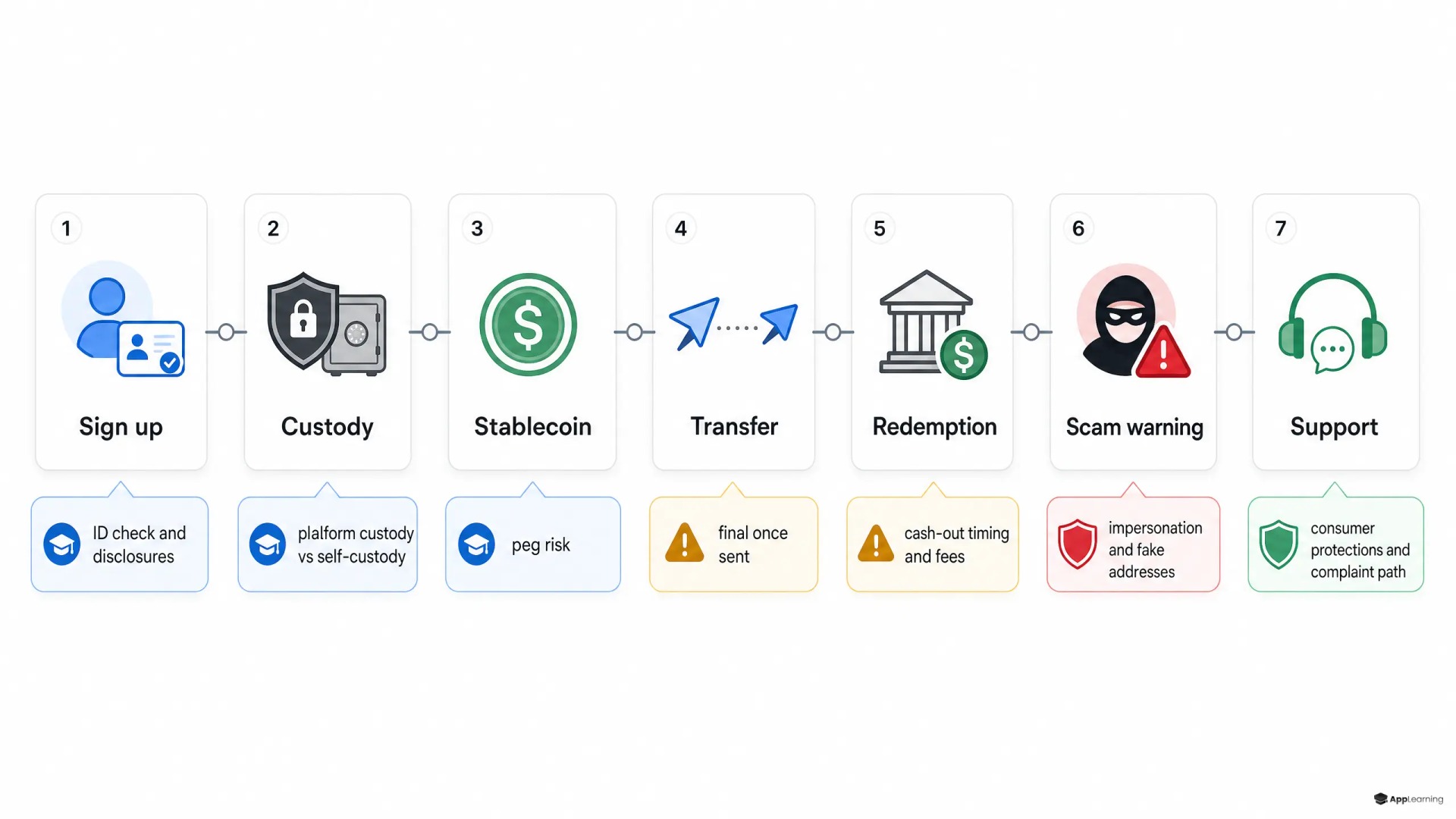
In crypto, user risk clusters around irreversible actions and misunderstood guarantees. Wallet education must explain who controls private keys, what happens if a recovery phrase is lost and how platform custody differs from self-custody. Trading flows must teach volatility, spreads and execution before the first order. Transfer flows must teach network selection, address checks, finality and fraud patterns. The FTC warns consumers that recovery may not be possible when funds are sent to the wrong person, a wallet is compromised or a password is lost.
Scams are not an edge case. In 2024, the FTC reported that consumers lost more money to scams paid by bank transfer or cryptocurrency than through all other payment methods combined. Crypto product education therefore has to cover trust signals, impersonation, fake investment offers and recovery fraud before a user confirms the action.
Disclosures are too far from the mistake
Generic disclosures and help-center articles are legally useful but operationally weak. Users do not leave a deposit screen to read a long explainer. They misread at input level. They assume available balance means withdrawable balance. They assume a USD token is the same as a bank deposit. They assume a regulated product means full protection. They assume an approved contract is safe.
Fintech risk education has to be short, specific and triggered by the action. The learning moment should sit where the risk changes.
- Before the first deposit, explain custody, asset support, recovery and protections.
- Before the first trade, explain volatility, fees, spreads and execution risk.
- Before a stablecoin purchase, explain issuer, backing, redemption and depeg risk.
- Before an external transfer, explain chain selection, address checks, finality and scams.
- Before staking or lending, explain lockups, counterparty exposure and liquidity risk.
Good to know
What is regulated crypto onboarding?
Regulated crypto onboarding is a product-native flow that teaches users the risks, protections and mechanics of a crypto feature before they use it. It should include short explainers, checks for understanding and clear next steps inside the journey.
Where should wallet education appear?
Wallet education should appear before account setup, backup, deposit, withdrawal, network selection and external transfer confirmation. Those are the points where a small misunderstanding can create a large loss.
How does stablecoin education differ from general crypto education?
Stablecoin education should focus on the peg, issuer obligations, backing assets, redemption terms, settlement behavior and depeg risk. It should not treat a stablecoin balance as if it were the same as cash in a bank account.
How can education analytics help fintech product teams?
Education analytics show which risks users misunderstand, which onboarding steps create friction and which lessons reduce support demand. That gives product teams a feedback loop between learning behavior and product outcomes.
Education becomes infrastructure
Crypto product education should be designed like authentication or payments, not content marketing. It needs version control, localization, analytics, triggers and audit trails. A regulated crypto onboarding system should know which concepts a user completed, where they failed a knowledge check, which warning reduced repeat errors and which support topics declined after a microlearning step.
That changes the metric set. Education is not measured by article views. It is measured by cleaner activation, fewer failed transfers, fewer where is my money tickets, higher completion of mandatory checks and safer use of advanced features. Knowledge checks create signal. They show misunderstanding before it becomes a complaint, churn or regulatory problem.
Build clearer crypto journeys with App-Learning.
StartThe learning layer can support the core team
App-Learning helps crypto, wallet and fintech teams turn regulatory clarity into product-native learning flows. The work is practical: onboarding modules, in-app explainers, quizzes, gamified sequences, multilingual content and analytics that map knowledge gaps to product behavior. The goal is not to make users take a course. It is to teach the minimum needed at the moment risk changes.
A wallet needs different learning than a trading app. A stablecoin payment flow needs different explainers than a yield product. Good systems reflect that. They separate mandatory fintech risk education from optional depth. They deflect support without hiding risk. They make comprehension measurable without adding friction everywhere.
The next phase of crypto regulation will reward teams that treat education as infrastructure. Those teams will ship safer journeys, better activation and clearer evidence of user understanding. Teams that treat education as a help-center update will discover the gap at the worst point: after a user has sent the asset, lost access or misunderstood the protection they thought they had.