
Key takeaways
- Model shutdowns are product events, not only engineering tasks.
- Learning platforms need stable learner outcomes, not merely API access.
- Track dependencies, test outputs, and define fallbacks before a retirement date.
- AI feature governance can become a trust signal for regulated buyers.
AI-native learning products sit on infrastructure that changes faster than most product roadmaps. A tutoring assistant, assessment generator, image workflow, or content-update tool may appear stable until its provider retires a model, changes an endpoint, adjusts output behavior, or withdraws a capability. That is AI model deprecation risk. It is also an operational form of AI product risk.
The hidden dependency beneath AI features
A model retirement is not a background engineering detail when a learner-facing feature depends on it. Google’s Firebase AI Logic model guidance records that Gemini 2.0 Flash models shut down on June 1, 2026, lists June 30, 2026 as the earliest shutdown date for all Imagen models, and states that requests to retired model names return a 404 error. The same guidance warns that an auto-updated model alias can change behavior when its underlying stable version changes.
The immediate failure is obvious when calls stop working. The more dangerous failure is silent degradation. A replacement may still return an answer, but use a different format, omit a required field, become more verbose, interpret instructions differently, or produce weaker media. Availability alone is not a meaningful definition of continuity.
A model replacement changes the learning experience
Learning platform infrastructure is exposed because AI is often embedded in workflows where consistency matters more than novelty. A small output shift can affect the learner journey, the facilitator workflow, and the audit trail at once.
- Tutoring can lose its intended tone, escalation logic, source-grounding behavior, or role-specific guidance.
- Assessment generation can change question difficulty, answer quality, scoring rationales, and the structure of exported results.
- Media workflows can fail when image or audio capabilities disappear, change formats, or produce materially different assets.
- Content updates can break when a model no longer supports the same context length, tool use, JSON schema, or safety configuration.
For a bank, these are not cosmetic defects. A weak explanation of an AI policy, an unreliable assessment item, or a missing escalation path can reduce confidence precisely when the organisation needs employees to adopt new technology safely. The European Banking Authority’s June 2026 risk assessment identifies third-party-provider reliance and operational failure among AI-related risks, and calls for stronger governance, security, testing, and resilience practices.
Assessment makes variation expensive
A learning assistant can degrade gradually and still offer value if people know when to seek expert help. Assessment is less forgiving. If a model produces questions, evaluates free text, recommends a learning path, or creates readiness signals, a model change can alter the measurement system itself. Teams must decide which outputs are advisory, which require human review, and which must stop rather than fall back to a lower-quality response.
This is where AI feature governance becomes practical. The product owner, learning team, risk function, and engineering team need a shared view of the feature’s purpose, the accepted quality threshold, and the action to take when that threshold is missed. Governance does not mean slowing experimentation. It means making a safe release process possible.
Good to know
What is model lifecycle governance?
It is the operating discipline for tracking AI model dependencies, monitoring provider changes, testing replacements, approving fallbacks, and managing releases throughout a model’s usable life.
Why are model deprecations a learning-platform risk?
They can stop AI features outright or change outputs without obvious technical failure. That can affect tutoring quality, assessment consistency, media generation, content workflows, and learner trust.
Should every AI learning feature have a fallback model?
Not always. Each feature needs a defined degradation path. A fallback model may fit low-risk assistance, while assessment, policy guidance, or high-impact recommendations may require approved content or human review instead.
How can banks assess AI feature resilience?
Ask for a dependency inventory, documented retirement monitoring, model evaluation evidence, fallback rules, human-review controls, and a clear process for provider-driven changes.
Model lifecycle governance as an operating discipline
Model lifecycle governance should turn provider change into a planned release event. It needs a lightweight control system that is owned, tested, and used before a deadline arrives.
- Maintain a model inventory that records each feature, provider, model ID, endpoint, owner, data classification, release stage, retirement date, and approved replacement.
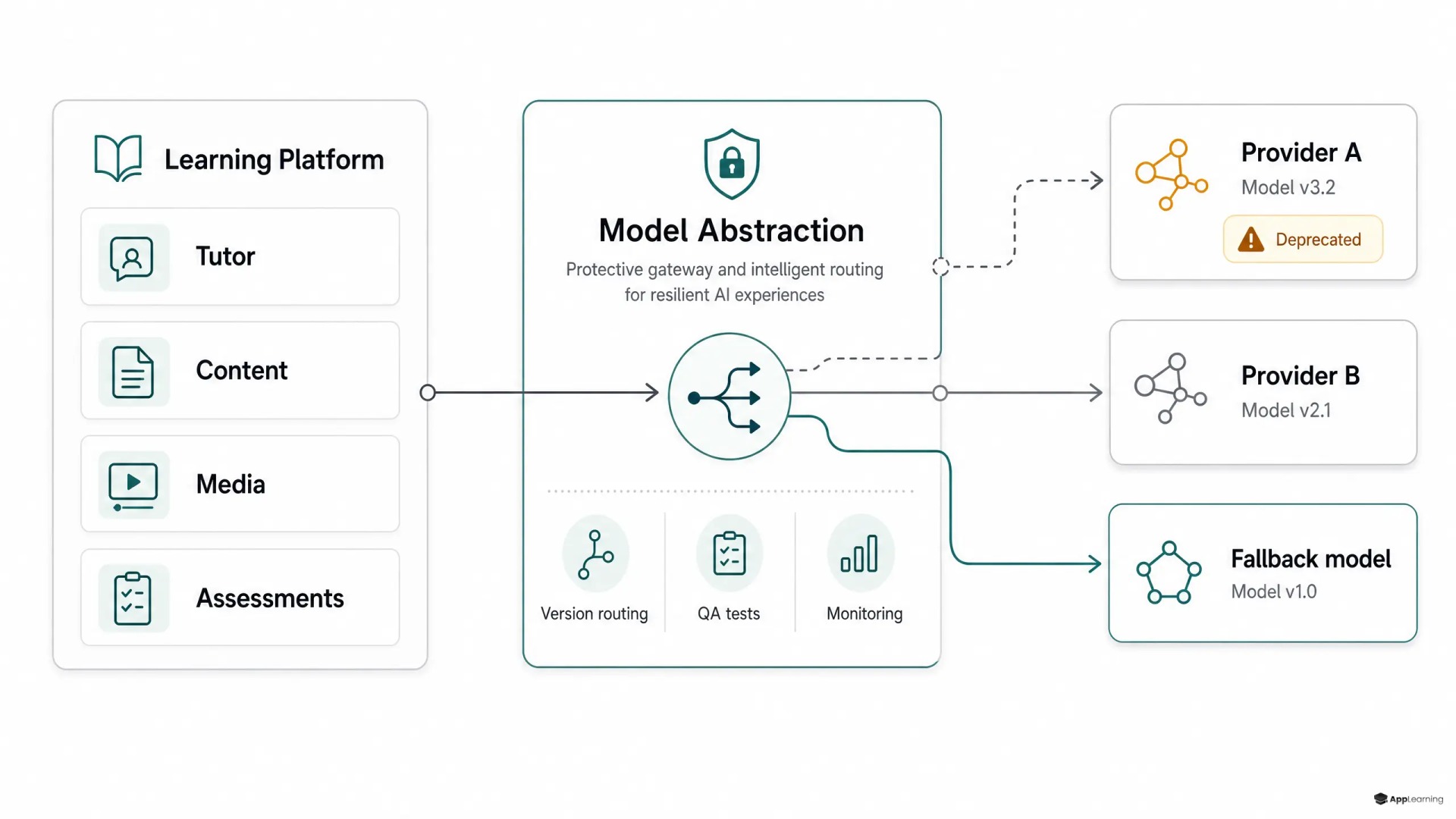
- Place a model abstraction layer between product features and providers so teams can switch configurations without rewriting every workflow.
- Build a representative evaluation set with banking scenarios, role-specific prompts, expected structures, safety checks, and human quality rubrics.
- Run candidate models in shadow mode before migration, then compare error rates, latency, schema compliance, learning quality, and expert-review outcomes.
- Define fallback rules, including when to route to another model, when to serve approved static content, and when to require a human reviewer.
This control system needs release monitoring as well. Assign someone to track provider notices, API and SDK changes, price changes, capability removals, and deprecation windows. NIST’s AI RMF core guidance specifically includes monitoring pre-trained models, post-deployment monitoring, incident response, recovery, and change management. Those are useful operating patterns for learning products, not just compliance language.
Make resilient AI learning infrastructure part of your transformation plan.
DiscussResilience becomes part of the learning proposition
For App-Learning, resilient AI learning infrastructure should be visible in the product and delivery model. Teams should be able to show how a tutor is evaluated, how assessments are protected from model drift, which workflows have fallbacks, and where a subject-matter expert remains in control. That gives innovation leaders a stronger basis for scaling AI, automation, cybersecurity, and digital-assets learning across different banking roles.
AI-native learning will not earn trust because it uses the newest model. It will earn trust because a provider change does not quietly alter what employees learn, how they are assessed, or when experts must intervene. That is the standard a modern learning platform should meet.