
Key takeaways
- Immediate accuracy is an incomplete KPI for AI tutor effectiveness.
- Structured support can improve recovery from mistakes while reducing fixed-session coverage.
- Track learning gain per minute, coverage, retention and intervention frequency together.
- Set intervention thresholds so scaffolding appears where it changes learner outcomes.
- Compare AI-assisted and non-AI learning paths before scaling across the academy.
Usage Is Not the Outcome
Many learning teams still judge an enterprise AI tutor by chat volume, completion rate or immediate quiz accuracy. None of those measures tells you whether the learner built capability. High chat usage may signal useful coaching, but it can also signal confusion, dependency or a poor task design. High accuracy can mean the tutor removed friction. It can also mean learners saw fewer difficult items in the time available.
This is the central measurement problem in AI tutoring metrics. A tutor changes the path through learning, not only the answer to the current question. It can spend more time diagnosing an error, prompting reflection and guiding a retry. That may improve the next attempt while leaving less time for new material. Teams need to see both sides of that trade-off.
A Better Answer Took More Time
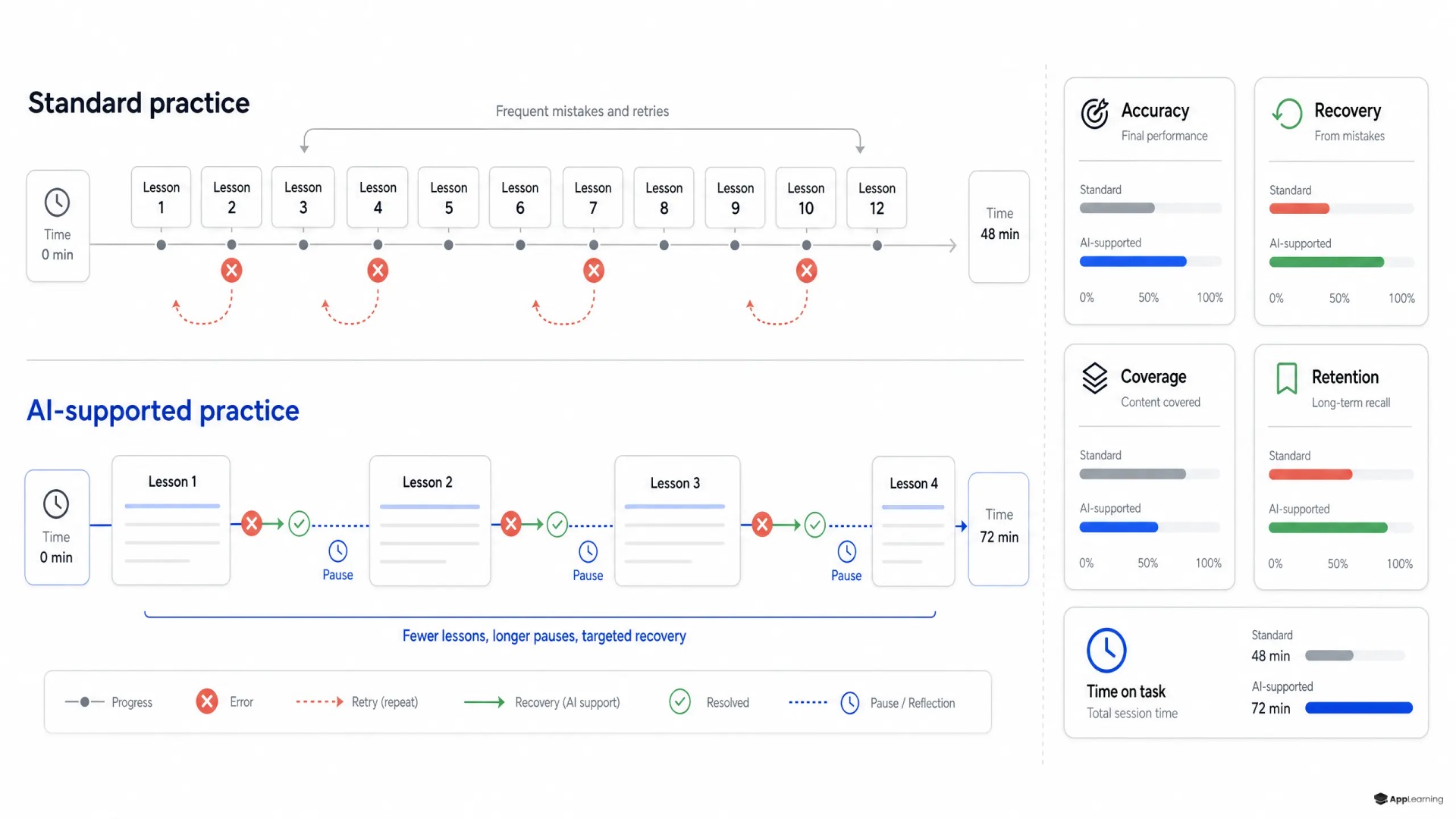
An August 2026 NBER working paper tested AI support and mastery-based progression with more than 6,000 middle-school students using a math practice platform. AI-supported learners progressed more slowly and attempted fewer questions, yet were more accurate once they reached an attempt. After mistakes, the AI improved next-attempt correctness and reduced the attempts needed to return to a correct answer. The strongest delayed-test signal appeared when AI was combined with a mastery workflow rather than offered as a standalone layer.
That is useful evidence, but it is not direct proof for workplace learning. The setting was K-12 math, the intervention was structured practice and the paper is still a working paper. For finance, banking and crypto academies, the right conclusion is a design hypothesis: guided recovery may improve learning quality, but it consumes a scarce resource in regulated learning journeys—time.
The Throughput Trade-Off
Every fixed-time module has a throughput budget. Minutes spent on an AI dialogue cannot also be spent on scenario coverage, retrieval practice or a new policy update. A tutor that intervenes after every wrong answer may create cleaner local performance while slowing a learner before they reach later objectives. The opposite failure is also common: a tutor that gives fast answers raises apparent flow but leaves misconceptions intact.
The design goal is not maximum tutor activity. It is enough support to change the learner’s trajectory, followed by enough independent practice to prove the change holds. That shifts AI tutor effectiveness from a product question to an operating question: where does intervention create more learning value than it costs in time and coverage?
A Budget Makes the Trade-Off Visible
A throughput budget treats AI support as an intentional allocation across independent attempts, diagnosis, hints, retries and progression. It gives AI learning analytics a job beyond reporting activity. For each skill, role and module, measure whether the intervention improves capability faster than a lighter-touch path.
- Learning gain per minute: change in skill performance divided by active learning time.
- Error-recovery efficiency: next-attempt correctness, attempts to recovery and minutes spent recovering.
- Coverage: critical objectives, scenarios or decisions reached in the available session time.
- Intervention rate: tutor prompts, hint steps or escalations per learner and per objective.
- Delayed retention: performance on a later check, separated from the supported practice session.
No metric should stand alone. A higher learning gain per minute with weak delayed retention is fragile. Better retention with a major fall in critical-content coverage may be unacceptable for onboarding or mandatory compliance. The useful view is a scorecard that exposes the trade-off rather than hiding it behind one headline number.
Good to know
What is a throughput budget for AI tutoring?
It is a deliberate limit on how much session time the tutor can consume relative to independent practice, retries and content progression. It makes the cost of each intervention visible.
Does the NBER study prove AI tutors work in enterprise learning?
No. It studied middle-school math practice, not workplace capability building. Its value for enterprise teams is as evidence of a likely design trade-off that should be tested in their own context.
Which metric should an L&D team add first?
Start with learning gain per minute, then pair it with intervention rate, critical-content coverage and a delayed retention check. This prevents a single activity metric from driving the program.
The Regulated Academy Needs Intervention Rules
For a finance or crypto company, not every learning moment deserves the same level of scaffolding. A new hire who misses a sanctions-escalation decision needs a different response from an experienced analyst who misses a low-risk product-detail question. The tutor should have an intervention policy, not an open-ended mandate to chat.
An App-Learning academy can make that policy visible in the experience and measurable in the data. Start with a first independent attempt. Trigger structured guidance after a defined error pattern, a high-risk decision or repeated failure on a prerequisite. Ask the learner to explain or choose the next step. Then withdraw support and require a fresh attempt before progression. Preserve an auditable record of the content version, intervention type and outcome for regulated topics.
- Define the critical decisions where an error warrants immediate guided recovery.
- Set a maximum hint depth before the learner must retry independently or escalate to a human expert.
- Tag each intervention by skill, risk level, content version and learner role.
- Run delayed checks on decisions that matter for conduct, controls and customer outcomes.
- Review the tutor’s time cost alongside learning gain and coverage every release cycle.
Build a measurable AI tutor pilot for your academy.
Plan pilotScale Only After Comparing Two Paths
Before broad rollout, run a controlled pilot with matched AI-assisted and non-AI paths. Keep the content, time allowance and assessment standard consistent. Test different intervention thresholds, not just tutor on versus tutor off. Segment results by role, prior knowledge and risk-critical task. A tutor may earn its time in complex case work and add little value in simple policy recall.
The decision to scale should rest on a clear pattern: stronger recovery from meaningful errors, stable or improved learning gain per minute, acceptable coverage and retained performance after support disappears. That is a more demanding standard than adoption, but it is the right one. An AI tutor is not a content vending machine. It is part of the learning operating system, and it should be managed with the same discipline as any other constrained capability resource.