

Key takeaways
- Personalization must feel relevant to employees, not merely route them differently.
- Perceived fit may be a distinct pathway to stronger training transfer intention.
- Separate intrinsic and extraneous cognitive load in learning analytics.
- Role, tenure, and experience can guide useful learning-path variation.
- Pair completion data with fit, self-efficacy, knowledge, and transfer measures.
Personalization Fit Is a Workplace Learning KPI
Most learning dashboards measure system activity. They report enrolments, completions, time spent, quiz scores, and perhaps whether a recommendation was opened. These are useful operating measures. They do not answer the harder question: did the employee recognise this training as appropriate for their role, experience, and immediate work? In adaptive workplace learning, that judgement deserves its own metric.
Technical metrics miss the learner’s judgement
A system can route people accurately and still feel generic. A junior analyst and an experienced compliance lead may receive different modules, yet both may see examples that do not match the decisions they make at work. In that case, the logic may be technically sound while the learning experience lacks credibility.
This gap matters in banking, fintech, and crypto. Mandatory learning often has a fixed policy core, but the work context differs sharply by role. The right question is not whether every learner received unique content. It is whether the required content was framed, practised, and paced in a way that made sense for that learner’s job.
Field evidence puts fit beside outcomes
A three-wave cluster-randomized field experiment invited 3,000 employees from six Chinese power utilities and analysed 2,574 participants. The adaptive delivery system showed small advantages in self-efficacy, transfer intention, and knowledge at the end of training, with the knowledge advantage still present six weeks later.
The more useful finding sits underneath the headline results. Higher perceived personalization fit was the indirect pathway associated with transfer intention. In plain terms, employees were more inclined to apply learning when the training felt suited to them. The study also split cognitive load into its components. Adaptive training reduced extraneous load but increased intrinsic load, which is a strong reason not to compress cognitive load into one dashboard score.
Fit is not recommendation accuracy
Recommendation accuracy is a system metric. It asks whether the platform selected an item that its model considers suitable. Personalization fit is an employee metric. It asks whether the employee believes the learning fits their work.
The distinction changes product decisions. An AI learning personalization engine can optimise paths from role data, prior results, tenure, and declared confidence. But its job is incomplete if it cannot show the learner why a scenario, practice task, or refresher is relevant. The product story should not be generic AI recommendations. It should be personalization that employees recognise as relevant.
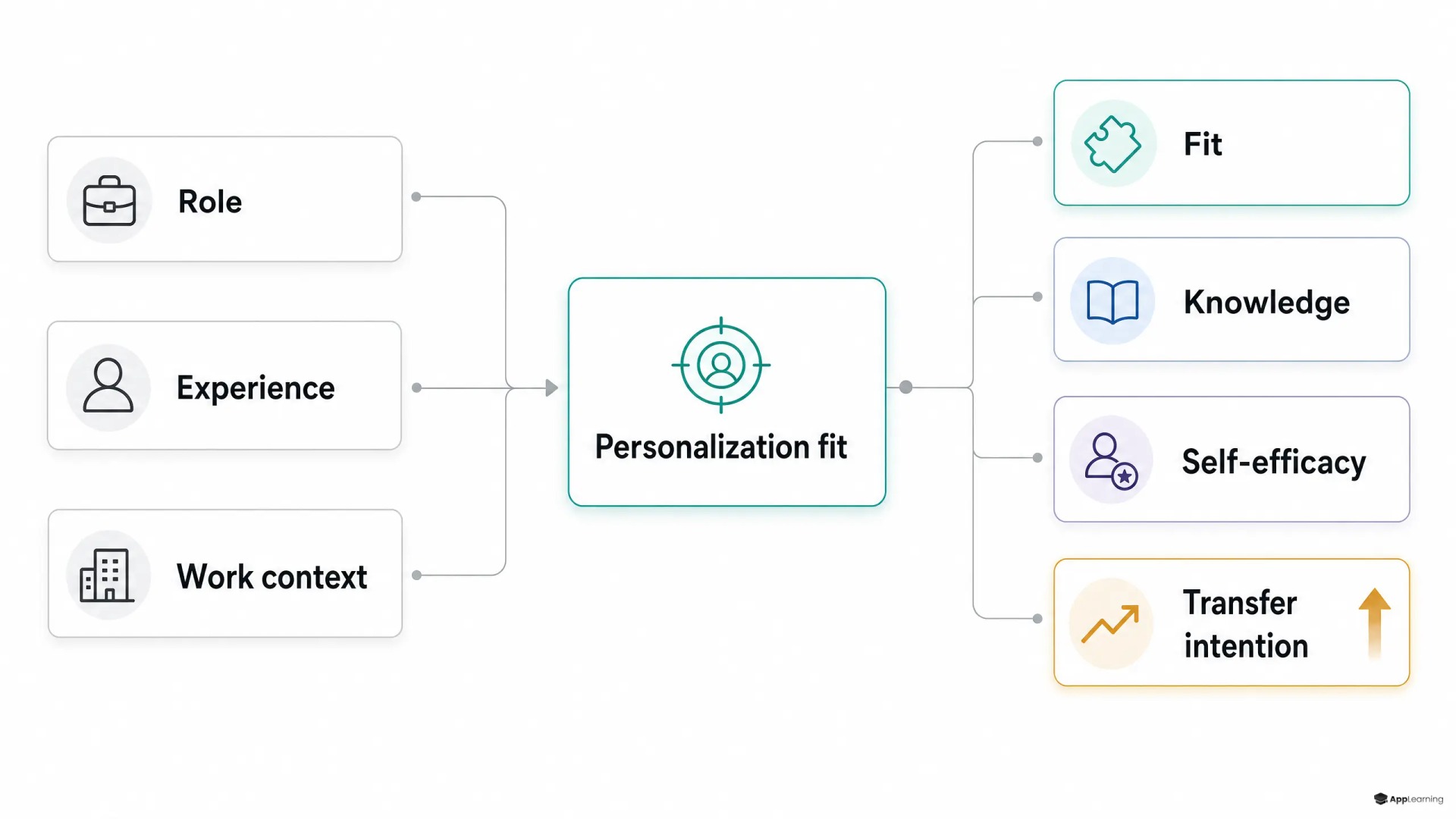
A KPI stack built for transfer
A practical learning personalization KPI stack combines four signals. Each signal answers a different operational question, so none should substitute for another.
- Perceived fit measures whether the content, examples, level, and path match the learner’s work context.
- Knowledge measures whether the learner can recall or apply the required information.
- Self-efficacy measures whether the learner feels capable of performing the task.
- Transfer intention measures whether the learner intends to use the learning in their work.
Completion remains necessary for auditability, especially in regulated programmes. It is not evidence of capability. A learner can complete a sanctions, market-abuse, or security module without believing it helps them handle a live case. The KPI stack makes that blind spot visible.
Good to know
What is perceived personalization fit?
It is the learner’s judgement that training matches their role, experience, knowledge level, and current work context.
Should fit replace completion reporting?
No. Completion remains important for audit and programme operations, but it should sit beside outcome measures rather than stand in for them.
Which learner inputs are most useful?
Start with inputs that alter the learning decision, such as role, functional level, tenure, product domain, prior performance, and task confidence.
How often should teams measure fit?
Measure it after meaningful learning units and review it by role and experience cohort so teams can adjust paths, examples, and practice.
Instrumentation turns fit into a design signal
Do not begin with a large learner-profile project. Capture a small set of inputs that change the learning decision: job family, functional level, tenure or prior experience, product area, and confidence on the task. Use these inputs to vary examples, practice difficulty, remediation, and refresh paths while keeping the policy baseline consistent.
Then place a short fit check after a meaningful unit, not only at course end. Ask employees to rate whether the training matched their role, prior knowledge, and current work. Combine that response with knowledge, self-efficacy, and transfer-intention measures. Segment results by role and experience to find where a path is too basic, too abstract, or poorly contextualised.
The evidence has clear boundaries
The result is promising, not a blank cheque for every adaptive product. As the researchers note in their design description, the treatment combined adaptive routing with a different delivery medium. The study therefore estimates a bundled adaptive delivery effect, not adaptivity in isolation. It also took place in a high-reliability utility setting, so finance and crypto teams should test the pattern in their own workflows rather than assume identical effect sizes.
See how App-Learning makes relevant training measurable.
TalkAI-enabled LMS design needs a visible learner contract
For an enterprise academy, the implication is concrete. Build adaptive workplace learning around a visible learner contract: the system knows enough about the employee’s role and experience to adapt practice, and the employee can see that the adaptation improves relevance. This calls for governed profile inputs, explainable path rules, reusable scenario components, and a measurement layer that connects fit to transfer.
That is where a modern learning platform earns its place. It should help L&D teams update regulated content quickly, preserve the mandatory core, and tailor the moments where context affects judgement. When personalized corporate training makes relevance measurable, learning analytics move beyond proof of attendance and toward evidence that employees are prepared to act.