

Key takeaways
- New settlement rails change workflows, not only infrastructure.
- Cross-functional handoffs become a direct source of operational risk.
- Scenario drills should cover collateral, settlement failure and escalation.
- Production access should depend on evidenced readiness, not attendance.
The bridge changes the work
Pontes is not a narrow technology change. The ECB describes Pontes as the Eurosystem DLT solution that links market DLT platforms and TARGET Services for DLT-based wholesale settlement in central bank money. That widens the operating perimeter. A transaction can now depend on market DLT status, T2 finality, interoperability logic, participant access, collateral eligibility and local reconciliation.
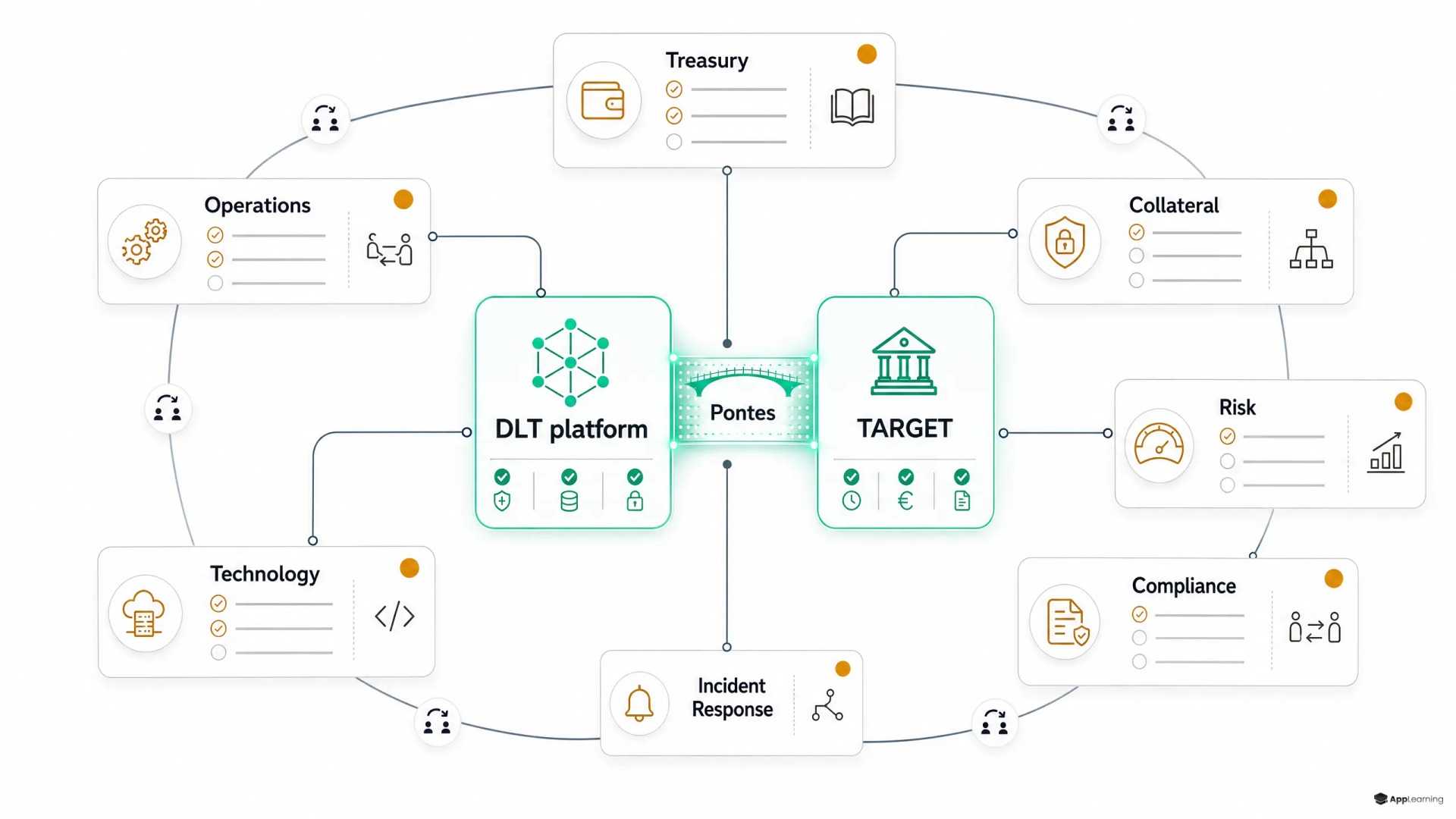
That is the hidden Pontes readiness gap. Infrastructure can pass a test while treasury, operations, collateral, risk, compliance and incident teams still read the same event through different mental models. DLT operating literacy means each team knows what changed, where its duty starts, where it ends and which signal triggers escalation.
Connectivity is not control
On 22 July 2026, the ECB’s Pontes go-live session separated user testing and onboarding from operational and legal aspects. The programme for that session also said Pontes functionalities were being tested by the Eurosystem. That split matters. Testing proves a path can work. Readiness proves people can run the path when something breaks.
The participants need to prepare for operational and legal aspects.
The shared model sits between functions
Pontes joins institutions that already own different parts of post-trade work. The ECB’s published criteria include T2 participants and market DLT operators such as CSDs, DLT settlement or trading and settlement systems, payment systems, CCPs and licensed financial institutions under defined conditions. A bank does not need everyone to become a DLT engineer. It needs one operating language across the rail.
- Treasury understands liquidity timing, funding impact and cash-leg finality.
- Operations understands booking, matching, reconciliation and exception queues.
- Collateral teams understand eligibility, mobilisation, substitution and lifecycle events.
- Risk understands exposure, concentration, failed settlement and loss scenarios.
- Compliance and legal understand terms, access conditions, reporting duties and evidence.
- Technology and incident teams understand dependencies, monitoring, recovery and escalation.
Exceptions decide whether the launch holds
Tokenization operations fail at the seams, not in the architecture diagram. The PFMI framework treats settlement finality, exchange-of-value settlement and operational risk as core controls for financial market infrastructures, while DORA places EU financial entities under rules for ICT risk management, incident reporting, resilience testing and third-party risk. Pontes-style change sits where these disciplines meet.
- A DvP instruction is matched, but the cash leg does not complete in T2.
- Collateral is mobilised on a DLT venue, but eligibility status is disputed.
- A hash-link timeout creates different status views across systems.
- An ICT incident hits during a high-value settlement window.
- A participant loses access and pending obligations need triage.
Tokenized settlement training should force decisions, not passive recall. Teams need to practise who freezes activity, who contacts the operator, who informs risk, who documents the event and who restarts the flow.
Good to know
Which bank teams need Pontes readiness training?
Treasury, operations, collateral, risk, compliance, legal, technology, cyber, incident response and business owners should share one operating model.
Is this only for teams that use DLT directly?
No. Teams can create risk if they own liquidity, reconciliation, access approval, reporting or escalation, even without touching the DLT interface.
What should be measured before go-live?
Measure role comprehension, handoff accuracy, scenario decisions, exception escalation, evidence quality and unresolved skill gaps.
A readiness academy turns the rail into practice
The ECB design materials include a dual settlement model, T2 finality and DvP through the Hash-Link protocol. A Pontes readiness academy should therefore be built like an operating system, not a slide deck. App-Learning would structure wholesale digital asset training by role, process and exception, so handoffs become visible before production access.
- Core rail literacy on Pontes, TARGET Services, T2 finality, DvP and the dual model.
- Role maps for treasury, operations, collateral, risk, compliance, technology and incident response.
- Process simulations for normal settlement, lifecycle events, liquidity and reconciliation.
- Exception drills for failed settlement, disputes, access issues, outages and reporting.
- Readiness evidence through assessments, scenario scores, confidence checks and dashboards.
Build Pontes readiness before production access.
TalkEvidence belongs before access
By go-live, a bank should know which teams can operate the new rail, not only which systems can connect to it. Evidence should show who can explain the settlement path, execute the daily procedure, recognise an exception, call the right owner and document the decision. Tokenized settlement will not be made safe by expert enthusiasm alone. It will be made safe by shared operating knowledge, rehearsed under pressure, before the first production exception arrives.