

Key takeaways
- Post-launch LMS work is decision support, not only course hosting.
- Attempt tracking exposes learner friction that completion data hides.
- Question-level analytics turn wrong answers into a content backlog.
- Cohort views help managers act without chasing every learner manually.
- An academy gains value when it shows what to improve next.
The work starts after launch
Before launch, most academy questions are practical. Which courses need to move. Which groups need access. Which certificates need to exist. Which compliance paths must be locked. That work matters, but it is setup work.
After launch, the questions change. A live academy starts producing behavior. Learners skip, repeat, guess, pass, fail, return, and ask for help. For finance and crypto companies, this is where the academy becomes useful. The environment is regulated, fast-moving, and exposed to changing risk. In Europe, DORA has applied since 17 January 2025, and that wider shift toward operational discipline also raises the bar for learning systems that support compliance and capability building.
The first useful post-launch question is rarely whether learners finished. It is where the learning experience creates friction. Which quiz needed more than one attempt. Which cohort passed but struggled. Which question pulled repeated wrong answers. Which lesson needs to change next.
Completion hides the useful signal
Completion is a control point. It says a learner reached the end. It does not say the explanation worked. It does not show whether the learner understood the rule, guessed the answer, or needed three attempts to pass.
That distinction matters for modern LMS reporting. The Society for Learning Analytics Research now frames learning analytics around actionable insights, not simple data collection. In academy platform analytics, that means reports should trigger decisions. A report that confirms completion is useful for audit. A report that shows repeated friction is useful for improvement.
Compliance teams still need completion records. No serious LMS provider should pretend otherwise. But if reporting stops at completion, every course looks healthy until the business sees a mistake, a support ticket, or a failed process outside the platform.
Attempts expose friction
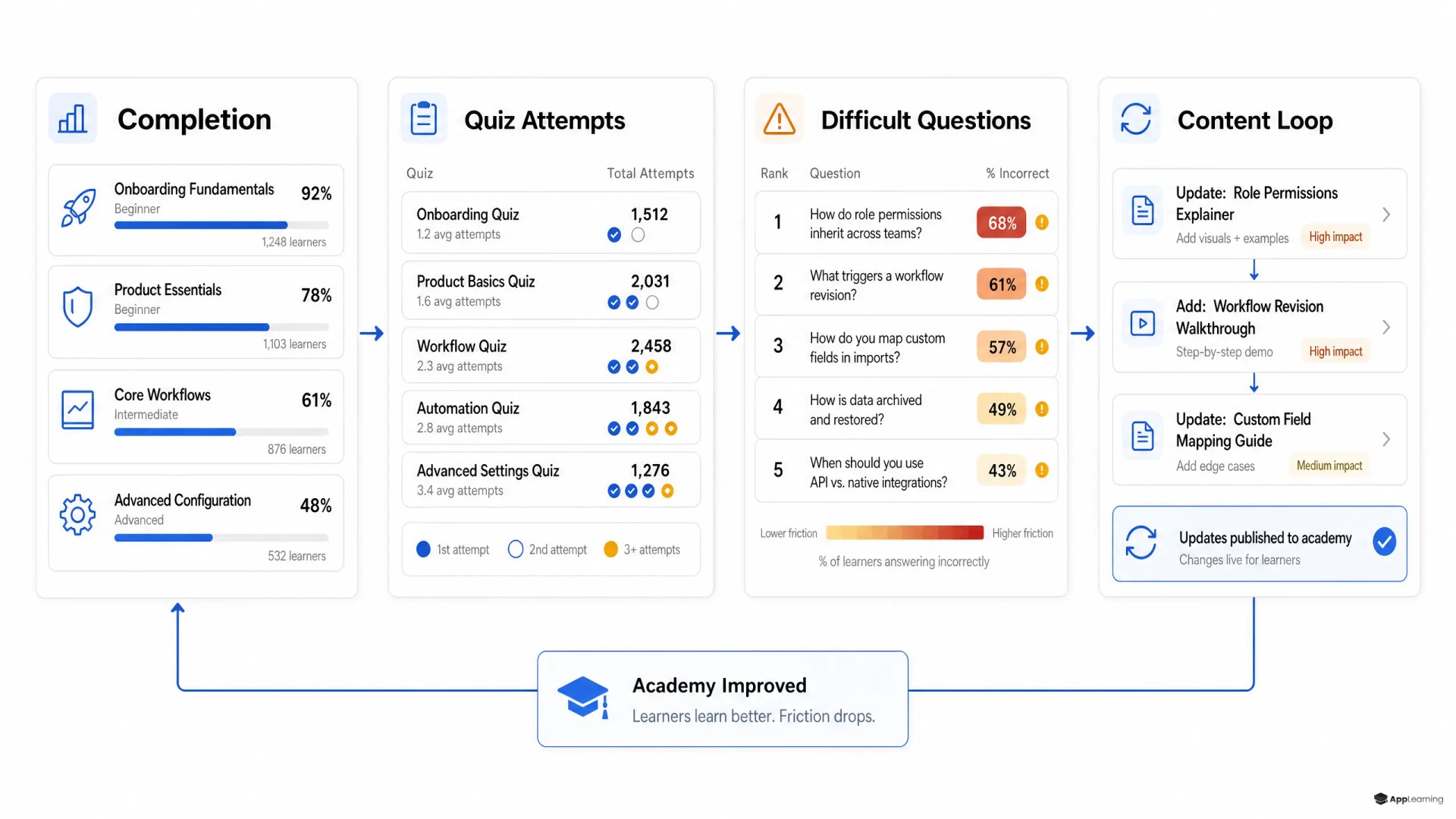
In a recent App-Learning academy implementation, the highest-value reporting requests after launch were not generic completion totals. The client wanted quiz attempts per learner and question-level difficulty based on wrong-answer patterns. The question changed from who is done to where is the system confusing people.
Repeat attempts are not proof of weak learners. They are a signal. They can point to unclear explanations, difficult concepts, weak question design, poor sequencing, or a mismatch between training and real work.
- One learner with repeat attempts may need support.
- One cohort with repeat attempts may need manager follow-up.
- One question with repeat wrong answers may need rewriting.
- One lesson that creates many retries may need a better example.
Modern learning data can support this level of detail. The xAPI result object includes success, completion, response, duration and score, which is enough to treat quizzes as diagnostic traces rather than final gates.
Wrong answers create a content backlog
Question-level difficulty turns reporting into a content improvement loop. If many learners choose the same wrong answer, the content team gets a concrete place to look. The issue may sit in the question. It may sit in the lesson before the question. It may sit in a policy explanation that sounds clear to experts but not to new employees.
This is not a new idea in assessment practice. The University of Washington’s guidance on item analysis describes item difficulty and discrimination as signals that can improve individual test items and the quality of a test as a whole. The operational move is to bring that logic into everyday enterprise learning operations.
- Sort questions by wrong-answer rate.
- Check whether high-friction questions map to specific lessons.
- Compare cohorts by role, market, seniority, or onboarding wave.
- Decide whether the fix is content, coaching, policy wording, or question design.
- Release the update and watch whether attempts decline.
That is the difference between a dashboard and a system. A dashboard displays the past. A system changes the next version.
Good to know
Is completion reporting still needed for compliance training?
Yes. Completion remains necessary for audit and control, especially in regulated environments. It should be treated as the baseline, not the full measure of training quality.
Which post-launch analytics matter most?
Start with attempts per learner, question-level difficulty, wrong-answer patterns, cohort progress, overdue learners, and content version changes.
How do quiz attempts help an L&D team?
Repeat attempts show where learners needed more than one try. That can reveal unclear content, difficult concepts, weak questions, or areas that need manager follow-up.
What makes an academy an operational learning system?
It becomes operational when analytics feed regular decisions about content updates, training design, learner support, and manager action.
Reporting becomes a management routine
The reporting layer should create a cadence. New onboarding paths may need weekly review. Compliance refreshers may need monthly exception checks. Product training may need a review after every release. The cadence depends on risk and change speed, not on the LMS menu.
Different users need different views. Managers need cohort status and exceptions. L&D needs learner friction, attempts, and drop-off. Content owners need question difficulty and wrong-answer patterns. Admins need reliable records, permissions, and audit-ready exports. One report cannot serve all of them well.
This is where many academies fail after launch. They have content. They have users. They have completion data. But they do not have a routine for turning LMS reporting into content decisions, manager action, and better training design.
Build an academy that shows what to improve next.
TalkThe academy becomes an operating system
App-Learning’s product angle is simple. An academy should not only host courses. It should connect quizzes, attempts, cohorts, reporting, and content updates into one operating loop. That loop is especially important for finance and crypto teams, where compliance and capability building share the same infrastructure but answer different business questions.
A live academy that only reports completion is a storage system with attendance. A live academy that shows attempts, difficult questions, cohort variance, and content fixes becomes decision support. It tells the L&D team where to spend time next. That is when an LMS stops being a place for courses and starts becoming part of enterprise learning operations.