

Key takeaways
- Learning platforms are operating infrastructure, not only enterprise L&D tools.
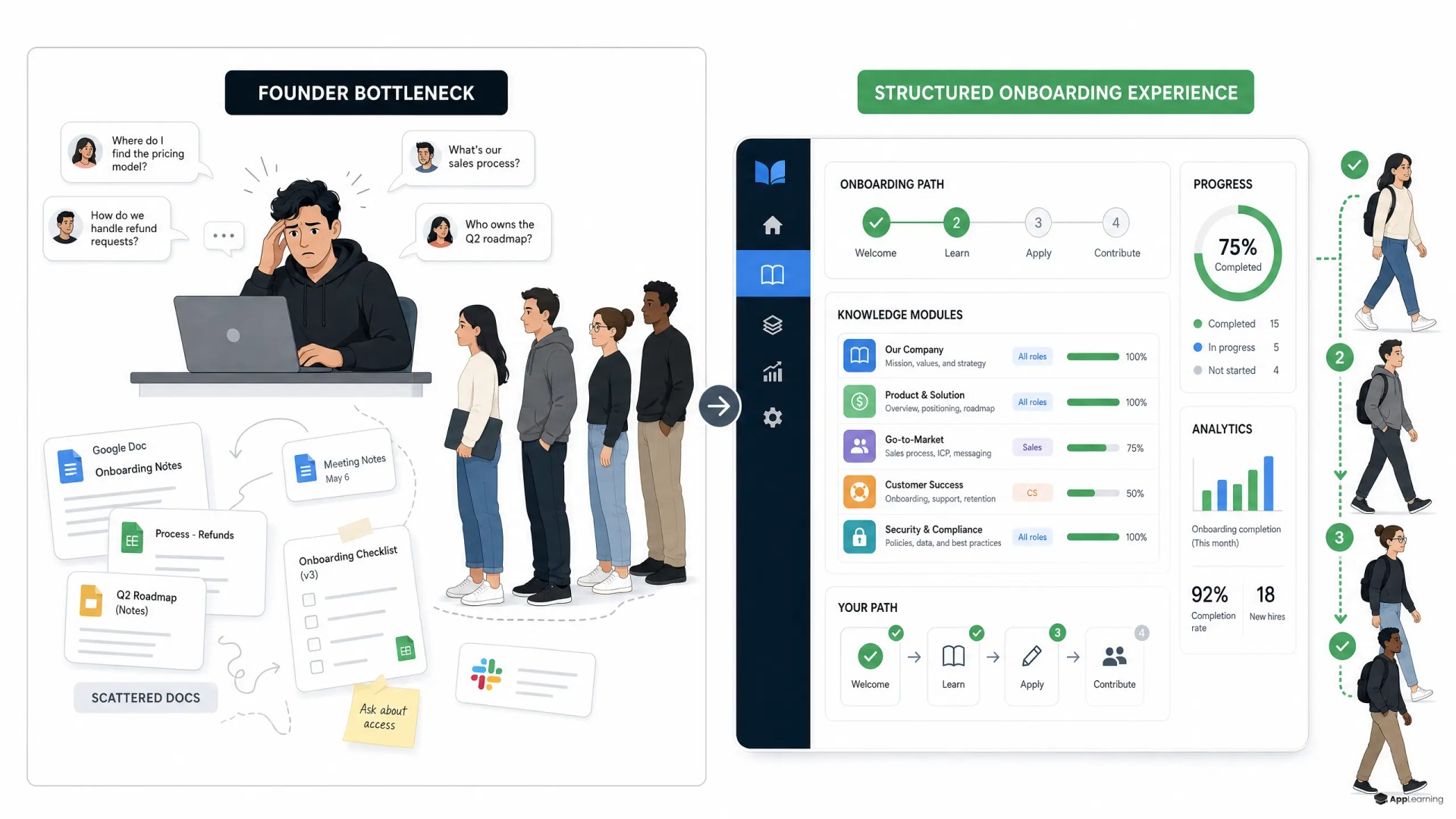
- Informal onboarding turns founders and managers into repeatable knowledge bottlenecks.
- A lightweight academy improves ramp time, consistency, and role clarity early.
- The right trigger is repeated knowledge transfer, not L&D headcount.
Training starts as a founder habit
Most startups delay structured learning because training sounds like a corporate function. It feels like something that comes after HR, management layers, and annual development plans. That framing is wrong. In a growing startup, learning is not a department first. It is an operating system for moving context from the few people who know it to the many people who need it.
At ten people, conversation works. The founder explains the market. The first product lead explains the product logic. The sales lead explains the customer. At fifty people, the same model turns expensive. The company is still hiring for speed, but its knowledge transfer depends on memory, availability, and whoever happens to be free that week.
Informal onboarding turns speed into drag
Manager involvement is still essential. Gallup found that when managers take an active role, employees are 3.4 times as likely to feel their onboarding process was successful. The mistake is making manager attention the whole system. Then every new hire receives a different version of the company, and every manager pays the same explanation tax again.
The symptoms are easy to spot before they become a people problem.
- New hires need weeks to understand basic context.
- The same product, process, and customer questions repeat in Slack.
- Founders keep joining onboarding calls to explain the company narrative.
- Manager quality becomes the main variable in ramp time.
- Critical knowledge lives in decks, calls, tickets, and individual memory.
A platform solves constraints before L&D exists
A startup learning platform should not be an enterprise LMS in miniature. It should turn repeated explanations into reusable learning paths. The goal is not a course catalogue. The goal is a shared baseline for how the company sells, builds, supports, protects customers, and makes decisions.
SHRM recommends measuring onboarding through time-to-productivity, retention, surveys, engagement, performance measures, and feedback. That is exactly where a startup training platform creates value. It makes ramp time visible, shows where people get stuck, and gives managers a structure to coach against.
- Company context that every hire receives in the same sequence.
- Role-based paths for sales, product, support, operations, and leadership.
- Short checks that reveal gaps before they hit customers.
- One place to update process changes when the company learns.
- Progress data that replaces guesswork with evidence.
The trigger is repetition, not headcount
The right trigger is not the day a startup hires its first L&D person. It is the moment the same knowledge is being taught by memory more than twice. Repetition is the signal that a human explanation has become infrastructure work.
APQC frames knowledge transfer around capturing and transferring critical knowledge, not hoping it moves through informal conversation. For startups, the critical knowledge is practical: who the customer is, how the product creates value, what good work looks like, and which mistakes the team has already paid for.
- Implement structure when hiring becomes continuous.
- Build paths when managers repeat the same walkthroughs.
- Document judgment when decisions keep routing back to founders.
- Create checks when readiness is hard to see.
- Update learning when process changes faster than documents.
Good to know
Does a startup need an L&D team before using a learning platform?
No. A startup can use a learning platform as a lightweight operating tool before it has a formal L&D role. The first owner is often a founder, people lead, operations lead, or functional manager.
When should a founder implement structured onboarding?
The clearest signal is repetition. If founders or managers explain the same topics every month, those explanations should become structured learning paths.
Is a learning platform the same as a knowledge base?
No. A knowledge base stores information. A learning platform sequences information, assigns it by role, checks understanding, tracks progress, and helps managers see readiness.
What should the first startup academy include?
Start with company context, product basics, customer knowledge, internal processes, tool usage, security or compliance basics, and role-specific standards for good work.
The academy can stay lightweight
A useful academy does not need a large L&D setup. App-Learning's academy platform supports branded academies, role-based learning paths, short lessons, quizzes, certificates, analytics, and content conversion from existing docs, slides, videos, and internal training material. For a startup, that means the first version can be narrow: company context, product basics, customer segments, core tools, security basics, and role-specific execution standards.
The point of startup learning software is not to professionalize the language of training. It is to remove avoidable interruptions from the operating system and make good execution easier to repeat.
Build a startup academy without adding L&D overhead.
TalkThe operating metrics that prove value
A learning platform pays off when operational friction drops. The first dashboard should stay simple.
- Days to first independent output by role.
- Completion of core onboarding path before day 10 or day 30.
- Quiz results by topic and team.
- Repeated questions from new hires and managers.
- Manager hours spent on basic explanations.
- New-hire confidence and role clarity surveys.
- Early retention, probation outcomes, and performance checkpoints.
A startup learning platform is not a sign that the company has become big. It is one mechanism that lets the company grow without turning founders and managers into the transmission medium for everything important. The earlier repeated knowledge becomes a system, the less scaling tax the team pays later.