

Key takeaways
- Daily learning rules follow calendar days, not just elapsed time.
- UTC resets make the same rule feel different across learner markets.
- Academy or tenant timezones create consistent shared operating rules.
- Separate analytics events reveal which daily constraint creates friction.
A daily rule contains a hidden calendar
“Daily” sounds precise, but it is incomplete product language. A reward cap, streak, reminder cadence or reporting cutoff needs both a duration and a calendar. If the rule says a learner can earn a reward once per day, the system must answer a basic question: which day? UTC provides a reliable global timestamp, but it does not define the learner’s or academy’s local calendar. The W3C guidance on time zones makes the distinction clear: timestamps can represent instants, while reporting and other calendar-based uses need a durable local interpretation.
This matters in fintech education. A learner completing a “daily” lesson after work in New York, Singapore or São Paulo expects the same human rule: one opportunity during their day. When the platform instead applies a fixed UTC boundary, the rule changes shape by market without anyone choosing that experience.
UTC moves fairness across markets
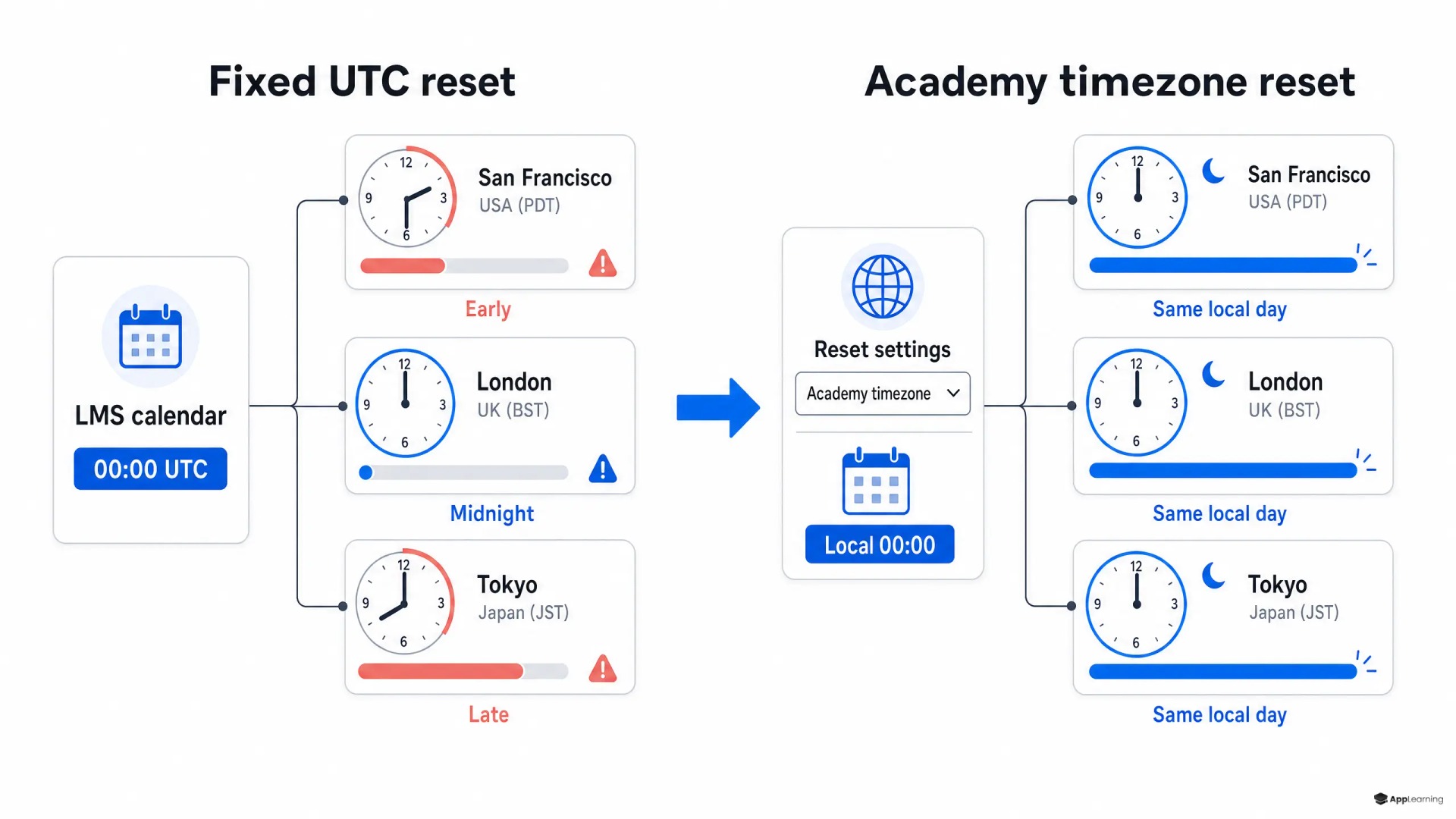
A midnight UTC reset arrives in the evening for much of North and South America, around midnight in parts of Europe and during the morning or afternoon across Asia-Pacific. A learner may hit a reward limit at 7 p.m., wait only a few hours for a reset, and then receive a fresh allowance before bed. Another learner may wait until the next morning. Both see the same configuration, but they do not receive the same daily experience.
That inconsistency affects more than points. It can break streak expectations, send reminders at the wrong moment, close a time-boxed learning challenge early, and shift dashboard totals into a different business day. It also makes support harder. Teams end up explaining UTC mechanics to users when the product should have applied a clear local rule.
The academy owns the clock
For a multi-market program, timezone should be a configurable academy or tenant setting. That creates one shared operating day for the people enrolled in that academy, including its learning calendar, daily reset logic, reminder schedule and reporting cutoff. It is usually more stable than deriving the boundary from each learner’s device, which can change when people travel or alter device settings.
Store every underlying event in UTC for ordering and auditability. Then derive an academy-local date from an IANA timezone identifier such as `Europe/Berlin` or `America/New_York`, rather than from a fixed offset. The IANA Time Zone Database is built for this purpose and is updated as governments change timezone boundaries and daylight-saving rules. Fixed offsets eventually fail when civil time changes.
- Define the academy timezone when the academy is created.
- Apply that timezone consistently to rewards, streaks, reminders, access windows and reporting.
- Persist the timezone and derived local date alongside each relevant event.
- Make timezone changes explicit, permissioned and auditable.
- State the learner-facing rule in local language, such as “resets at midnight academy time.”
Good to know
Should every learner have an individual timezone?
Not by default. Use an academy or tenant timezone when learners share one program calendar. Individual timezones fit personal schedules, but they can make shared challenges, reporting and support more complex.
Why not keep all rules in UTC?
Keep event storage in UTC. Apply the academy timezone when a rule depends on a calendar day, local send time, access window or business reporting date.
Which rules need local-day logic first?
Start with reward limits, streak calculations, scheduled reminders, daily challenges, access expirations and dashboard cutoffs. These rules create the most visible mismatch when a reset occurs at an arbitrary UTC hour.
Events expose the rules that create friction
Changing the boundary is only half the job. Teams also need to know which constraint users actually encounter. In one App-Learning academy observation, 39 of 271 active learners reached the reward limit, while only 3 reached the maximum action limit. The two limits were not equally important, even though both were configured as daily controls.
A catch-all event such as `daily_limit_hit` hides that difference. Emit a distinct event for each rule, with the rule identifier, academy timezone, derived local date, learner segment and the action that was blocked or deferred. Then product, growth and lifecycle teams can separate a reward-design issue from an engagement-frequency issue. This is especially useful when education supports activation and trust: friction in the learning journey should be visible before it becomes a retention problem.
Make daily learning behave consistently in every market.
TalkGlobal delivery lives in product behavior
Translation makes content readable. Local-day behavior makes the academy operationally coherent. A timezone-aware LMS treats the calendar as part of the learning design, not as an infrastructure detail. That is the difference between a global academy platform that merely serves multiple markets and an international learning platform that behaves predictably within them.
App-Learning supports configurable LMS rules at the academy level, while separate analytics events preserve the evidence needed to refine each constraint. The result is a system where daily learning feels daily to learners, and where operators can see precisely which rule needs attention. Global education becomes credible when the product honors the local time in which people actually learn.