

Key takeaways
- Manager-led onboarding does not scale cleanly beyond the early team.
- Uneven onboarding creates uneven productivity, confidence, and culture transfer.
- Structured learning protects manager focus while improving new hire clarity.
- Founders should systemize critical onboarding knowledge before growth accelerates.
The manager bottleneck starts as common sense
Early startup employee onboarding is usually personal. The founder explains the market. The first sales lead explains the customer. The engineering manager explains the product logic. This works because the company is still small enough for context to move by conversation.
The problem is not manager involvement. Managers matter. Gallup found that new hires are 3.4 times as likely to feel onboarding was successful when their manager takes an active role. The failure starts when manager attention becomes the system. At 50 people, every new hire competes with roadmap pressure, customer escalations, hiring loops, and team rituals.
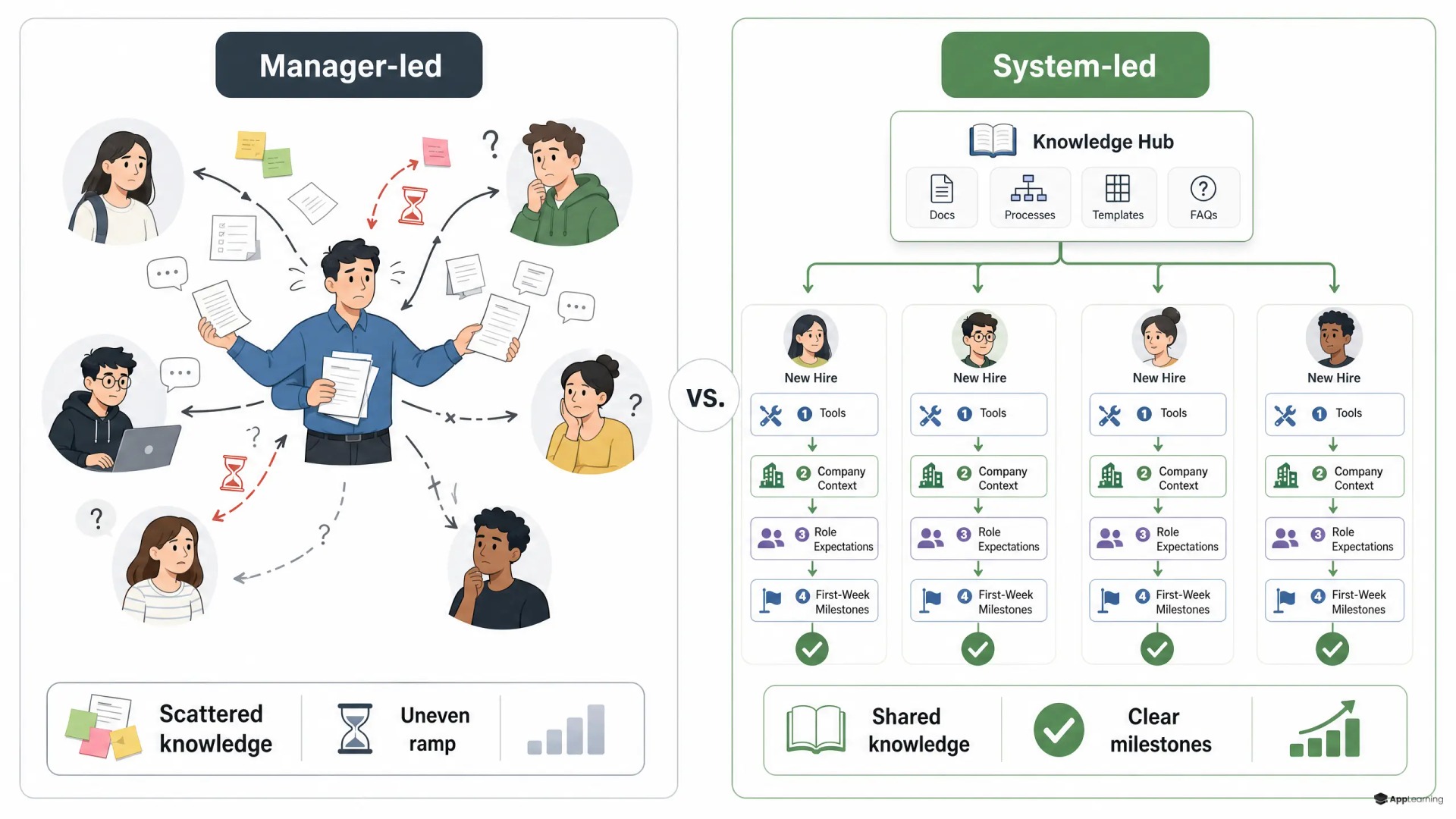
That is where manager-led onboarding becomes uneven. One new hire gets the full company story. Another gets tool access and a few shadowing calls. A third learns through Slack archaeology. The startup onboarding process still exists, but only as a set of habits distributed across busy people.
The signals appear before the process collapses
The warning signs are operational, not cosmetic. They show up in the questions people ask, the delays managers tolerate, and the decisions new hires avoid because no one has explained the operating model.
- New hires ask different people the same basic questions.
- Managers repeat the same explanations every hiring round.
- Role expectations vary by team, not by design.
- Product, customer, and culture context arrive too late.
- New employees copy local habits instead of company standards.
These signs do not mean the team needs bureaucracy. They mean the company has outgrown oral transmission. Informal context is fast until it becomes scarce. Then it becomes a hidden tax on every manager and every new hire.
The knowledge layer needs structure before scale
A useful onboarding system does not document everything. It captures the knowledge that should never depend on who happens to be available. Research on software-team onboarding found that onboarding tasks shape learning, confidence building, and socialization. The same pattern applies across startup roles. New hires need sequenced exposure, not a document dump.
- Company narrative, strategy, and operating principles
- Customer segments, jobs to be done, and common objections
- Product logic, roadmap trade-offs, and key constraints
- Decision rights, ownership rules, and escalation paths
- Tool norms, data standards, security, and compliance basics
- Role-specific workflows and first 30-day performance expectations
This layer should be reusable, searchable, and easy to update. It should also leave room for human judgment. The manager should explain priorities, coach performance, and build trust. The system should carry the repeatable load.
Standardization does not mean corporate drag
Good standardization sets a floor, not a script. A public-sector onboarding model draws a useful distinction between orientation and onboarding, where onboarding integrates people, tools, resources, training, and networks over a longer period than first-day administration. Startups can use that logic without copying enterprise weight by building a minimum viable path for each role.
The path should answer three questions. What must every employee know to represent the company well? What must this role know to create value quickly? What must the manager still handle personally because it depends on judgment, trust, or live business context?
Good to know
When should a startup stop relying on manager-led onboarding?
Usually when hiring becomes recurring, not occasional. If managers repeat the same explanations every month, the knowledge should move into a structured onboarding system.
Does structured onboarding make a startup feel less personal?
Not if it is designed well. Structure should handle baseline knowledge so managers have more time for coaching, feedback, and real relationship building.
What should founders systemize first?
Start with company context, role expectations, customer knowledge, tool norms, and the recurring questions every new hire asks in the first 30 days.
A learning academy keeps context close
This is where a lightweight learning academy fits. App-Learning helps teams turn source material into role-specific microcourses, quizzes, and learning paths that can be launched without building an L&D department. For a growing startup, the value is not the course format alone. The value is that company knowledge stops living only in calendar time.
Short lessons can carry the baseline. Quizzes can expose gaps. Analytics can show where people drop off. Managers can then spend their onboarding time on the parts that actually need a manager: priorities, feedback, judgment, and belonging.
Build onboarding that scales before manager time breaks.
StartThe shift must be measured in ramp quality
After the shift, do not measure success by the number of lessons published. Measure whether the startup employee onboarding system reduces dependency and improves speed to contribution.
- Time to first independent output
- Manager hours spent on repeated explanations
- Question volume by topic during the first 30 days
- Completion and quiz performance by role
- 30, 60, and 90-day manager confidence ratings
- New hire retention and early performance signals
The goal is not to remove managers from onboarding. It is to stop wasting their attention on explanations a system can carry better. Founders who make that shift protect speed without accepting chaos. They also make the company easier to join, easier to manage, and easier to scale.