
Key takeaways
- Sales enablement training must change field behavior, not just publish content.
- Mobile access and short modules decide whether agents actually use training.
- Readiness signals matter more than views, downloads, or course completions alone.
- App-Learning fits teams that need repeatable product and sales knowledge at scale.
What makes a sales enablement LMS and training platform mobile-ready?
Teams comparing sales enablement LMS software and sales training platforms need more than a content library. They need a mobile training platform that gives agents short, usable product lessons between customer conversations, works in real field conditions, and shows who is ready to sell. The product deck, tariff sheet, and promotion update may already exist; the gap appears when an agent cannot explain the offer, handle an objection, complete the next operational step, or know whether they are allowed to sell a campaign.
For a field sales business with thousands of agents, a sales enablement training platform must turn product and process knowledge into repeatable behavior. It must help a new agent move from signup to first sale. It must keep existing agents current when prices, bundles, incentives, compliance rules, or stock processes change. A content portal cannot do that alone.
Four platform models dominate the shortlist
The market groups into four useful models. Revenue enablement suites combine content, training, coaching, buyer engagement, and analytics. Highspot describes unified analytics across content, training, coaching, engagement, and outcomes, while Seismic says its learning product supports interactive training, microlearning, performance metrics, coaching playbooks, and onboarding. For teams seeking mobile sales tools that keep coaching and training in one place, verify that both fit the same seller workflow rather than separate desktop modules.
Sales readiness platforms go deeper into skills, practice, and manager coaching. Mindtickle positions its platform around sales training, AI role play, coaching, content management, analytics, and a readiness index. This model fits teams that need practice before high-value conversations, not just campaign communication.
Traditional LMS platforms focus on training structure, assignments, reporting, certificates, and governance. Docebo describes sales training use cases that include role play, CRM integration, gamification, reporting, and business intelligence workflows. TalentLMS highlights mobile apps, offline-compatible courses, notifications, leaderboards, points, badges, and rewards.
- Choose a content-led suite when sellers need approved assets and playbooks in complex B2B cycles.
- Choose a readiness platform when skill practice, role play, and coaching quality are the main gaps.
- Choose an LMS when governance, compliance, certificates, and formal learning paths matter most.
- Choose an academy model when product knowledge, onboarding, updates, quizzes, and activation must reach many distributed users fast.
Mobile access separates field systems from office systems
Field sales training software must be designed for the device in the agent’s hand. That often means a low-end Android phone, limited storage, intermittent connectivity, expensive data, and short attention windows between customer interactions. Desktop-first learning fails here because it assumes time, bandwidth, literacy, and motivation that the field does not always have.
Good mobile learning is not a smaller version of a classroom course. It is a sequence of short actions. Open the module. Learn the product point. Answer a quiz. See the next operational step. Repeat during the next update. If an agent must search a portal, download a PDF, watch a long video, or leave the sales app, usage drops.
Readiness signals beat content views
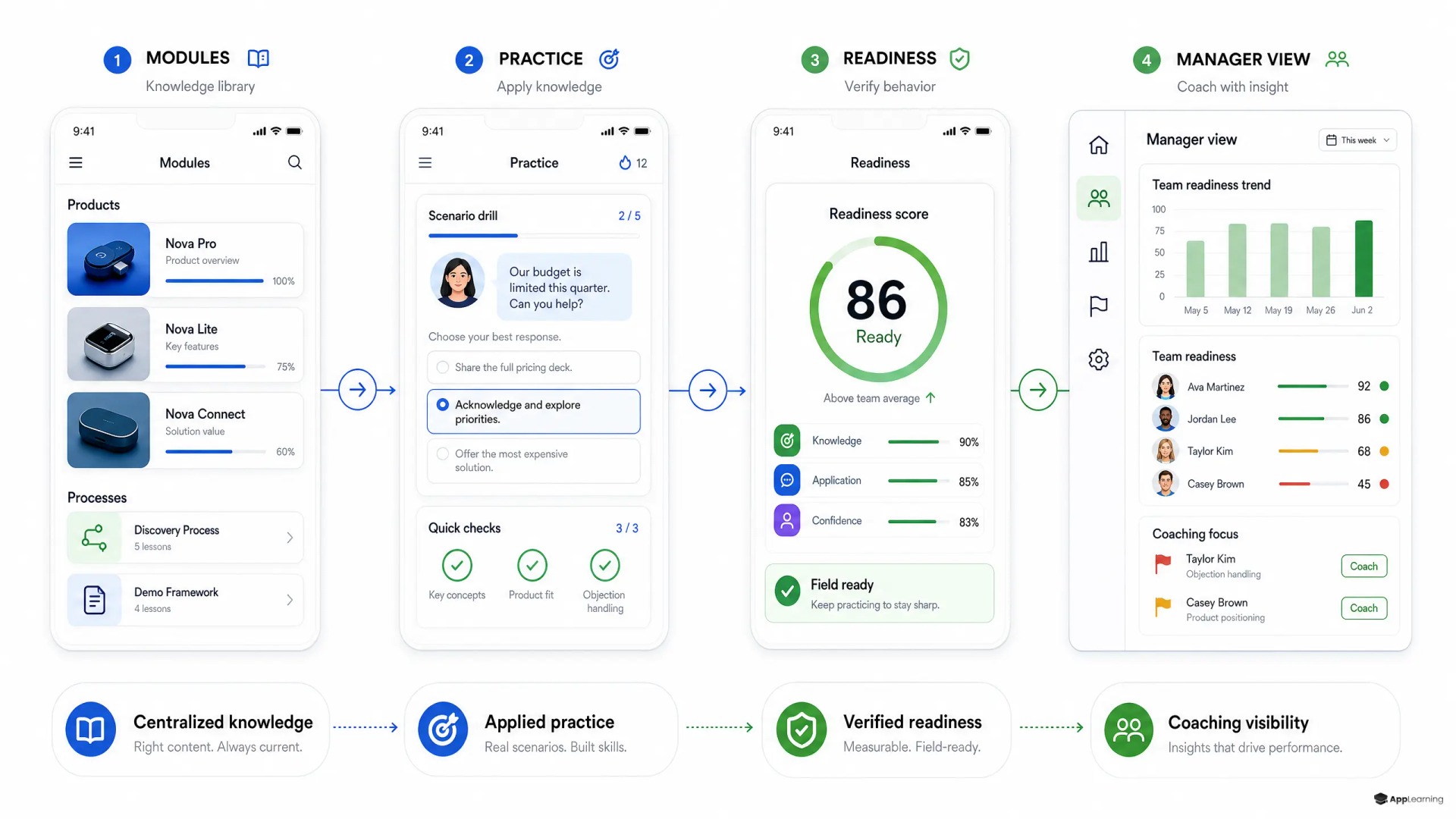
Content views are weak evidence. An agent can open a deck and still fail the conversation. Better signals include quiz scores, failed questions by region, certification status before campaign access, completion of onboarding milestones, repeat attempts, drop-off points, and the time from registration to first successful sale.
App-Learning’s academy platform is built around role-based learning paths, microlearning modules, quizzes, certificates, gamified mechanics, and analytics for progress, completion, quiz results, and learner activity. That makes it useful when the operating problem is not just training delivery, but readiness visibility across regions, roles, and campaigns.
Good to know
What is the best sales enablement training platform for field agents?
The best choice depends on the operating problem. Field-heavy teams usually need mobile-first onboarding, short product modules, quizzes, certification, and analytics more than a large content repository.
Is an LMS enough for sales enablement?
An LMS can work for structured courses, compliance, and certificates. It is usually not enough when agents need real-time product updates, embedded field guidance, campaign readiness, and activation tracking.
What should CEOs and COOs measure first?
Start with activation metrics. Track onboarding completion, quiz pass rates, time to first sale, campaign readiness, support tickets, and sales performance by agent cohort or region.
Where does App-Learning fit compared with larger enablement suites?
App-Learning fits teams that need practical product and sales knowledge delivered through mobile microlearning, role paths, quizzes, certificates, gamification, and readiness analytics for distributed users.
Where App-Learning fits
App-Learning fits best when the sales network is broad, fast-moving, and operationally fragmented. Telecom, prepaid, retail distribution, financial products, and partner-led sales teams often need the same core system: mobile-first onboarding, simple product education, localized explanations, readiness checks, and quick updates when the offer changes.
The App-Learning angle is practical. Convert product docs, PDFs, decks, help-center articles, compliance notes, and campaign instructions into short lessons, quizzes, certificates, and role paths. Then connect progress data to the systems that already run the field business. That might be CRM, onboarding, rewards, support, or the existing agent app.
Product launches need activation loops
A product launch is not complete when headquarters publishes the announcement. It is complete when the right agents know the offer, pass the check, can explain the value, avoid the compliance mistakes, and start selling without calling support for every edge case.
The same logic applies to onboarding. New agents should not receive a folder of instructions. They should see the next required action, the reason it matters, the product knowledge needed for the first customer conversation, and the proof that they are ready to sell. That is where a sales training platform becomes part of operations rather than an HR tool.
Build field readiness into your sales app.
TalkSelection criteria for field sales leaders
- Mobile-first experience on low-end Android devices.
- Offline or low-data support for weak connectivity environments.
- Short modules that explain one product, process, or behavior at a time.
- Role-based curricula by region, product, sales role, agent type, and career stage—from onboarding to launch refreshers.
- Quizzes and certifications before agents sell new offers.
- Analytics that show readiness, not just usage.
- Deep links or embeds inside the existing field app.
- Fast content updates without developer dependency.
- Multilingual support and simple formats for mixed literacy levels.
- Integration paths to CRM, onboarding, support, and rewards systems.
The best sales enablement training platforms do not win because they store more content. They win because they reduce field ambiguity. They make the next action clear, test whether knowledge is usable, and give leaders a live view of who is ready to sell. For a distributed field sales business, that is the difference between a trained network on paper and a productive network in the market.