
Key takeaways
- Learning analytics assistants should explain feedback, not just summarize dashboards.
- Low self-regulated learners may benefit most from scaffolded AI feedback.
- Trust calibration needs limits, confidence signals, next actions and escalation paths.
- Assistant conversations should improve content, coaching and learning operations.
Dashboards expose signals but do not coach
Most learning dashboards show data. They rarely change behavior by themselves. A learner sees overdue modules, low quiz scores, weak confidence ratings or a red compliance indicator. The harder question remains open: what does this mean, what should I do next, and when is this serious enough to ask for help?
That gap is sharp in finance and crypto learning environments. Compliance training dominates the agenda, but completion data is a weak proxy for capability. A person can finish an AML module and still misread a transaction-risk scenario. AI learning analytics becomes useful only when it turns signals into guided action without pretending that every signal is a diagnosis.
The assistant becomes a scaffold, not a judge
A 2026 LAK paper by Yildiz Uzun, Andrea Gauthier and Mutlu Cukurova makes the gap visible: students, especially those with lower self-regulated learning competence, struggled to engage with and interpret learning analytics feedback. In their 10-week study, lower-SRL learners used a GenAI assistant for clarification and reassurance, while higher-SRL learners asked more technical questions and requested personalized strategies.
This pattern maps well to workplace learning. Strong learners can often translate a dashboard into a plan. Less confident learners need scaffolding: what the metric means, why it matters, which content to revisit, and how to practice. A learning analytics assistant should therefore act less like a dashboard narrator and more like a structured feedback coach.
A 2026 study on GenAI feedback and self-regulated learning also points to the importance of how learners perceive the feedback source. Some learners care mainly about usefulness. Others change their attitude once they know feedback came from AI. That is not a messaging issue. It is learner trust calibration.
Trust calibration is the design problem
Overtrust is dangerous. A learner may follow vague AI advice because it sounds fluent. Undertrust is also expensive. A learner may ignore useful feedback because it comes from a machine. Both failures create noise in the learning system.
The design task is to keep the assistant honest about what it knows. It should show the evidence behind a recommendation, name missing context and avoid certainty when the data is thin. The NIST AI Risk Management Framework frames AI risk management as work across design, development, use and evaluation, which is the right operating model for learning systems as well.
For regulated employers, trust is also governance. The European Commission notes that AI literacy rules under the AI Act started to apply on 2 February 2025, and the Act’s Annex III includes certain education and vocational training systems that evaluate learning outcomes. Not every internal learning assistant falls into that category. Still, the signal is clear: AI feedback that shapes development needs oversight, explainability and human review routes.
Good feedback shows its operating logic
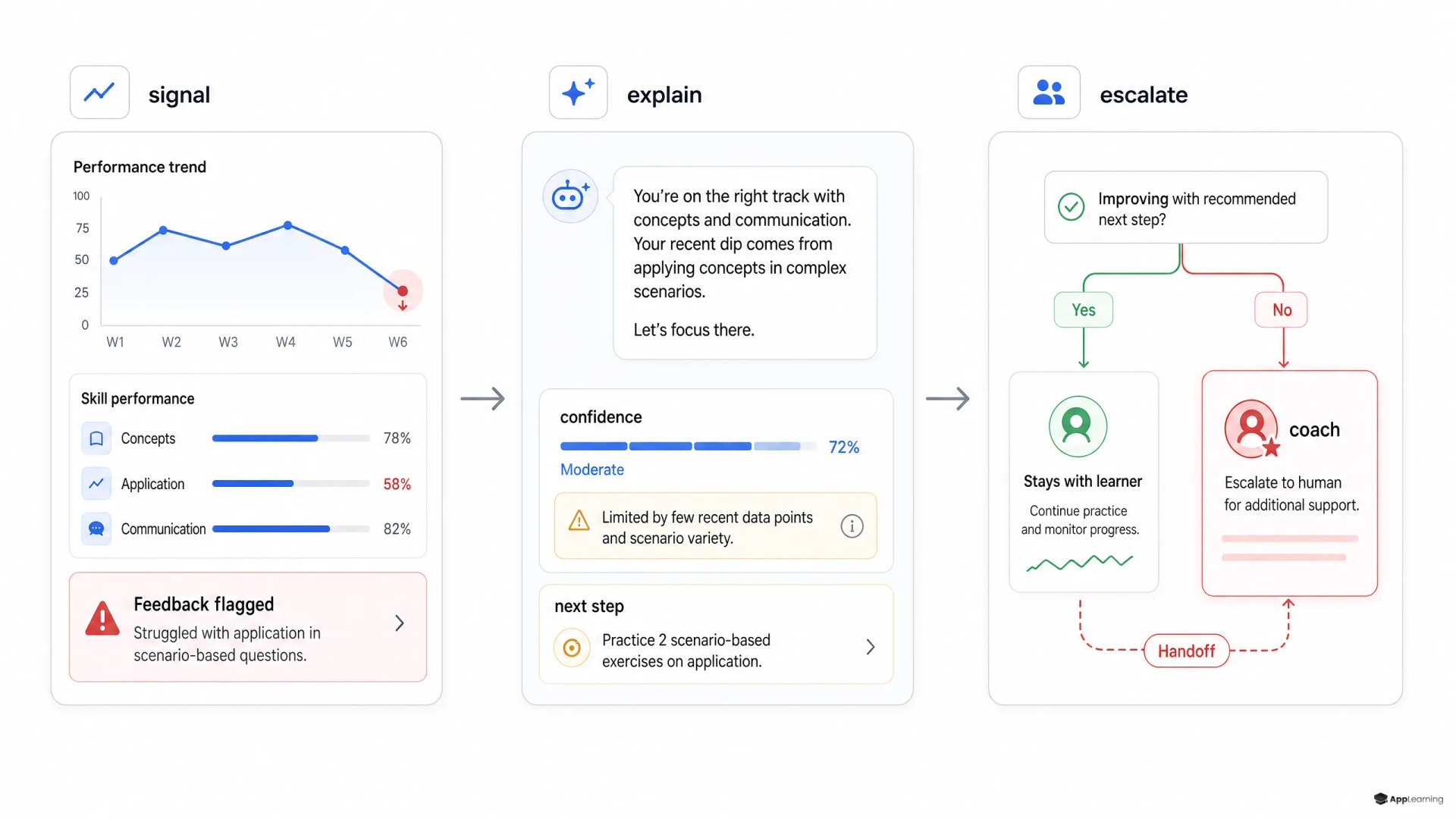
The practical standard for a learning analytics assistant is simple. It must explain, bound and route feedback. If it cannot do that, it should not advise the learner.
- Signal: the exact data point or pattern that triggered the feedback.
- Interpretation: a plain-language explanation of what the signal may mean.
- Limit: what the assistant cannot infer from the available data.
- Confidence: whether the recommendation is strong, tentative or incomplete.
- Next action: one concrete step the learner can take now.
- Escalation: when a coach, manager, subject expert or compliance owner should step in.
- Audit trail: what was shown, why it was shown and which rules shaped the response.
This structure prevents the assistant from becoming a general-purpose advice box. It also protects the learner. If a compliance scenario is ambiguous, the assistant should not improvise policy. It should point to the approved source, suggest the relevant refresher and route the case to a human if the answer affects real work.
Good to know
Where should a learning analytics assistant sit in the stack?
It should sit between analytics data and the learner experience. It translates LMS, assessment and engagement signals into structured feedback, while preserving governance rules and escalation paths.
Can AI feedback replace managers or coaches?
No. It can handle first-level explanation, reflection prompts and practice recommendations. Managers, coaches and subject experts are still needed for sensitive cases, role-specific judgment and performance conversations.
What should HR and compliance teams see?
They should see aggregated patterns, risk categories, content gaps and escalation records. Raw personal dialogue should be limited by policy, privacy requirements and the purpose of the learning program.
Learning operations turns conversations into improvement
The App-Learning angle is not to add a chatbot to an LMS. It is to create a guided learning layer around analytics. Learners get explanations and next steps. The organization gets structured visibility into where training breaks down.
This is where learning operations AI matters. Assistant conversations can reveal repeated confusion around a policy, weak examples in a scenario, unclear quiz wording or missing prerequisite knowledge. Those patterns should feed content improvement, coaching playbooks and compliance review. The learner should not become the product. The learning system should become easier to improve.
- Content teams see which lessons generate repeated clarification requests.
- Coaches see where human intervention is more useful than another module.
- Compliance owners see where approved guidance is missing or misunderstood.
- L&D leaders see whether analytics produce action, not just reports.
Turn learning analytics into guided action.
DiscussOversight makes assistance useful
A good learning analytics assistant reduces confusion without removing accountability. It helps the learner interpret feedback, shows limits, recommends the next action and escalates when the situation exceeds the data. That is the real value: not a smarter dashboard, but a safer learning loop where signals become action and action improves the system.