
Key takeaways
- AI productivity depends on post-automation behavior, not only tool adoption.
- Saved time needs decision rules by role, workflow, and risk level.
- L&D should connect AI training to quality, compliance, and workflow redesign.
- Learning analytics must show how teams reinvest AI-assisted time.
Access only starts the clock
AI access is easy to justify. It is also easy to misread. A team can summarize policies, draft customer replies, or classify alerts faster and still create no durable value. In finance and crypto, unmanaged speed can even create review debt, weak documentation, and brittle decisions.
Ramp and Revelio’s underlying study of paid AI adoption found that high-intensity adopters grew headcount by 10.2% over two years, while entry-level headcount rose 12.0%. The same paper warns that enterprise chat subscriptions alone do not appear enough to drive gains because benefits require organizational change and learning inside the firm.
That is the real AI training ROI problem for HR and L&D. Tool rollout is not the same as behavior change. AI adoption training must define what better work looks like after the tool has removed friction.
Saved time becomes a management problem
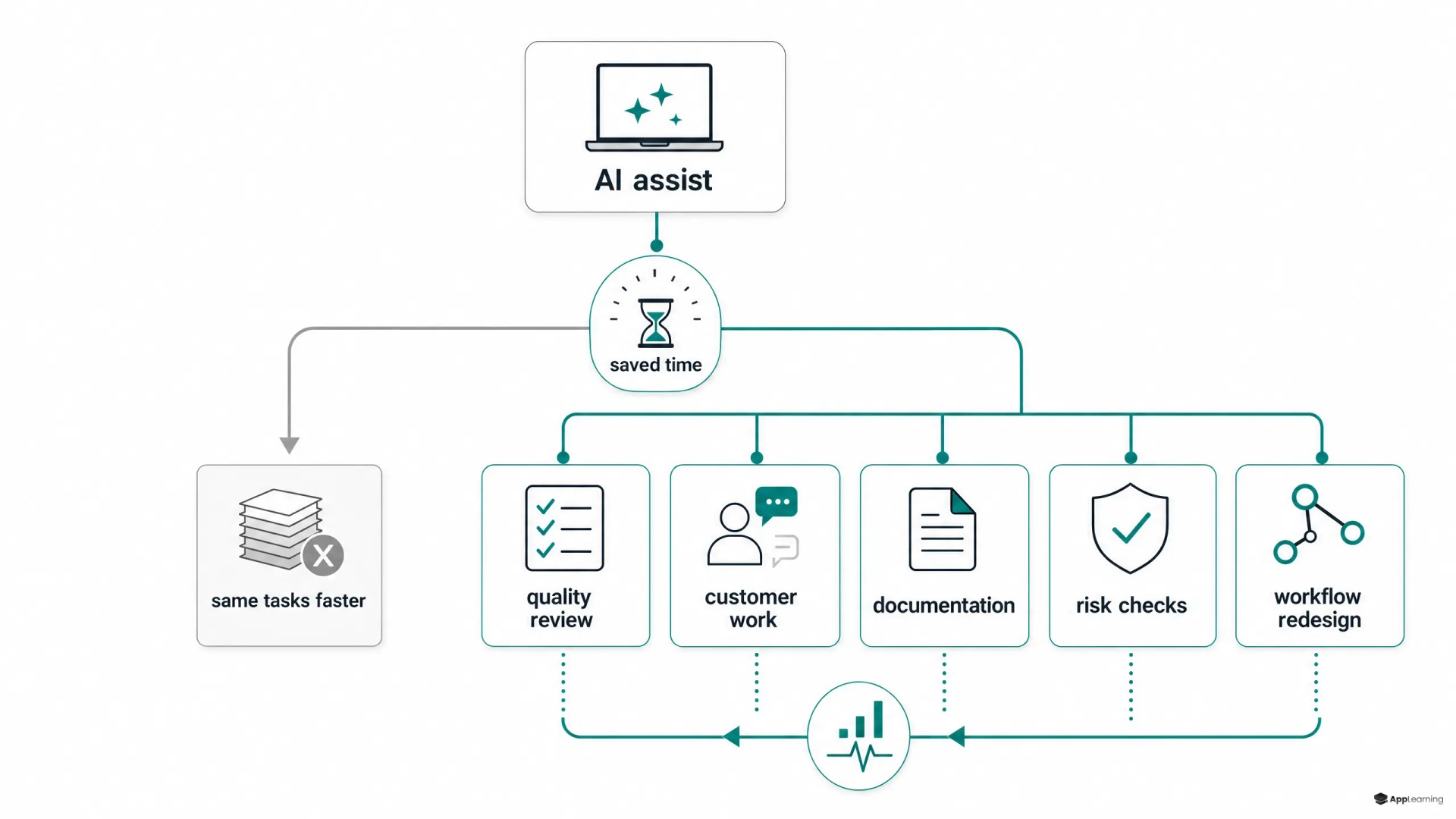
The saved-time question is simple but often ignored. If AI reduces a task from 40 minutes to 15, what should happen to the other 25 minutes. Without a rule, people fill the space with the next ticket, the next message, or the same old backlog.
That may increase activity, but not AI workforce productivity. A risk analyst may need to use the time for second-source checks. A customer operations specialist may need to improve the response record. A manager may need to coach a junior employee through an exception pattern. The correct use of saved time depends on role, risk, and workflow maturity.
Prompt lessons cannot carry operating risk
Generic prompt training teaches input technique. It does not teach judgment after the output arrives. That gap matters in regulated teams, where the business risk is often not the first draft. It is the unchecked conclusion, the missing rationale, or the undocumented exception.
A Business Insider report on BCG’s AI at Work findings reported that workers with strong strategic clarity but limited AI access were more likely to see measurable impact than workers with broad access and little direction. Strategy beats tool volume because it tells people what to optimize.
Good to know
How should L&D measure AI training ROI?
Measure behavior after automation. Track how saved time is reinvested, then connect it to quality, risk, customer, and workflow outcomes.
Should regulated teams prioritize speed or control?
Both matter, but the default depends on risk. In high-risk workflows, saved time should first strengthen evidence, review, and decision quality.
Where does App-Learning fit with an existing LMS?
App-Learning can sit around the LMS as a practice and analytics layer for role-specific AI behavior change.
Decision rules belong inside the role
Saved-time rules should be short, specific, and testable. They should sit inside the workflow, not in a policy PDF no one opens during a live case.
- Customer support teams use AI-drafted replies to spend more time on regulated wording, tone, and edge-case escalation.
- Compliance teams use AI-assisted research to improve evidence trails, adverse media notes, and review consistency.
- Product teams use faster synthesis to test disclosure impact, customer risk, and control changes before shipping.
- Managers use saved time for coaching, decision review, and workflow redesign instead of only increasing throughput.
In high-risk processes, the default reinvestment path is quality and evidence. In low-risk processes, it may be volume, experimentation, or deeper customer work. The rule should be explicit before the tool goes live.
Build measurable AI practice loops with App-Learning.
TalkLearning operations make the gain visible
BCG’s corporate learning analysis argues that L&D must move beyond content updates and redesign learning in the flow of work. That is where AI learning operations become useful. The system should not only ask whether someone completed a module. It should show how the person used the time AI created.
For App-Learning, this means building role-specific microlearning loops around real decisions. A learner practices an AI-assisted task, chooses a reinvestment path, sees the consequence, and repeats until the decision becomes reliable. Analytics then connect training to work signals.
- Saved time by workflow and role
- Chosen reinvestment path after automation
- Quality defects, rework, and escalation rates
- Policy adherence and documentation completeness
- Manager review patterns and coaching needs
AI training ROI is not proven by logins, prompt libraries, or faster drafts. It is proven when saved minutes become better decisions, stronger controls, clearer documentation, and redesigned workflows. The organizations that win with AI will not be the ones that merely make old work faster. They will be the ones that teach people how to spend the time well.