

Key takeaways
- Measure confidence and action, not content volume alone.
- Put guidance inside the product journey at moments of hesitation.
- Use quizzes, personalization, and analytics to turn education into a system.
- Customer financial education should support trust, activation, and long-term engagement.
Content libraries do not create confident users
Many financial education experiences look useful because they contain a lot of material. There are articles, glossaries, videos, market updates, and beginner guides. The problem is not effort. The problem is placement. A user who hesitates during onboarding, a first purchase, a wallet setup, or a recurring buy does not need a library. They need enough understanding to take the next safe step.
This is where many customer financial education programs fail. They answer abstract questions while the product asks for concrete action. In a Bitcoin product, the user is not only asking what Bitcoin is. They are asking whether they can trust the flow, what risk they are accepting, what happens after purchase, and what to do if they make a mistake.
Information is not the same as readiness
The OECD defines financial education as helping consumers understand products, concepts, and risks while developing the skills and confidence to make informed choices and take effective action through its financial literacy framework. That definition matters because it moves the goal away from content delivery. The goal is readiness.
Readiness has three parts. The user understands the concept. The user trusts their own ability to decide. The user knows what to do next. A financial literacy platform that only measures page views or course completion can miss the real signal. The better question is whether users become more capable inside the product journey.
The decisive moment sits inside the product
Complex financial products create predictable moments of hesitation. In Bitcoin, these moments include identity verification, first purchase, price volatility, fee explanations, wallet transfers, savings plans, recurring buys, and self-custody. Each moment has a different learning need. A beginner needs reassurance and simple language. A returning user may need a risk reminder. An advanced user may need feature-specific guidance.
- Explain the decision in plain language.
- Show the risk boundary without exaggeration or fear.
- Give one clear next step.
- Confirm understanding before higher-stakes actions.
- Offer help without forcing the user out of the flow.
This is why embedded financial education usually works better than a separate academy alone. The academy can build broad understanding. The product journey must convert that understanding into confident action.
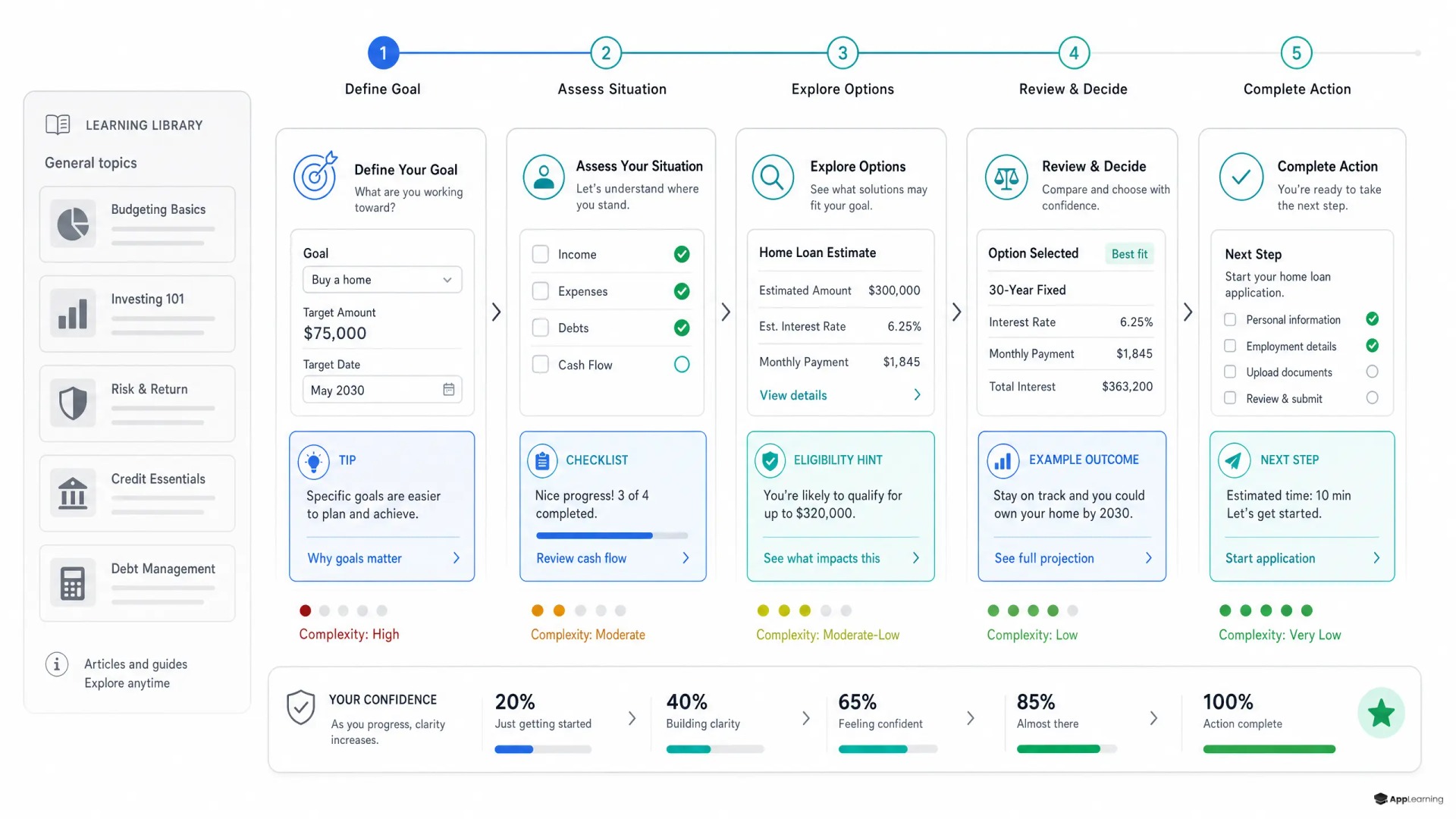
Effective education behaves like a system
The CFPB’s principles for effective financial education emphasize knowing the audience, providing actionable and timely information, improving skills, building motivation, and making good decisions easier to follow through on in its financial well-being guidance. For product teams, that translates into a design system, not a publishing calendar.
- Segment education by knowledge level, intent, and product stage.
- Trigger micro-lessons at friction points instead of relying on search.
- Use quizzes, simulations, and confidence checks before critical actions.
- Connect learning data to activation, support topics, feature adoption, and retention.
- Keep content modular so it can be localized and updated quickly.
The operational consequence is simple. Financial education needs ownership across product, growth, compliance, support, and content. If it sits only with marketing, it becomes awareness material. If it sits only with support, it becomes reactive help. If it is built into the product system, it can reduce uncertainty before it becomes drop-off.
Good to know
What makes financial education effective in fintech products?
It is effective when it helps users understand risk, build confidence, and take the next appropriate action inside the product journey.
How is a financial education platform different from a resource center?
A resource center stores content. A financial education platform connects lessons, quizzes, personalization, triggers, and analytics to real user behavior.
How should Bitcoin companies measure customer financial education?
Measure learning progress, quiz accuracy, confidence, onboarding completion, feature adoption, support topics, and retention after key product actions.
Trust grows when education reduces uncertainty
A financial education platform should not act like a persuasion layer. This is especially true in Bitcoin. Education that ignores volatility, custody, scams, irreversible transactions, or user responsibility may increase short-term activation while weakening long-term trust. Strong education helps users understand both product value and product limits.
This changes the role of education in growth. It is not just top-of-funnel content. It supports onboarding completion, first transaction confidence, savings-plan adoption, wallet usage, and retention after the first market shock. It also gives support teams fewer repeated beginner questions because the product answers them at the right moment.
App-Learning approaches this problem through branded, gamified learning journeys rather than static content. App-Learning describes its microlearning platform as supporting mobile and web academies with quizzes, analytics, and Learn-to-Earn rewards, while Simple Bitcoin shows the same pattern in a consumer format with short lessons and reward-based learning in its app listing. The useful part is not the reward alone. It is the structure around progress, feedback, and measurable learning behavior.
Build education into the moments where users hesitate.
TalkThe metric is the next safe action
Financial education works when users do something better after learning. They complete onboarding with less doubt. They understand a fee before they confirm. They set up a recurring buy because the mechanism is clear. They use a wallet with more care. They ask fewer basic support questions because the product taught them before the question became a ticket.
The shift is from explaining finance to designing confidence. A static resource center can answer what Bitcoin is. Effective financial education answers what the user can safely do now, what they still need to understand, and where the product should guide them next. That is the difference between content that exists and education that changes behavior.