

Key takeaways
- Confidence is a hidden driver of onboarding quality.
- Beginners need clarity and reassurance before they need more features.
- Trust-building education should appear before fear becomes drop-off.
- Onboarding metrics should show readiness, not only step completion.
Access is not the same as readiness
Beginner users rarely abandon crypto onboarding because they want less access. They abandon it because the product asks them to act before they feel ready. A Bitcoin app can be clean, fast, and technically correct, yet still feel risky to someone who does not understand price volatility, wallet types, recovery phrases, transaction finality, or what happens after they tap buy.
This creates a different onboarding problem from normal fintech activation. A banking app usually explains a known product through a new interface. A Bitcoin company often has to explain a new interface, a new asset, a new mental model, and a new set of responsibilities at the same time. If all of that arrives in the first session, the user does not experience empowerment. They experience exposure.
The product consequence is simple. If confidence is missing, every step starts to look like a trap. Identity checks feel intrusive. Risk disclosures feel alarming. Wallet setup feels technical. First purchase screens feel irreversible. Even good compliance work can increase hesitation if it appears without plain explanation.
Confidence fails at the first risk signal
Crypto onboarding happens inside a trust deficit. In the U.S., Pew Research Center found that only 5% of adults were extremely or very confident in cryptocurrencies, while 63% had little or no confidence in their reliability and safety. For a product team, that means many users arrive curious but unconvinced. They may have downloaded the app, but they have not yet decided that the category deserves their trust.
That hesitation is rational. FINRA warns investors that crypto assets can be highly volatile, that theft is a significant risk, and that some crypto service providers may operate with different levels of oversight and protection. A beginner may not know the vocabulary, but they can sense the stakes. When a screen mentions custody, recovery, price movement, fees, or irreversible transfers, the user understands that mistakes may have real consequences.
The mistake is to treat this hesitation as low intent. Often it is not. It is unresolved uncertainty. The user wants to know whether the product is safe enough, whether they understand enough, and whether the next action fits their own risk tolerance. Better crypto onboarding answers those concerns before the user has to search elsewhere.
Trust needs visible structure
Trust is not created by adding a single educational page. It is created by a visible structure that helps the user predict what will happen next. Beginners need to know where they are in the journey, why a step exists, what risk it introduces, and what control they still have.
Three layers matter in the first experience. The first is conceptual clarity. Users need plain explanations of Bitcoin, volatility, custody, and transaction basics. The second is procedural clarity. Users need to know what the app is asking them to do and how long it will take. The third is emotional readiness. Users need reassurance that they can pause, learn, compare options, and proceed without being pushed into a decision they do not understand.
This is where many onboarding flows underperform. They optimize for the shortest path to account creation or first transaction, but not for the safest path to informed action. The shorter path can look better in a funnel report while producing weaker retention, more support tickets, and lower adoption of features that require conviction, such as recurring buys, savings plans, wallet transfers, or self-custody tools.
The product moments that break confidence
The breakdown usually appears at predictable moments. The user has enough interest to start, but not enough understanding to interpret a high-stakes screen. Regulators describe this environment as one where users may face gaps in transparency, disclosure, and protection; the U.S. Treasury notes that crypto-asset platforms can expose consumers to risks when processes are limited, opaque, or poorly aligned with user understanding in its report on crypto-asset implications.
- A user sees a volatile price chart before they understand why Bitcoin moves.
- A custody choice appears before the user understands the difference between custodial and self-custodial setups.
- A recovery phrase warning appears without a practice step or safe explanation.
- A compliance disclosure lists risks but does not translate them into user decisions.
- A first-buy screen shows fees, spread, limits, and timing before the user knows what matters.
- A wallet transfer flow asks for irreversible action without building enough procedural confidence.
None of these moments are bad by themselves. They are necessary product realities. The problem is sequencing. If the product introduces risk before it introduces comprehension, confidence drops. If it introduces comprehension just before the risk appears, the same moment can become a trust-building checkpoint.
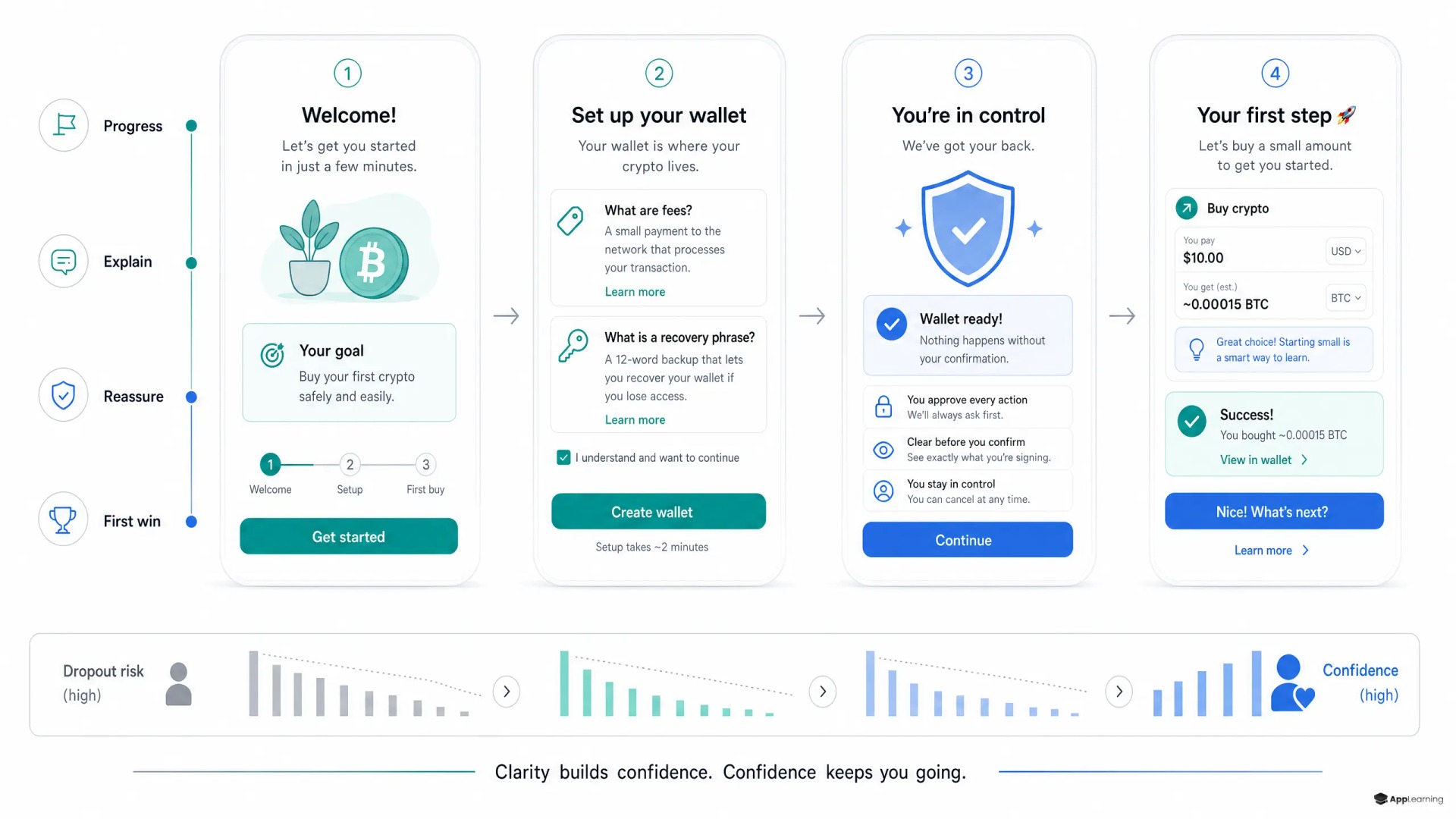
Confidence belongs in the onboarding model
A better onboarding model treats confidence as a growth metric, not a soft brand outcome. Completion alone is too narrow. A user can finish onboarding and still feel unsure, avoid the first purchase, abandon wallet setup, or return to support with basic questions. That is not real activation. It is mechanical progression without durable readiness.
Product teams should pair standard funnel metrics with confidence signals. These signals do not need to be complex. They need to be close to the moments where hesitation appears.
- Self-rated readiness after key lessons or decisions
- Quiz accuracy on Bitcoin basics, custody, fees, and security
- Drop-off points after risk-heavy screens
- Return visits to explanatory content before first action
- Support volume by beginner question category
- Conversion from learning completion to first meaningful product action
- Retention after first buy, first transfer, or first recurring setup
This changes the operating rhythm. Instead of asking only where users drop, the team asks what they did not yet understand. Instead of making every screen shorter, the team makes key decisions clearer. Instead of hiding education in a blog or help center, the product places learning where confidence is about to break.
Education works when it sits inside the journey
Financial education is not just content. The OECD defines it as a process that helps people improve their understanding of financial products, concepts, and risks while developing the skills and confidence to make informed choices in its digital financial literacy framework. That definition matters for Bitcoin products. A glossary page may inform. A guided sequence can build readiness.
Embedded education performs a different job from marketing content. It reduces cognitive load at the point of action. A short lesson before wallet setup can explain custody. A two-question check before recurring buys can confirm that the user understands volatility. A contextual module after KYC can explain why verification exists and what happens next. A practice interaction can make recovery phrases less abstract before the user handles real keys.
This does not mean turning the product into a course. It means designing small learning interventions that protect momentum. The lesson should be short. The quiz should prove comprehension. The reward should reinforce progress. The next product step should feel earned, not forced.
Good to know
How can a Bitcoin company improve crypto onboarding for beginners?
Start by identifying the moments where users hesitate, then add short explanations, guided choices, and comprehension checks directly before those moments.
Where should education appear in the onboarding journey?
Education should appear before high-friction actions such as KYC, first buy, wallet setup, recovery phrase handling, recurring buys, and withdrawals.
Which metrics show whether confidence is improving?
Useful metrics include readiness ratings, quiz accuracy, lesson completion, support-ticket reduction, first-action conversion, feature adoption, and retention after the first transaction.
Should crypto onboarding education replace risk disclosures?
No. Education should make disclosures easier to understand, not replace legal or compliance requirements.
A practical system for Bitcoin teams
For a Bitcoin company, confidence-building education should be modular. Different users arrive with different knowledge levels. A complete beginner needs first-principles explanations. A returning user may only need a refresher on fees, self-custody, or recurring buys. A user in a new market may need localized examples, local payment context, and clearer regulatory language.
The operating system should include five parts.
- Map the moments where users hesitate, pause, or contact support.
- Define the knowledge required to continue safely at each moment.
- Create short lessons that explain only what the next action requires.
- Use quizzes, confidence checks, and progress data to measure readiness.
- Localize modules without rebuilding the full onboarding experience.
This is the space App-Learning works in. The platform is built for customer and employee education, with short lessons, quizzes, certificates, gamified mechanics, analytics, and product entry points through deep links or embeds, as described on the App-Learning platform page. The important part is not the format alone. It is the system around it: content that can be produced, reviewed, localized, measured, and updated without pulling product teams away from core execution.
A concrete example is the Invity Academy. App-Learning helped build an in-app Bitcoin learning experience with 19 lessons, 6 quizzes, bilingual content, illustrations, certificates, and contextual product calls to action; the Invity case study describes how the academy moved education from static channels into the product journey. That pattern is useful for Bitcoin teams because it connects understanding to action without asking beginners to leave the app to learn.
Build confidence into your Bitcoin onboarding.
TalkThe first transaction is not the finish line
The goal of crypto onboarding is not to rush a beginner into a transaction. It is to help a user become capable enough to make the next decision with awareness and control. That is a higher bar than access, but it is also a better growth strategy.
A confident user is more likely to return, explore, ask better questions, adopt deeper features, and trust the product during volatile periods. A confused user may complete a step today and disappear tomorrow. Bitcoin companies that understand this will stop treating education as a side channel. They will build it into the product system, measure it like activation, and use it to turn complexity into durable user confidence.