

Key takeaways
- DORA makes resilience training a mandatory control.
- Training depth should match real role exposure and decision rights.
- Senior management is explicitly in scope.
- Weak evidence can become a supervisory problem.
The training line just moved into the control framework
Since DORA entered into application on 17 January 2025, cyber training for in-scope financial entities has sat inside the operational resilience regime, not beside it. That matters at leadership level because Regulation (EU) 2022/2554 makes the management body responsible for defining, approving, overseeing, and implementing the ICT risk-management framework.
Many financial scaleups still run one annual awareness module and a phishing exercise and call it covered. Under DORA, that model is too weak. The issue is no longer whether training exists, but whether it is role-based, mandatory, documented, and defensible under scrutiny. That is the broader shift behind Why Learning Is Becoming Strategic Infrastructure.
Article 13(6) turns awareness into a compulsory control
The legal pivot sits in Article 13(6) of DORA. It requires financial entities to build ICT security awareness programmes and digital operational resilience training into staff training schemes as compulsory modules, and it explicitly brings both employees and the management body into scope.
That changes the baseline. Training is no longer a discretionary awareness campaign owned by HR or security alone. It becomes part of the controlled operating model, which means leadership needs visibility into coverage, recurrence, exceptions, and remediation.
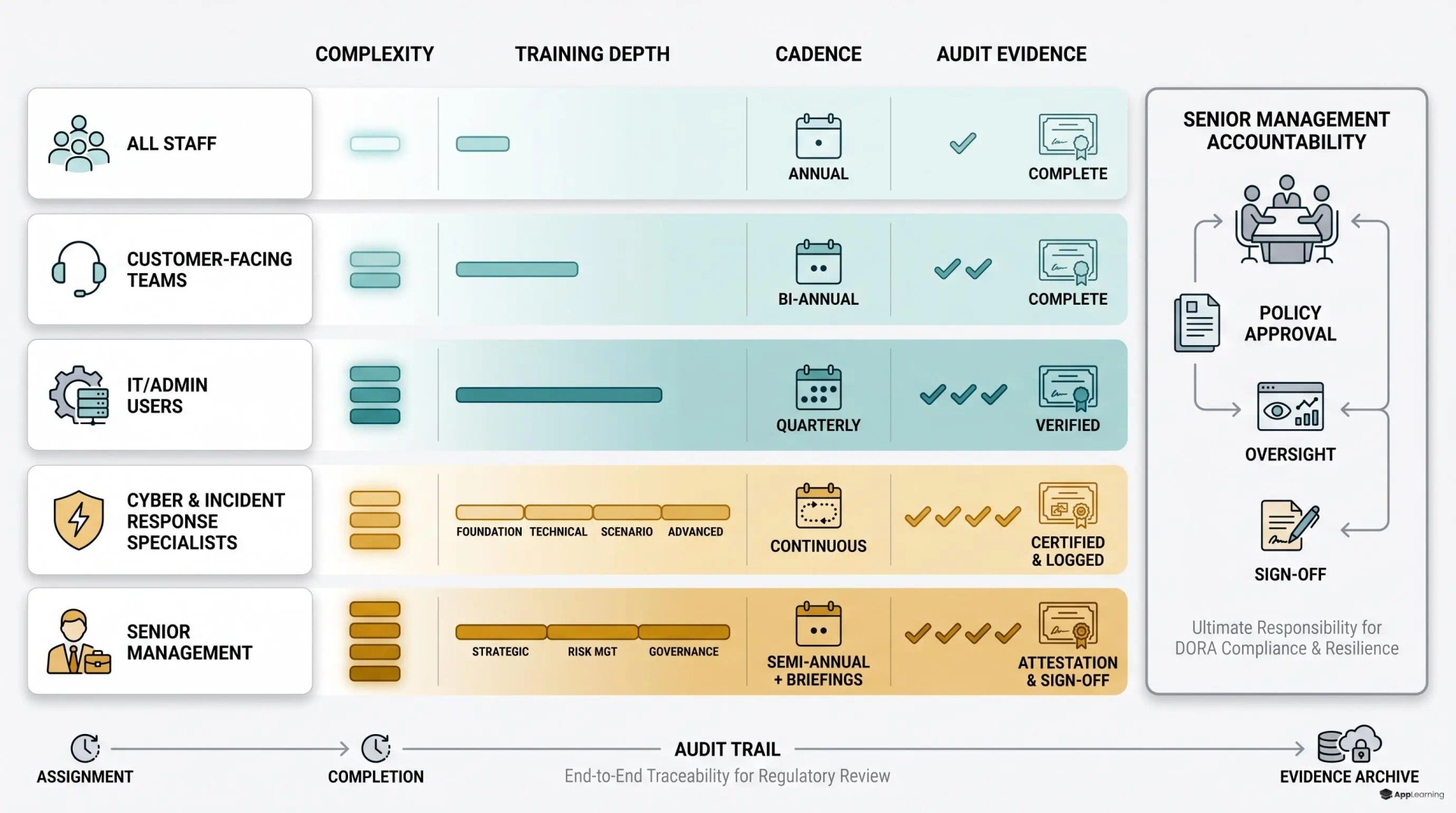
The real audience extends from staff to the management body
DORA does not reserve this obligation for security specialists. It reaches the people who approve outsourcing, sign off incidents, make change decisions, and own customer-impacting processes, while the management body's governance duties under DORA make senior leadership impossible to carve out of the training plan.
This is why role complexity matters more than course volume. Boards need decision-grade training on accountability, crisis escalation, third-party concentration, and resilience trade-offs. Engineers need material tied to secure design, change, and dependency risk. Operations, finance, and customer teams need clear routines for escalation, continuity, and incident response. It is the same structural shift described in Why Skills Policy Is Becoming Economic Policy: capability is increasingly treated as part of resilience capacity, not a soft support layer.
Good to know
Does DORA require training for senior management?
Yes. Article 13(6) brings the management body into the training obligation, and DORA's governance provisions make that body responsible for the ICT risk-management framework.
Is a generic annual cyber awareness module enough?
Usually not. DORA points toward compulsory training that matches actual roles, risk exposure, and governance responsibility rather than one uniform module for every employee.
What makes training auditable under DORA?
A defensible program can show role mapping, mandatory assignment, versioned content, completion and exception records, and a refresh cadence tied to changes in role or risk.
Can firms be sanctioned for getting this wrong?
Yes. DORA's enforcement chapter requires Member States to provide administrative penalties or remedial measures for breaches through competent authorities.
Evidence turns awareness into a defensible system
Auditable training is not defined by how many modules sit in an LMS. It is defined by whether the firm can evidence that the right people received the right training at the right depth and on the right schedule. In a DORA context, a defensible setup usually includes:
- A role map that ties job families and seniority to concrete ICT and resilience risks
- Mandatory assignment rules, including separate pathways for the management body
- Version-controlled content mapped to policy, control, or scenario changes
- Completion, assessment, and exception logs that survive audit sampling
- A refresh cycle triggered by role change, control change, or incident learning
This is where many firms fail. They can show content, but not obligation logic. They can show completions, but not why one role received a deeper module than another. They can show annual training, but not how gaps were escalated. That matters because DORA requires Member States to equip competent authorities with administrative penalties and remedial measures for breaches, and to publish certain penalty decisions.
See how structured training can support DORA readiness.
ExploreExecution starts with governance, not content procurement
For leadership teams, the first move is governance design. Decide who owns the training control end to end, how role taxonomy is maintained, what evidence is retained, and what dashboard the board or executive committee sees. The EBA describes DORA as the harmonised ICT risk-management framework applying from 17 January 2025, so fragmented ownership is harder to defend.
- Map each critical role to the decisions and ICT risks it actually carries
- Separate leadership training from workforce-wide awareness instead of reusing one generic module
- Define the evidence trail before rolling out content
- Set refresh and remediation rules for missed training, role changes, and incident-driven updates
If you are still procuring awareness content as a standalone annual package, you are solving the wrong problem. The real requirement is a repeatable training control with assignment logic, governance, and proof. That is where App-Learning can help by structuring role-based learning paths and keeping the evidence trail needed for DORA readiness.
DORA does not ask financial firms to be more aware in the abstract. It asks them to show that resilience capability is built, assigned, refreshed, and overseen. Teams that treat training as an auditable part of operational resilience will be able to defend their position. Teams that keep it as a side task will struggle when supervisors ask for evidence.