

Key takeaways
- MiCA turns disclosure quality into a visible trust signal.
- Compliant documents still fail when users cannot decode them.
- Machine-readable white papers increase consistency pressure across product and marketing.
- Education-led onboarding can improve acquisition quality before spend scales.
MiCA pulled trust into growth
Too many crypto fintechs still treat regulation as back-office insurance. But MiCA’s full entry into application on 30 December 2024 changed the market signal that users see when they compare platforms.
That signal is still getting sorted in public. On the ESMA MiCA overview page, the regulator makes clear that some Member States can use transitional measures that let existing firms continue until 1 July 2026 or until authorisation is granted or refused. In a market with mixed regimes, trust does not come only from being regulated. It comes from making regulatory status and product risk legible to the customer faster than competitors do.
For growth teams, that changes the job. Acquisition is no longer only about reach, CAC, and creative. It is also about whether a prospective user can understand what the product is, what the token does, what the risks are, and why this platform is safer to start with than the next tab in their browser.
Disclosure became a product surface
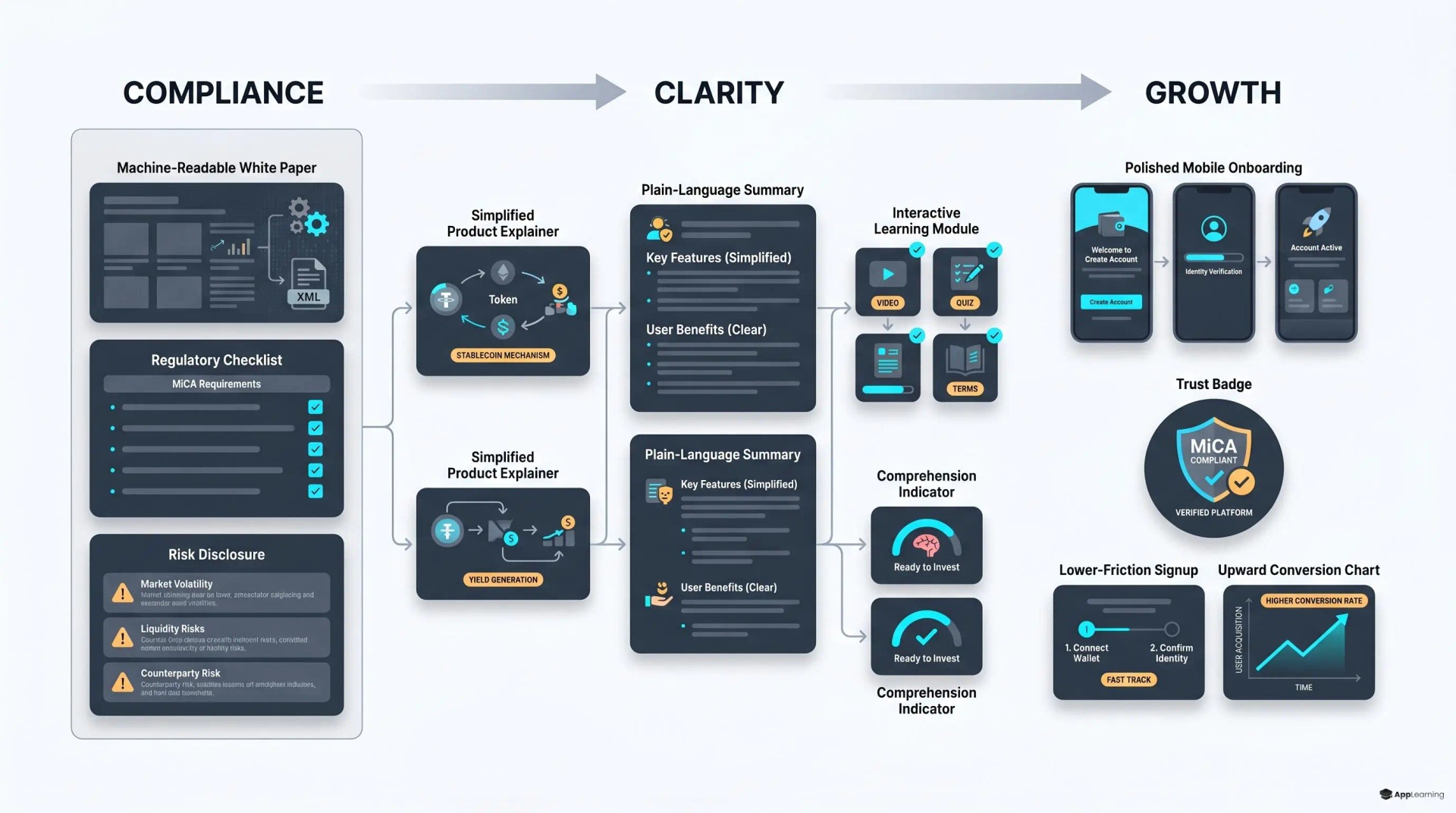
The biggest shift is structural. Commission Implementing Regulation (EU) 2024/2984 requires MiCA white papers to be prepared in XHTML with Inline XBRL and says the information must be non-discriminatory, fair, clear, not misleading, concise, and comprehensible. That is not a small formatting tweak. It raises the quality bar for every public explanation that sits around the product.
ESMA’s MiCA white paper proof of concept makes the direction obvious. The regulator is pushing toward disclosures that humans can read and machines can parse. Once that becomes the norm, the white paper stops being a static legal PDF and starts acting like a canonical data object that other surfaces can be checked against.
- Homepage claims need to match the formal disclosure language.
- Risk summaries need to stay consistent across onboarding and support.
- Product education can no longer drift from the source document without creating trust debt.
The market still does not understand the documents
This is where many teams miss the real opportunity. A compliant disclosure is not the same as a usable explanation, and Article 15 on liability for the information given in a crypto-asset white paper is a reminder that explanation quality is not a cosmetic issue.
Investors should fully understand the risks before engaging in this space.
The conversion problem sits in the gap between legal completeness and customer comprehension. A user who does not understand custody, reserve logic, token utility, redemption conditions, or service limitations will hesitate, abandon, or convert with the wrong expectations. None of those outcomes help growth.
Structured disclosures raise the trust benchmark
ESMA has been explicit that new MiCA rules are meant to increase transparency for retail investors. That matters commercially because transparency is no longer judged only by whether a document exists. It is judged by whether the same story shows up consistently in the white paper, the landing page, the onboarding flow, the help center, and the risk prompts.
The same ESMA MiCA framework now points to registers for white papers, authorised crypto-asset service providers, and non-compliant entities. Once disclosure and authorisation status are organised this way, inconsistency becomes easier to spot and harder to explain away.
Some platforms are already treating white papers as a visible user-facing resource rather than a buried legal file. Kraken’s asset listing whitepapers hub is a useful signal of where the market is moving. Discoverability itself is becoming part of trust messaging.
Good to know
Does MiCA make customer education a growth responsibility?
Yes. Legal still owns the source text, but growth now owns many of the user-facing surfaces where that meaning is interpreted, including landing pages, onboarding, and support content.
Do MiCA white papers need to be machine readable?
Yes. Commission Implementing Regulation (EU) 2024/2984 sets the format requirement around XHTML and Inline XBRL, and ESMA’s proof of concept shows how that machine-readable approach is meant to work in practice.
Is a compliant white paper enough to build trust?
No. Compliance can satisfy disclosure obligations, but users still need plain-language explanations that help them understand product mechanics, risk, and suitability before they act.
Why should teams move now if some transition periods still exist?
Because the transition is already public. MiCA has applied in full since 30 December 2024, and some grandfathering measures can run until 1 July 2026. That means customers are already comparing firms with different levels of visible regulatory maturity.
Education is the conversion layer
This is the growth move most teams have not made yet. If MiCA gives you a clearer source of truth, education is the layer that turns that clarity into acquisition and onboarding value. The goal is not to rewrite legal text into softer copy. The goal is to translate it into formats that reduce uncertainty before the customer hits KYC or deposit friction.
- A plain-English asset explainer that mirrors the white paper without copying its density
- Short risk cards that explain downside, eligibility, and product limits in human terms
- Glossary layers inside onboarding for terms such as custody, issuance, reserve, redemption, and staking
- Scenario-based help content for first deposit, first trade, withdrawal, and support escalation
- A visible changelog when disclosures, token availability, or platform treatment changes
When this works, compliance stops acting like drag. It becomes a trust accelerator. Better educated users self-qualify earlier, understand the product faster, and enter onboarding with fewer false assumptions. That improves acquisition quality even before it improves raw conversion.
Turn compliance clarity into onboarding that converts.
TalkThe operating model growth teams need now
Growth teams should stop waiting for the legal team to finish a document and hand it over at the end. ESMA was still publishing implementation support on MiCA standards and format in November 2025, which tells you exactly what this environment is now. The disclosure layer is operational. It needs an operating model, not a one-off upload.
- Audit every public explanation surface against the formal white paper and risk language.
- Build a plain-language layer for each core asset and service before paid traffic scales.
- Embed explanation modules inside onboarding instead of pushing all complexity into a legal footer.
- Test sequence, timing, and depth of risk education just like any other activation variable.
- Create a cross-functional workflow so legal owns source truth, product owns context, and growth owns delivery and measurement.
This is where App Learning fits the problem well. The hard part is not producing more content. It is turning dense regulatory source material into modular learning objects that can live inside landing pages, onboarding, CRM flows, and support systems without drifting from the canonical explanation.
Under MiCA, the company that explains risk best may acquire better users than the company that shouts loudest. Regulatory clarity is becoming visible market behavior. The teams that reduce the distance between white paper and first deposit will build trust earlier, qualify users better, and waste less spend on people who were never ready to convert.