

Key takeaways
- Judge a crypto content agency on business fit, not output volume.
- Strong partners understand the product, user journey, and trust barriers.
- Useful deliverables span acquisition, onboarding, product education, and support.
- Product-aware content should be measurable, maintainable, and easy to update.
Output volume is the wrong buying criterion
A crypto content agency can publish articles every week and still miss the business problem. In crypto products, the hard part is not creating more words. The hard part is reducing doubt at the moment a user has to act. A buyer wants to know whether the product is safe, how fees work, what custody means, why a savings plan matters, and what happens if they make a mistake.
Measured usage shows the gap. The Federal Reserve's 2025 household report found that 8% of U.S. adults used cryptocurrency for any purpose in 2024, while 7% bought or held it as an investment and 2% used it to make a transaction. That does not mean the category lacks interest. It means interest is not the same as confident use.
This is where many content programs fail. They treat content as a traffic machine. The brief becomes a list of keywords, titles, and deadlines. The team gets output, but not clarity. Support still answers beginner questions. Users still hesitate during onboarding. Product features still need repeated explanation. Compliance still worries about claims that sound clean in a blog post but do not match product reality.
The agency must understand the product
A serious crypto content agency starts with the product map, not the editorial calendar. It has to understand the user journey, the account model, the custody model, the risk disclosures, the fee logic, the support themes, the activation points, and the features the business wants users to adopt. Without that context, the agency is guessing.
The first deliverable should often be a content diagnosis. That means mapping what users need to understand before they can move from curiosity to action. For a crypto product, this may include the difference between buying and holding, the reason a recurring plan exists, the trade-off between custodial and self-custody flows, or the steps needed to send over Lightning.
- Define the user segments and their knowledge levels.
- Map learning moments to product screens and lifecycle stages.
- Identify trust barriers that block activation or repeat usage.
- Create a source of truth for claims, terms, risk language, and examples.
- Agree on review workflows with product, compliance, support, and marketing.
The agency should ask uncomfortable questions. What action should this content support? Which misconception is causing friction? Which feature is underused because users do not understand the value? Which claims are off limits? Which terms must be localized with care? If the agency cannot ask those questions, it is not ready to work close to the product.
Generic writing breaks at the moment of use
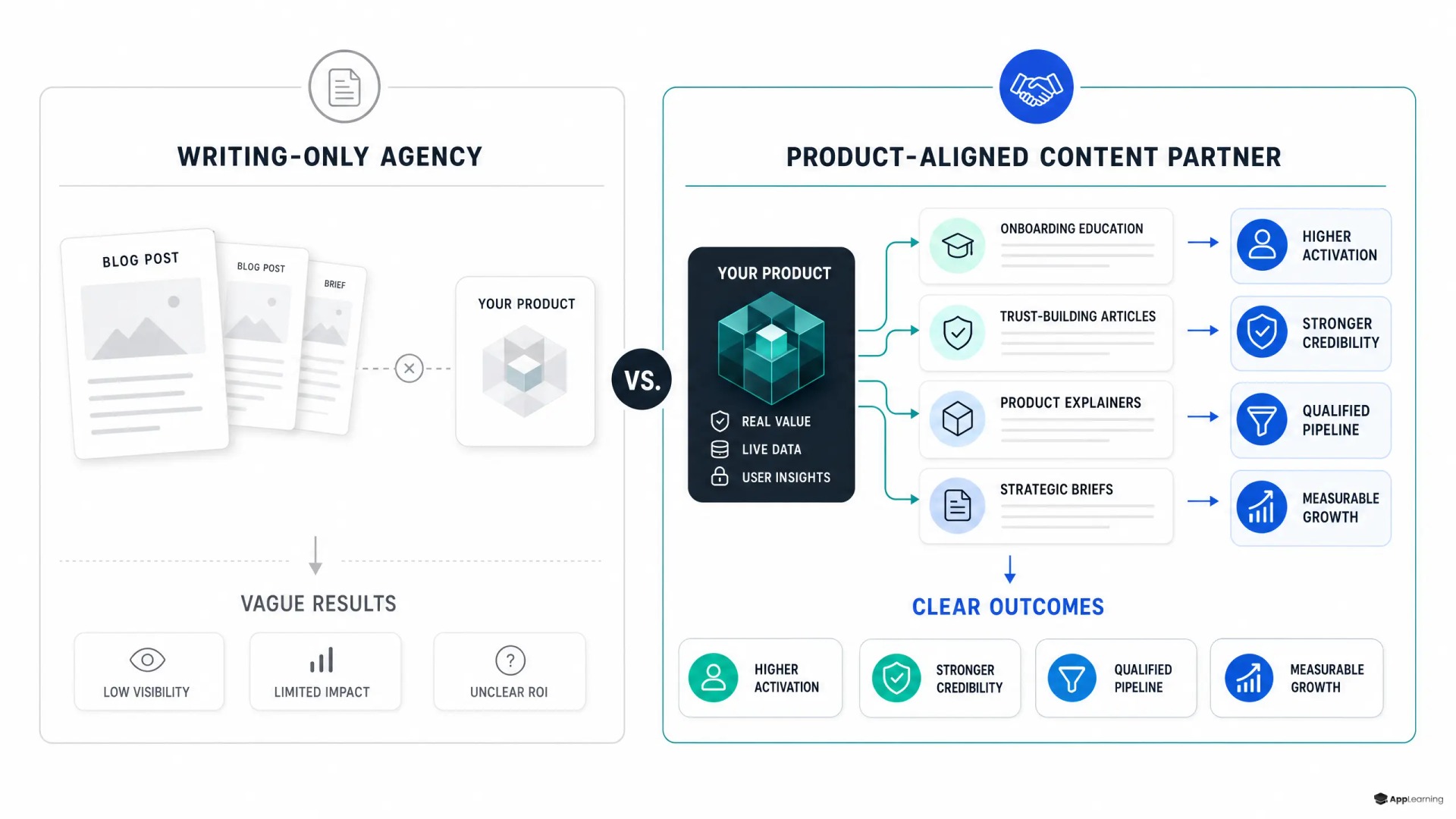
Generic writing support can produce readable content. That is useful, but not enough. Product-aware content has to survive contact with the app. It has to fit the screen, the user's state of mind, the compliance boundary, and the next action.
- Generic support writes a custody article. Product-aware support explains custody during wallet setup and checks whether the user understands seed phrase responsibility.
- Generic support writes a crypto beginner guide. Product-aware support turns the guide into onboarding lessons, quiz checks, glossary entries, and contextual help.
- Generic support optimizes for search intent. Product-aware support connects search intent to activation, first purchase, recurring buy setup, or feature adoption.
- Generic support delivers copy. Product-aware support delivers a system that product, support, and growth teams can reuse.
This distinction matters because crypto content is not neutral information. It shapes risk perception. It influences user behavior. It can reduce support load or create new confusion. It can make the product feel safer, or it can overpromise and create trust debt. The better the content fits the product, the less the business has to compensate through support, sales, or manual onboarding.
The useful deliverables sit across the funnel
A crypto content agency should not define scope as blog posts. Blog posts can support acquisition, but they are only one layer. The content system has to work across acquisition, onboarding, activation, retention, and support. For crypto products, the most valuable content often lives close to the product itself.
- Search content that explains the category without hype.
- Landing page education that sets correct expectations before signup.
- Onboarding modules that build confidence step by step.
- In-app explainers triggered by hesitation, errors, or advanced feature entry points.
- Gamified lessons, quizzes, and certificates that make progress visible.
- Glossaries that reduce terminology friction inside the product.
- Lifecycle emails and push messages that reinforce useful habits.
- Support-deflection content based on real tickets and common misconceptions.
- Localization-ready modules for new markets and user groups.
For mobile-first retail journeys, the form matters as much as the argument. Long articles are poor tools when a user is one screen away from a first purchase or a wallet action. Short lessons, swipe formats, checkpoints, and contextual prompts can teach just enough at the right time. The goal is not to make every user an expert. The goal is to give each user enough understanding to take the next safe step.
Good to know
How should a crypto company evaluate a crypto content agency?
Look for product understanding first. The agency should ask about onboarding, activation, support tickets, compliance review, feature adoption, and user trust before it proposes an editorial calendar.
Should crypto education live in the blog or inside the product?
Both can matter, but product-close education is often more useful for activation. Blog content can create awareness, while in-app lessons, tooltips, quizzes, and contextual explainers help users act with confidence.
What deliverables should be included beyond articles?
Useful deliverables can include content strategy, onboarding modules, in-app education, glossary systems, lifecycle messaging, quizzes, localization-ready lessons, support content, and analytics on learning progress.
How is product-aware content different from freelance writing?
Freelance writing often solves the writing task. Product-aware content solves the user comprehension task by connecting copy, learning design, product flows, claims, review workflows, and measurable outcomes.
Measurement changes the brief
If no one defines measurement, content quality becomes subjective. Product teams need better signals. A useful agency should help define what each asset is meant to improve and how the team will know whether it worked. That does not mean every article needs a direct revenue target. It means the content should have a role in the system.
- Onboarding completion by segment.
- Drop-off after specific educational screens.
- Quiz completion and wrong-answer patterns.
- Support ticket volume for beginner topics.
- Activation after lesson completion.
- Adoption of advanced features after contextual education.
- Retention differences between educated and non-educated cohorts.
- Localization speed and update effort per market.
The difference becomes visible in real implementations. In App-Learning's Bitsonauts Academy case, repeated expert workshops became a structured academy with a reported 90% course-certification rate across departments. In the Invity Academy case, education moved inside the app through 19 lessons, 6 quizzes, bilingual content, and contextual product calls to action.
We achieved a 90% course-certification rate among employees, ensuring they have the minimum crypto knowledge we expect of them.
Product education is a content operating system
The best agency output is maintainable. Crypto products change. Features ship. Fees change. Regulations influence wording. New markets need translation. New support patterns appear. A content partner should help create the operating system behind the assets, not just the assets themselves.
- A single source of truth for core explanations.
- Reusable content modules for blog, app, academy, and support.
- Approval flows that include product and compliance early.
- Modular localization so markets are not rebuilt from scratch.
- Analytics loops that show where users understand and where they struggle.
- Update routines for product releases and policy changes.
This is also where AI-supported content systems help, if they are used correctly. AI can speed outlines, drafts, variants, quiz generation, and localization. It should not replace expert review. In crypto, unchecked automation can create precise-sounding errors. The safer model is hybrid: structured inputs, AI-assisted production, human review, product validation, and measurable rollout.
Build crypto education your users can finish.
TalkWhere App-Learning fits for crypto teams
App-Learning sits in the product education layer. Its platform combines content authoring, learning management, and engagement-first learning experiences for employee and customer education. The operating idea is simple: complex financial topics need short, interactive learning that can be launched, measured, and maintained without forcing internal teams to build a full academy from scratch.
The team's own Simple Bitcoin product shows the same pattern in a direct-to-user format. The Simple Bitcoin app uses short lessons, swipe-based explanations, quizzes, a Bitcoin glossary, certificates, and Lightning-based rewards to make Bitcoin easier to understand for beginners. That experience matters when building education for fintech teams, because the constraints are real: short attention spans, high trust barriers, mobile screens, and users with very different starting knowledge.
The decision is not whether to outsource content. The decision is whether the partner can join the product operating rhythm. A good crypto content agency does not sell pages. It should help product teams turn complex Bitcoin and crypto concepts into trust, understanding, and product use.