
Key takeaways
- Learning supports daily operational readiness, not occasional training events.
- Infrastructure thinking shifts design from content delivery to capability deployment.
- Repeatability and measurement determine whether learning can scale.
- Capability systems create leverage across onboarding, compliance, and change adoption.
Learning is still often budgeted like an event and judged like a content function. That frame is too small. If the business depends on people doing certain things correctly every day, then the system that builds and refreshes that capability is not support work. It is part of how the business runs.
Infrastructure is defined by dependency, not visibility
Infrastructure is what work leans on quietly. Payroll, identity, CRM, permissions, analytics, quality controls. Nobody celebrates them in normal operation, but the minute they fail, execution slows or stops. Learning crosses into that category when it reliably turns people into role-ready operators and keeps them current as conditions change.
This is already obvious in compliance and safety. OSHA requires employers to train workers who face job hazards before they perform that work. In other words, the organization cannot separate capability from execution. Training is already functioning as an operational control.
- It is tied to roles, workflows, and decision points.
- It can be updated quickly when products, policies, or tools change.
- It produces evidence of readiness, not just proof of attendance.
- It reinforces behavior after launch instead of ending at publish time.
Learning already sits inside the operating model
Onboarding is the clearest example. New hires do not ramp because an LMS checklist turns green. They ramp when access, process knowledge, product context, practice, and manager feedback arrive in the right sequence. That sequence is infrastructure because revenue, service quality, and error rates depend on it.
The same pattern shows up whenever the business changes. In the 2025 Work Trend Index, Microsoft reports that 82% of leaders see 2025 as a pivotal year to rethink strategy and operations, while 81% expect AI agents to be integrated into company AI strategy within 12 to 18 months. When change moves at that pace, the bottleneck is no longer information. It is workforce uptake.
The talent side tells a similar story. LinkedIn’s 2025 Workplace Learning Report says only 36% of organizations qualify as career development champions, yet that group reports stronger confidence in profitability, talent attraction, retention, and advanced generative AI adoption. That is the signature of infrastructure: it improves multiple business outcomes at once.
- Onboarding and time to first productive action
- Compliance and safety-critical role readiness
- Product launches, pricing changes, and process rollouts
- Manager calibration and frontline coaching
- AI adoption and tool usage in the flow of work
Courses are assets but systems create capability
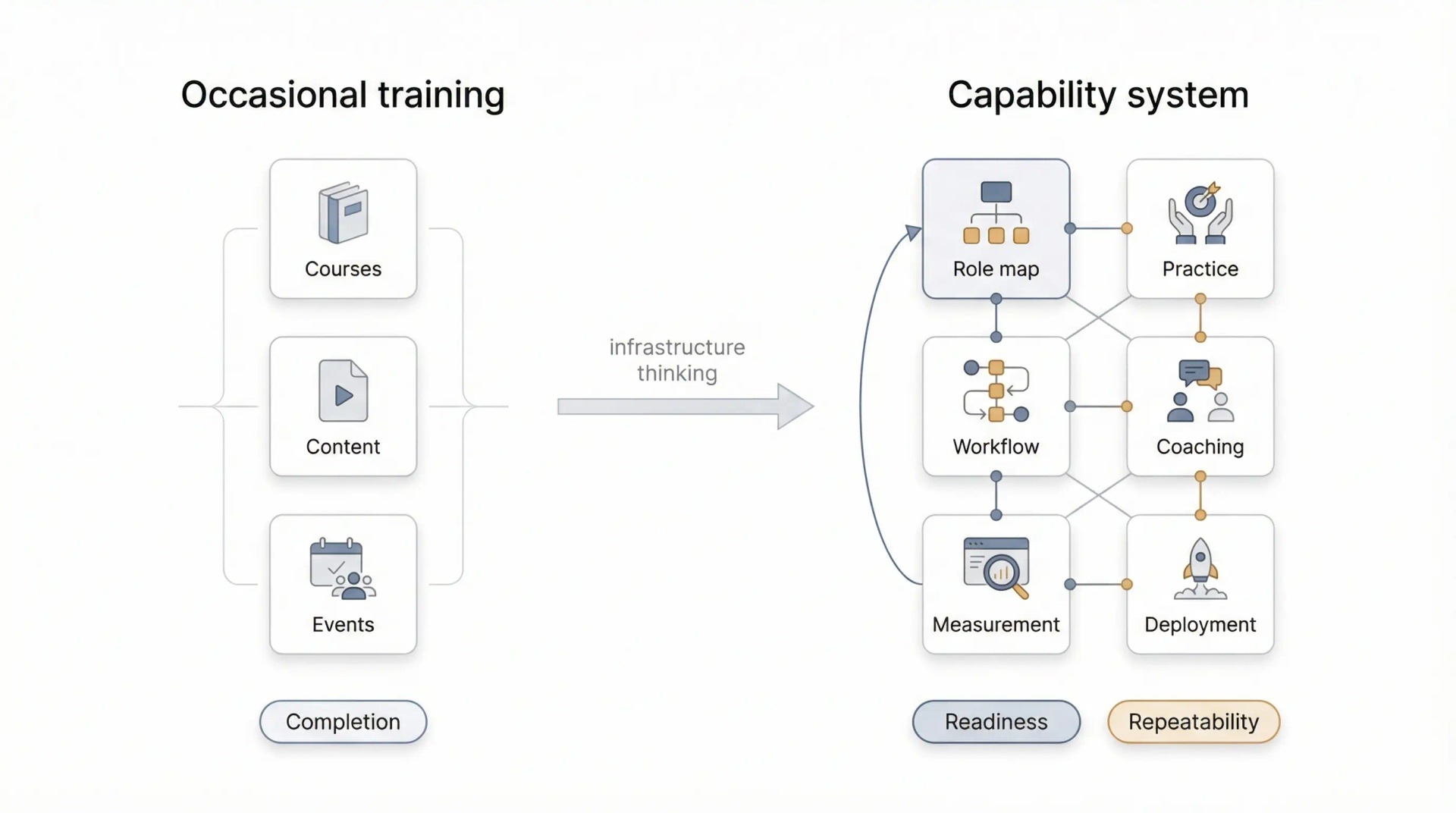
Most learning functions are still organized around asset production. They ship modules, decks, paths, certifications, and events. Those assets matter, but assets are components, not the system. Infrastructure design starts one layer lower: what must someone be able to do, under what conditions, with which supports, and how will the business know that the behavior actually transferred?
That shift changes design choices immediately. Content gets shorter, more role-specific, and easier to update. Practice moves closer to live work. Reinforcement stops being optional. Managers, prompts, job aids, and system nudges become part of the learning design because capability is not created at the moment a course is assigned.
- Start with the critical workflow, not the course outline.
- Design for recurrence, because capability decays and operations change.
- Instrument readiness with lightweight signals that teams can actually use.
- Build reinforcement into manager routines and app surfaces.
- Treat version control as a core learning requirement, not an admin detail.
Enablement needs an operating model, not a content queue
If learning is infrastructure, enablement teams should stop presenting themselves as internal studios waiting for requests. The job is to build capability supply chains: define readiness states for critical roles, reduce time to competence, support launches, and keep execution aligned when the business changes.
This also changes measurement. Completion rates and satisfaction scores tell you whether content was consumed. They do not tell you whether capability was deployed. Better measures are ramp speed, policy adherence, error reduction, manager confidence, repeatable task quality, and adoption depth in the tools people actually use.
This is where App-Learning fits naturally. Used well, it becomes the system layer that makes repeatable capability-building visible inside daily work. Instead of scattering learning across isolated events, it connects content, practice, nudges, evidence, and updates into one operating environment that teams can scale and measure.
See how App-Learning makes capability systems visible and measurable.
ExploreFrom training calendar to capability backbone
The strategic case for learning will not be won by calling learning important. It will be won by showing that execution now depends on fast, repeatable capability deployment. Once that becomes the frame, the design brief changes from courses and campaigns to systems and controls. The organizations that move first will not just train faster. They will adapt faster because they can update human capability with the same discipline they apply to software, process, and risk.
Good to know
When does learning become infrastructure?
It becomes infrastructure when business performance depends on it every day and the system can repeatedly build, refresh, and verify readiness for critical roles.
Do courses still matter in this model?
Yes. Courses remain useful assets, but they only create leverage when they sit inside a broader system of practice, reinforcement, manager support, and measurement.
What should enablement teams measure first?
Start with one critical role or workflow and track time to competence, error rate, and manager confidence. Those measures connect learning activity to operational execution.
Where does App-Learning create leverage?
It creates leverage when it becomes the operational layer for practice, reinforcement, updates, and evidence inside the flow of work.