

Key takeaways
- AI-native education needs learning loops, not only answer access.
- Chatbots work best inside structured journeys with checks and practice.
- Microlearning gives AI the small signals needed for useful personalization.
- Finance and crypto teams can pilot this without replacing the LMS.
The chatbot became the shortcut
Many teams will start their AI learning strategy by adding an LMS chatbot. The reason is clear. Chat feels natural. Employees can ask questions in plain language. Admins can reduce repetitive support. Content becomes easier to search. EDUCAUSE lists virtual assistants, chatbots, personalized learning, and learning analytics among common uses of AI in higher education, and LMS vendors are now embedding these features directly into learning environments.
The market signal is strong. D2L announced Lumi Chat, Lumi Tutor, and study support features inside Brightspace during its Fusion 2025 product updates. Blackboard now documents AVA as an AI virtual assistant that helps learners move through a course. This is useful. But an interface is not a learning system.
For finance and crypto companies, that distinction matters. Regulated teams do not only need content access. They need evidence that people understand the rule, can apply it in context, and can prove completion when needed. FINRA describes the Firm Element as a formal training program based on an annual needs analysis and written training plan with records of content and completion in its continuing education guidance. ESMA has also published MiCA guidelines for assessing staff knowledge and competence at crypto-asset service providers.
Access without structure creates false confidence
A chatbot can answer a question. It does not automatically know whether the learner asked the right question. It may not reveal a missing prerequisite. It may not create practice. It may not bring the learner back next week when memory decays. It may not show a manager whether a team is ready for a policy change, a product launch, or an audit.
Even the support documents for Blackboard’s AVA tell learners to review responses carefully because AI-generated responses may be incomplete or inaccurate, and the assistant is controlled by institutional and instructor settings in Blackboard LMS. That is the right warning. In regulated learning, the problem is not only hallucination. The deeper problem is shallow confidence.
AI-native education is a learning loop
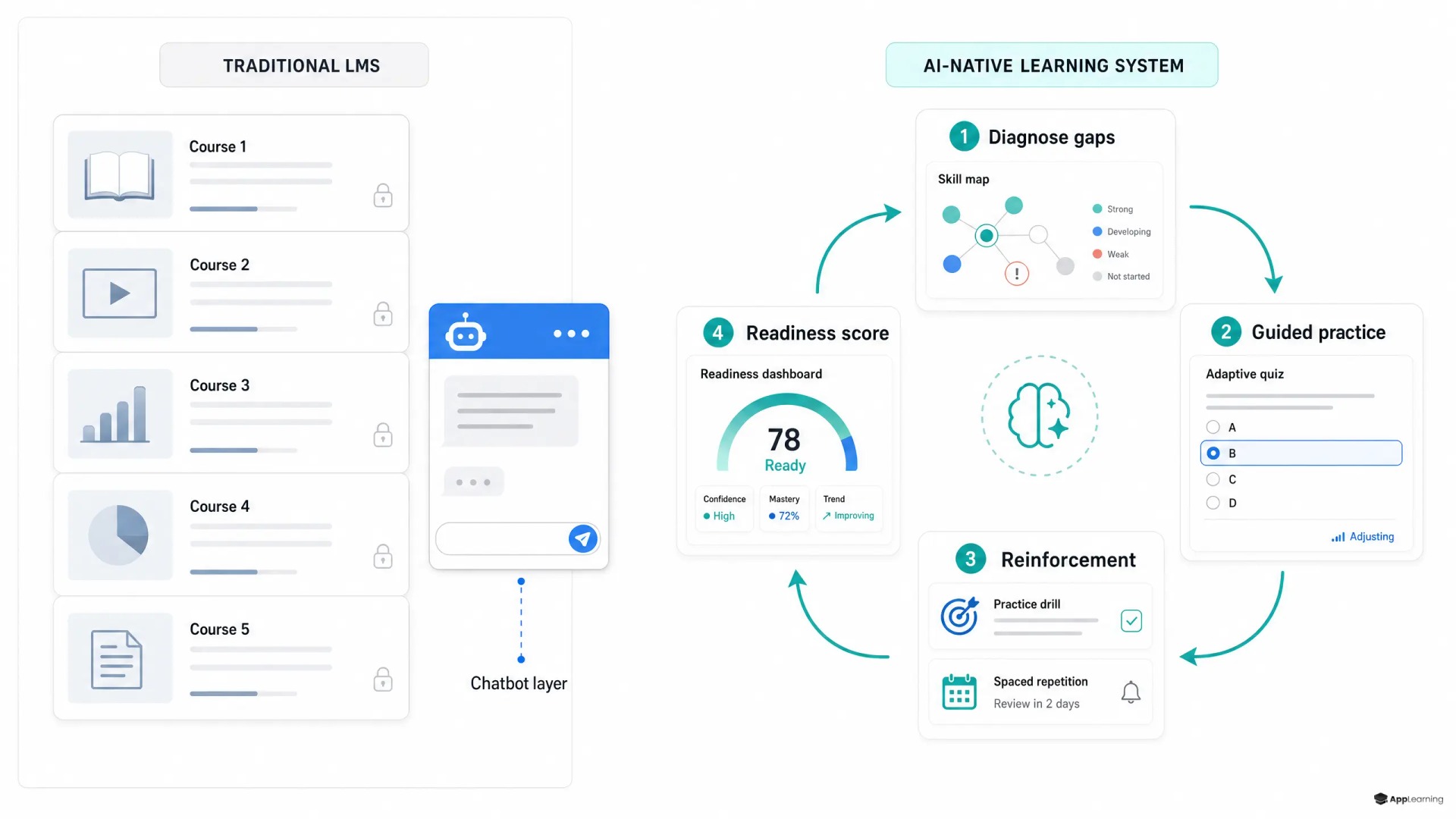
AI-native education starts from a different design. It treats learning as a loop, not as a library with a chat box. The system must do five jobs well:
- Diagnose what the learner already knows and where the gaps are.
- Guide the learner through the shortest useful path.
- Create practice through questions, scenarios, and decisions.
- Reinforce knowledge over time with timely repetition.
- Measure readiness by role, team, topic, and business outcome.
This changes the work of L&D. The task is no longer only to publish courses. It is to maintain a skills map, define readiness thresholds, design good checks, and connect learning data to operational risk. A serious AI learning platform should see missed questions, route learners to the right micro-lesson, trigger a refresher, and show whether a team is improving.
Microlearning gives the model useful signals
Personalization needs small, reliable units. A two-hour compliance module is hard to adapt. A five-minute lesson with one concept, one scenario, and one check creates a cleaner signal. Research on spacing and retrieval practice shows that learning improves when people return to material and actively recall it, not when they only reread or rewatch it in one block in effective learning research.
That is why a microlearning platform fits AI-native education. Each unit can carry metadata: topic, role, difficulty, policy area, confidence, quiz result, scenario choice, and time since last recall. AI can then personalize with evidence. It can guide a payments analyst differently from a customer support agent. It can reinforce market abuse rules before a campaign. It can make onboarding faster without removing structure.
Good to know
Is an LMS chatbot still useful?
Yes. It can improve search, answer common questions, and reduce support load. It becomes much more valuable when it is connected to a structured learning path with checks, practice, and reinforcement.
Do we need to replace our LMS to build AI-native education?
No. Most teams should start with a focused academy layer beside the LMS. The existing LMS can remain the system of record while the new layer handles engagement, practice, analytics, and readiness signals.
What makes microlearning useful for AI personalization?
Microlearning breaks training into small units that can be tagged, checked, and improved. This gives AI better signals about gaps, difficulty, role relevance, confidence, and retention over time.
How should readiness be measured in regulated teams?
Measure more than completion. Use scenario performance, quiz accuracy, confidence, repeat recall, role-based progress, certificate status, and manager-level visibility into team gaps.
Start beside the LMS
Teams do not need to migrate the LMS to start. A better first move is one high-value use case. Choose anti-fraud training, new analyst onboarding, crypto fundamentals, product compliance, or customer-risk workflows. Define the readiness outcome. Convert the source material into a short path. Add checks and scenarios. Launch to one cohort. Compare gaps, completions, confidence, and assessment results before scaling.
This is where App-Learning fits. A branded academy can sit beside the existing stack and focus on the part the LMS often handles poorly: short learning paths, mobile access, quizzes, certificates, analytics, and fast content updates. The App-Learning employee academy supports role-based paths, progress tracking, assessments, team readiness views, and reports for stakeholders and audits.
The pattern is not theoretical. In the Bitso Anti Fraud Academy, a static compliance plan became a branded learning experience with short lessons, realistic scenarios, certificates, SSO, HR integration, and analytics in a few weeks, according to the Antifraud Academy case study. The important point is not the format. It is the operating model. Learning becomes visible, updateable, and tied to work.
Pilot one AI-ready learning path.
PlanThe real shift is capability evidence
An LMS chatbot can explain a policy. It cannot, by itself, prove that a team can apply the policy under pressure. AI-native education moves from content access to capability evidence. It keeps the helpful interface, but places it inside diagnosis, guided practice, reinforcement, and measurement. For finance and crypto teams, that is the useful standard. Not more content. Not a smarter search box. A learning system that shows who is ready, where risk remains, and what needs to happen next.