

Key takeaways
- Founder access does not scale as an onboarding system.
- Uneven manager-led onboarding creates uneven ramp speed and culture transfer.
- Separate company context, role execution, and operating rituals.
- Track time to productivity and early attrition, not completion.
The founder bottleneck shows up in onboarding
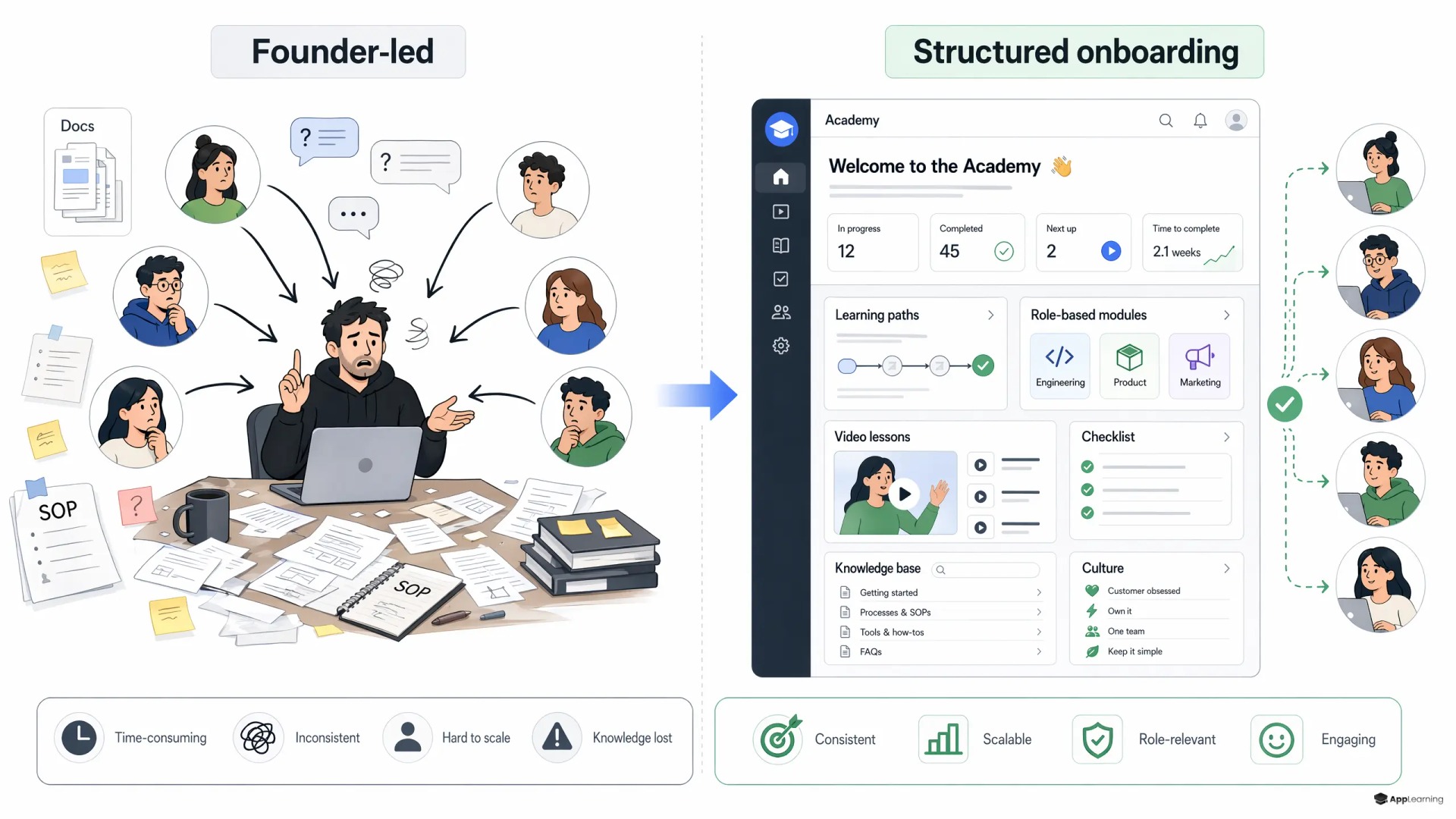
In the earliest stage, onboarding is mostly proximity. New hires sit near founders, ask questions in real time, and absorb context through conversation. That works when the company is small enough for everyone to share the same mental model.
The break usually becomes visible somewhere around 50 people. Not because 50 is a scientific breakpoint, but because headcount, tools, decisions, and cross-team dependencies have outgrown memory. At that point, a founder can still explain the company well, but can no longer be the operating system that transfers knowledge to every new hire.
Manager-led onboarding creates avoidable variance
Once founder access drops, onboarding gets pushed to managers. That sounds reasonable until every manager teaches a different version of the same company. A well-structured induction helps new hires settle in, get the information they need to do their jobs, and understand what is expected of them. Review evidence on formal onboarding points in the same direction: standardized plans, explicit time frames, and access to experienced role models are associated with stronger role clarity, task mastery, and social acceptance. (acas.org.uk)
- New hires ask the same basic questions in Slack every week.
- Ramp speed depends more on the manager than on the role.
- Different teams describe the same process in conflicting ways.
- Culture is reduced to founder stories instead of visible habits and decision rules.
- Managers spend their first month with each hire repeating background instead of coaching real work.
The first 30 days need a path to usefulness
New hires do not need every document in week one. They need the shortest path to useful contribution. The strongest onboarding research keeps coming back to the same adjustment goals: role clarity, task mastery, and social acceptance. Meta-analytic work also shows that these adjustment factors sit between socialization tactics and outcomes such as job satisfaction, commitment, performance, intentions to remain, and turnover. (pmc.ncbi.nlm.nih.gov)
- Company knowledge so people understand the product, customer, business model, vocabulary, and strategy.
- Role knowledge so they know the core workflows, tools, quality bar, and first deliverables.
- Operating rituals so they understand how planning, decisions, approvals, and escalation actually happen.
- A relationship map so they know who can answer what, who owns what, and where handoffs fail.
If those four pieces are clear, a new hire can start producing. If they are missing, the company gets fake onboarding completion and real operational drag.
Knowledge has to be split into layers
Most startups make onboarding harder by mixing everything together. A new hire gets a Notion dump, a few recorded calls, scattered slide decks, and whatever their manager remembers to mention. The fix is simple: separate the knowledge that everyone needs from the knowledge a specific role needs and from the rituals that explain how work moves.
- Company layer with mission, market, product, customers, values, terminology, and basic policies.
- Role layer with the actual tasks, examples, tools, checklists, failure modes, and quality standards for one function.
- Ritual layer with recurring meetings, documentation norms, decision rights, feedback loops, and escalation paths.
That separation matters because each layer changes at a different speed and should have a different owner. Founders should update the company layer, functional leaders should own role content, and team leads should keep rituals current. Once ownership is clear, onboarding stops being a vague HR project and becomes maintainable operating infrastructure.
Good to know
When should a startup formalize onboarding?
Before repeated hiring turns manager calendars into the default knowledge base. If new hires need several people to understand basic workflows, the company is already late.
Does structured onboarding mean more bureaucracy?
No. A small academy with short modules, role paths, and scheduled check-ins gives structure without adding heavy process.
What should stay with managers instead of content?
Coaching, prioritization, feedback, and judgment calls. Content should carry the repeatable basics so managers can focus on live performance.
A startup academy should stay light and operational
The right academy model is small by design. The goal is not to build a corporate university. The goal is to capture repeatable knowledge once, deliver it in short modules, keep it easy to update, and leave managers with the parts that actually need judgment and coaching.
SHRM’s onboarding guidance frames the process as a combination of preboarding, orientation, foundation-building, and mentoring or buddy support. That matters because a one-day welcome session cannot carry company context, role practice, and social integration on its own. (shrm.org)
This is where App-Learning fits well for growing startups. It gives the company a lightweight academy layer that can hold the repeatable basics, keep them mobile and accessible, and reduce the amount of background teaching managers have to do live.
See how App-Learning can turn scattered onboarding into one repeatable system.
DemoMeasure ramp quality instead of checklist completion
Most founders track onboarding completion because it is easy. That metric says almost nothing about whether a hire can execute independently. SHRM recommends evaluating onboarding with measures such as time to productivity, turnover or retention rates, retention thresholds, new-hire surveys, employee satisfaction and engagement, performance measures, and informal feedback. (shrm.org)
- Time to first independent task completed at the expected quality bar.
- Time to first role-standard output such as a shipped ticket, qualified opportunity, resolved support case, or customer-ready analysis.
- Manager hours spent per new hire in the first 30 days.
- Day-14 and day-30 clarity scores on role expectations, tools, and decision paths.
- First-90-day regretted attrition and the point in the journey where people usually fail.
Early failure is not rare enough to ignore. In CIPD’s 2024 resourcing survey, 41% of employers that recruited in the previous year said new recruits always, mostly, or sometimes resigned within the first 12 weeks. A founder does not need enterprise-scale analytics to respond to that risk, but they do need a visible ramp system and a clear retention threshold. (cipd.org)
At 50 people, onboarding stops being hospitality and becomes infrastructure. If founders keep treating knowledge transfer as a set of conversations, growth quietly taxes every hire with confusion, manager dependency, and slower output. A lightweight startup academy changes that. It preserves speed by making the repeatable parts teachable, searchable, and consistent, so people can spend less time decoding the company and more time moving it forward.