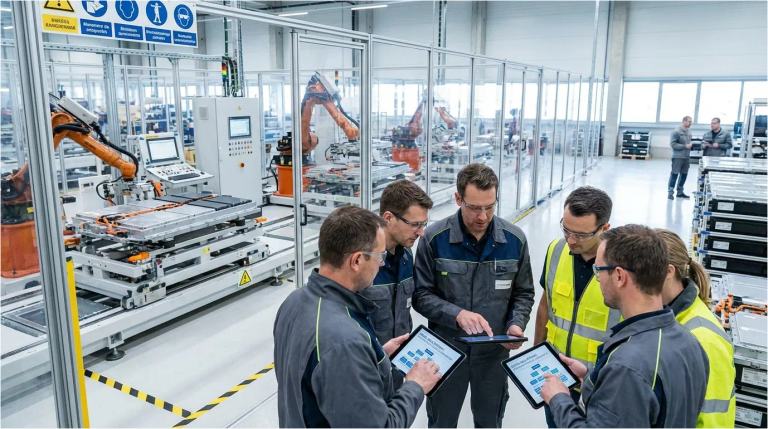
Executives in a modern boardroom reviewing workforce capability dashboards as part of business strategy

Key takeaways

  • Skills policy now sits inside competitiveness strategy, not beside it.
  • Capability-building affects investment, adaptation speed, and resilience.
  • Learning systems should be managed as operating infrastructure, not support tooling.
  • Leadership teams need a policy-aware workforce strategy, especially in strategic sectors.

The biggest misunderstanding in leadership teams is still structural. Learning is often treated as support work, while growth, productivity, industrial strategy, and resilience are treated as the real economic agenda. That split is becoming harder to defend.

The policy direction in Europe has changed. The European Commission’s Union of Skills is not framed as an education-side initiative floating next to the economy. It is explicitly positioned to reinforce the EU’s competitiveness agenda, its industrial transition, and its preparedness strategy.

From education portfolio to economic operating system

This is the core shift: skills are now being treated less as a social policy output and more as economic capacity. In the Competitiveness Compass, the Commission places the Union of Skills alongside innovation, decarbonisation, and security of supply as part of the broader roadmap for restoring growth and productivity.

That framing matters because it changes what skills policy is expected to do. The goal is no longer only employability or inclusion, important as those remain. The goal is also to reduce labour and capability bottlenecks that slow investment, delay technology deployment, and weaken adaptation in strategic sectors.

Human capital is key to Europe’s competitive strength and economic resilience.
Council of the European UnionRecommendation on human capital, adopted March 9, 2026

Why the policy framing changed

The change is a response to pressure from several directions at once. Europe is trying to accelerate clean industry, expand digital and AI capability, respond to demographic strain, and improve preparedness under more volatile geopolitical conditions. The Commission’s skills strategy announcement ties this directly to STEM capacity, digital transition, clean-tech readiness, and talent attraction.

At the same time, the policy system is starting to govern skills more like an economic constraint. The Council recommendation on human capital brought skills into the European Semester as an explicit competitiveness instrument. That is a meaningful administrative signal: capability gaps are no longer being treated as downstream symptoms. They are being treated as macro-relevant frictions.

  • Industrial plans fail when workforce capability lags capital deployment.
  • Technology adoption stalls when firms cannot redeploy people fast enough.
  • Resilience weakens when critical sectors depend on thin talent pipelines.
  • Regional growth slows when learning systems cannot convert labour supply into usable capability.

Competitiveness now depends on deployable capability

Once policy starts treating skills as economic infrastructure, the logic becomes straightforward. Competitiveness is not only about financing, energy, regulation, or innovation. It is also about whether firms can turn strategic intent into execution with enough speed and reliability.

That is why skills shortages are showing up as an investment issue rather than a training issue. According to the Council’s March 2026 release, 77% of EU companies in 2024 said skills shortages were a barrier to long-term investment. The European Investment Bank’s investment analysis has been making the same point from the firm side: lack of skills is moving up the list of obstacles that directly affect investment decisions.

This is the economic policy connection. If a region cannot produce, update, certify, and mobilise capability fast enough, it does not just have a learning problem. It has a productivity problem, an industrial scaling problem, and eventually a resilience problem.

A side-by-side comparison of legacy learning systems and capability infrastructure models.
The organizational shift is not more content. It is a different operating model for workforce capability.

Resilience is becoming a workforce design problem

Economic resilience used to be discussed mainly through supply chains, energy, inventories, and fiscal capacity. Those still matter. But resilience now also depends on whether labour markets and employers can absorb shocks, reskill quickly, and move talent toward priority work without excessive lag.

That is visible in the EU’s own architecture. The Union of Skills page explicitly links the strategy not only to the competitiveness agenda but also to the Clean Industrial Deal and the Preparedness Union strategy. In other words, the same policy layer is now expected to support growth, transition, and shock-readiness.

For employers, the operational implication is clear. Workforce resilience is not created by annual training calendars. It is created by having a system that can identify emerging capability gaps, prioritize the roles that matter most, and move people through credible learning pathways fast enough to matter.

The employer implication is strategic, not cosmetic

Many companies still run learning as a content library, a compliance channel, or a benefits-layer perk. That model is too weak for the environment that is forming. If policy, investment, and industrial planning are converging on capability constraints, employers need learning systems that behave more like strategic infrastructure.

That means four practical shifts:

  1. Map capability to business-critical roles, not generic job families.
  2. Measure time-to-readiness, not course completion.
  3. Connect learning design to hiring constraints, automation plans, and internal mobility.
  4. Treat skill visibility as an executive planning input, not an L&D reporting output.

This is where the App Learning angle becomes concrete. A platform positioned as capability infrastructure is materially different from a generic LMS. It supports role-based pathways, faster activation, evidence of readiness, and tighter connection between business change and workforce change. That aligns much better with the economic logic now shaping policy.

Leadership needs a policy-aware workforce lens

Executives do not need to become policy specialists. They do need to understand that policy is redefining what counts as strategic infrastructure. Skills systems are moving into that category because governments increasingly see workforce capability as a determinant of competitiveness, innovation uptake, and resilience.

The leadership response should be disciplined. Identify the capabilities your strategy depends on. Build an operating model for reskilling and redeployment before shortages become bottlenecks. And assess whether your current learning stack can produce deployable capability at the speed your business model now requires.

The overlooked economic infrastructure is not abstract. It is the system that turns available people into usable capability. As policy catches up to that reality, leadership teams that still treat learning as support work will underinvest in one of the few levers that affects growth, adaptation, and resilience at the same time.

Good to know

Why is skills policy now being discussed as economic policy?

Because capability gaps now affect investment, technology adoption, industrial scaling, and resilience. Europe’s current policy framing places skills inside the competitiveness agenda rather than treating them as a separate education-side concern.

What does this mean for leadership teams?

Learning can no longer be managed as a peripheral support function. Leadership needs visibility into critical capabilities, time-to-readiness, and whether the organization can redeploy talent fast enough for strategic change.

How should companies evaluate their learning systems now?

Assess whether the system helps build deployable capability for priority roles, supports internal mobility, and produces operational evidence of readiness rather than just activity metrics.

Want this level of editorial clarity for your academy?

Let's turn content into a learning product.