
Key takeaways
- Clearer skill signals reduce guesswork in hiring and promotion.
- Recruiting and internal mobility depend on the same recognition layer.
- Better evidence improves speed, trust, and talent matching.
- Capability visibility becomes a real competitive advantage.
The signal problem sits in both workflows
Most leadership teams do not have a hiring problem or a learning problem in isolation. They have a signal problem. Resumes, job titles, degrees, course completions, self-reported skills, and manager opinions all say something, but they rarely say enough in a format that is easy to verify, compare, and reuse.
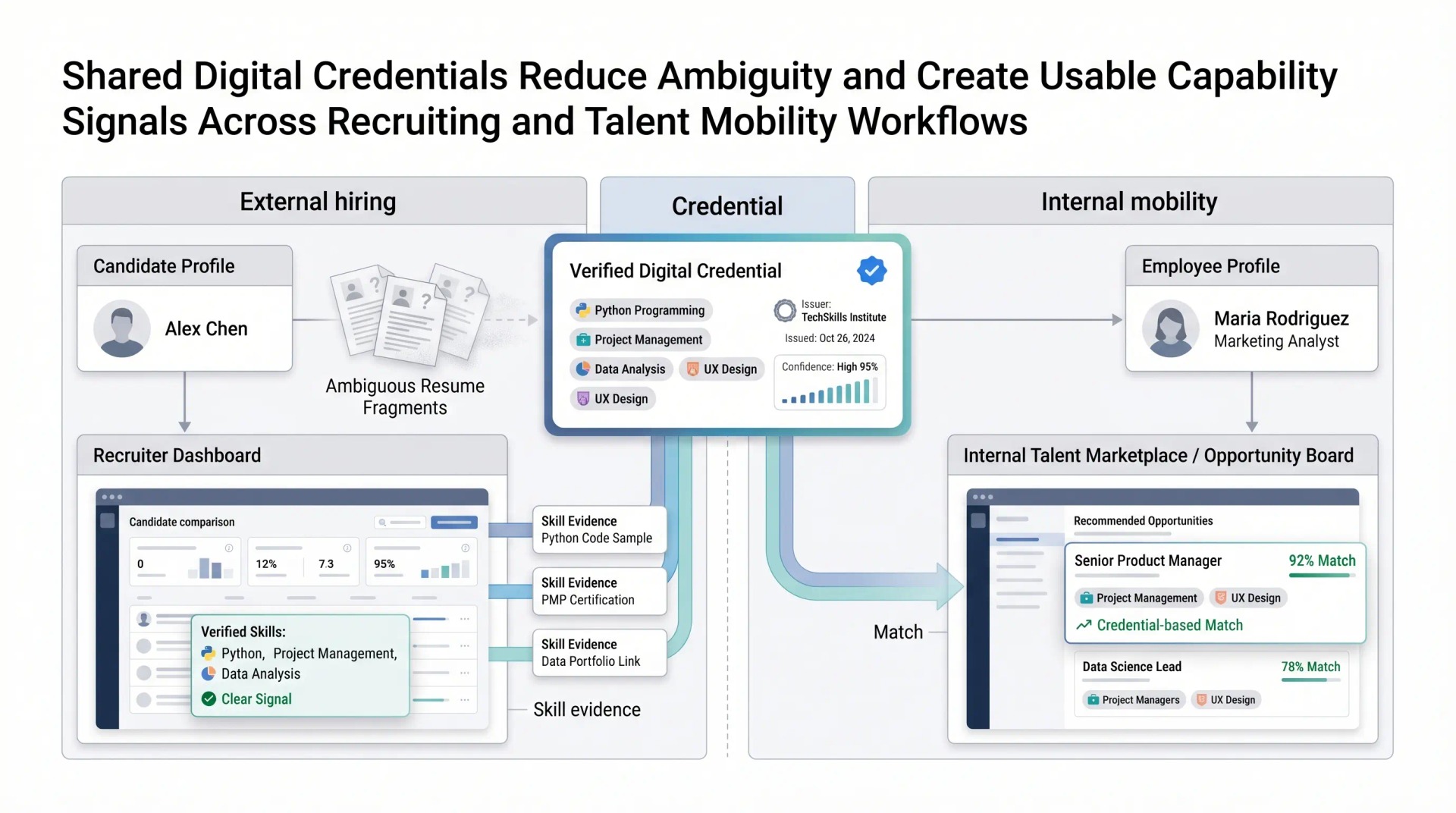
That breakdown shows up twice. In recruiting, weak signals slow screening and push recruiters back toward proxies. Inside the company, the same weakness makes internal mobility depend too much on who is visible, well-networked, or already known by the next manager. When skill recognition is ambiguous, both external hiring and internal movement become more political and less precise.
Digital credentials change the unit of recognition
A digital credential is not just a nicer PDF certificate. The European Commission’s Europass Digital Credentials are issued natively in digital form, can be electronically sealed, stored in a wallet, shared directly, and verified for authenticity. The important shift is structural: the proof travels with the achievement instead of being detached from it.
The standards layer is what makes this useful. 1EdTech’s Open Badges can carry criteria, issuer data, and evidence for a specific achievement, while the Comprehensive Learner Record can bundle multiple verified achievements into a broader record. The W3C Verifiable Credentials Data Model 2.0 gives these records a common trust model for exchange across systems.
make individuals’ skills more visible, portable, and verifiable
That is the real change. A credential stops being a decorative completion artifact and becomes a usable data object. Once the object carries issuer trust, evidence, criteria, and machine-readable structure, it can support decisions in an ATS, a talent marketplace, a manager review, or a promotion process.
Recruiting gets a cleaner front-end signal
In hiring, digital credentials help because they reduce ambiguity before the interview even starts. The OECD’s skills-first work describes skills passports, digital credential wallets, and verified skill profiles as mechanisms that make skills easier for employers to evaluate without relying only on degrees or job titles.
That does not eliminate assessment. It improves triage. Recruiters still need interviews, work samples, and structured scorecards, but the starting signal gets stronger when a credential shows what was assessed, against which criteria, and with what evidence. The OECD has also noted that alternative credentials lose labor-market value when employers cannot treat them as reliable or comparable signals.
This is why interoperability matters so much. 1EdTech’s roadmap shows that Open Badges 3.0 moved to final status in June 2024, and Europass already provides issuing and wallet infrastructure. The market is shifting away from badge images and toward portable records that systems can read and verify.
Internal mobility runs on the same evidence layer
Internal mobility is usually framed as a career architecture issue. It is also a recognition issue. If managers cannot see credible evidence of capability outside formal job history, they default to known performers, familiar teams, and linear career paths. The same credential logic that helps an outside recruiter read a candidate can help an internal system surface overlooked talent.
The business case is already there. LinkedIn’s Global Talent Trends data found that employees stay 41% longer at companies that regularly hire from within, and a separate LinkedIn retention analysis found employees who change roles internally are more likely to stay. Once mobility has measurable retention impact, skill visibility stops being a soft HR topic and becomes an operating lever.
Most organizations are still weak on that visibility. In a McKinsey survey on reskilling, fewer than half of respondents said their organizations had a clear sense of their current workforce skills. If leadership cannot see capability clearly, talent marketplaces, succession plans, and reskilling programs all run on partial information.
The cost of that gap is not theoretical. McKinsey has argued that more than 80 percent of workers’ moves to new roles involve switching employers rather than moving internally. That suggests many companies are still buying skills from the outside that they could have recognized and redeployed from within.
Good to know
Where should leadership teams start with digital credentials?
Start where hiring friction and internal redeployment friction overlap. That usually creates the clearest business case on time-to-fill, manager confidence, and retention.
Do digital credentials replace degrees, interviews, or manager judgment?
No. They improve the quality of the signal before and between those decisions. The goal is better evidence, not blind automation.
What makes a credential system credible to managers?
Clear issuer rules, shared skill definitions, evidence of performance, and verification inside the systems managers already use.
Usability beats issuance
Most credential programs fail for a simple reason: they optimize for issuing more credentials instead of making credentials usable in talent decisions. A useful system needs shared skill language, trusted issuer identity, evidence of performance, and portability across products. That is why Credential Engine’s registry model focuses on structured, comparable credential data, and why 1EdTech’s digital credential work connects badges, learner records, and competency frameworks rather than treating each artifact separately.
- Trusted issuer identity and verification
- Skills or competencies aligned to a common framework
- Evidence and assessment criteria, not just completion status
- Portability across wallets, profiles, and enterprise systems
- Placement inside ATS, HR, learning, and talent marketplace workflows
Leadership teams should also separate participation from proficiency and proficiency from applied performance. A credential that proves attendance can be useful for compliance, but it is weak hiring evidence. A credential that proves assessed capability can support screening. A credential tied to applied work can support staffing, promotion, and mobility. Mixing those levels is how credential systems lose manager trust.
See how App Learning turns learning evidence into usable credential signals.
ExploreFrom learning evidence to talent infrastructure
This is where the App Learning angle becomes practical. Learning content does not change talent decisions on its own. Decisions change when practice, assessment, and demonstrated performance are turned into evidence that hiring teams and managers can actually use. When App Learning connects learning evidence to practical credential signals, learning stops sitting on the side of the talent system and starts feeding hiring, promotion, and internal movement.
The leadership question is not whether digital credentials are fashionable. It is whether skill recognition will remain ambiguous, manual, and manager-dependent. Recruiting and internal mobility are two expressions of the same recognition problem. The organizations that move faster will not just produce more learning. They will build a trusted signal layer that makes capability legible across the whole talent system.