Key takeaways
- Hiring does not equal productivity.
- Ramp-up is a system problem, not a motivation problem.
- Learning systems reduce time to value.
- Onboarding should be measured by readiness, not completion.
The offer is not the expensive part of hiring. The expensive part is the stretch after day one when a new employee is on payroll but not yet creating consistent value.
That is why most hiring dashboards stop too early. They report time to hire, cost per hire, and acceptance rate, while the business feels something else entirely: delayed output, manager drag, avoidable mistakes, and slow role readiness. The U.S. Office of Personnel Management describes onboarding as the bridge between selection and productivity and frames it as a process that starts before day one and runs through the first year.
Time to productivity is the real post-hire metric
Time to productivity is the elapsed time between start date and repeatable contribution at the expected level for the role. It is not the moment a laptop is issued, a checklist is completed, or a manager says the new hire seems settled in.
For People Ops, this matters because the metric is role-specific by design. A seller becomes productive through pipeline creation and independent deal motion. A support agent becomes productive through quality at target handle time. An engineer becomes productive through clean delivery, reliable collaboration, and low-rework output. If you do not define readiness this way, ramp-up stays vague and impossible to improve.
- Use one or two validated milestones per role instead of one generic company-wide definition.
- Separate access and orientation milestones from actual work-performance milestones.
- Treat manager support as part of the metric. A new hire is not fully ramped if output still depends on constant rescue.
Most lost time sits inside the ramp
Companies often assume post-hire underperformance starts with a hiring miss. More often, it starts with a broken ramp. Tool access arrives late. Role expectations stay abstract. Information is delivered in a dump instead of a sequence. Managers coach inconsistently. Practice happens after live work begins instead of before it.
- Delayed system access and workflow setup
- Weak role clarity in the first 30 days
- Too much content with too little application
- No structured practice on core tasks
- No shared coaching rhythm between manager and People Ops
- No checkpoint that proves someone is ready for the next level of responsibility
These failures compound. A week lost to setup becomes a missed practice cycle. Vague expectations become rework. Ad hoc coaching turns one onboarding process into five different experiences depending on manager quality. The OPM onboarding toolkit also summarizes research linking proper onboarding to higher job satisfaction, better job performance, stronger organizational commitment, and lower stress, which shows that ramp quality affects more than speed alone.
Learning systems convert onboarding into capability
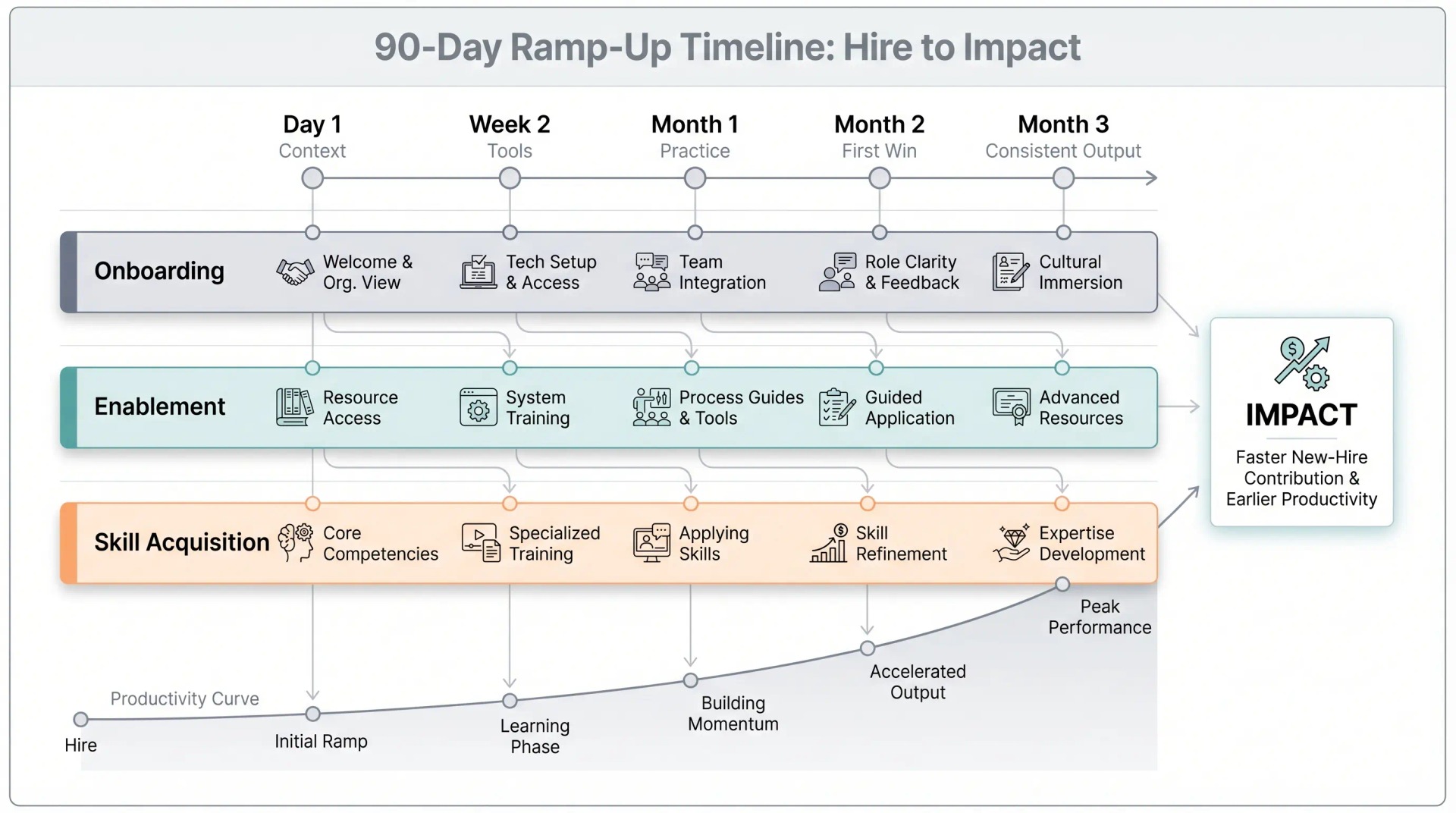
The shift is simple but important. Stop asking whether onboarding was delivered. Start asking whether capability was built. That requires a learning system: clear task maps, sequenced knowledge, guided practice, retrieval, reinforcement, manager feedback, and evidence that the employee can perform without heavy intervention.
- A role map that identifies what someone must know, do, and decide early
- Learning sequences tied to actual work milestones rather than generic orientation topics
- Practice loops that let people try core tasks before the stakes are high
- Manager prompts and check-ins that reinforce the same standards across a cohort
- Readiness checks that show whether the person can operate independently at the next stage
This is also why learning should sit closer to productivity conversations than many teams assume. In the official 2025 Workplace Learning Report, LinkedIn says organizations with more mature career development systems are more confident in profitability and in their ability to attract and retain talent. Learning is not a perk layered on after hiring. It is part of the operating system that makes hires useful faster. For App Learning, that means turning onboarding and early enablement into measurable capability-building flows rather than static content libraries.
Good to know
How should People Ops define time to productivity?
Define it as the point when a new hire can perform core tasks at expected quality with normal manager support. Avoid generic definitions that ignore role differences.
Who owns ramp-up inside the organization?
People Ops should own the system design, functional leaders should define role milestones, and managers should own coaching and validation in the flow of work.
What should teams measure first if they only track onboarding completion today?
Start with time to first validated milestone for each role. It is easier to operationalize than full productivity and quickly exposes where the ramp breaks.
Where does App Learning fit in this system?
App Learning fits as the layer that structures early knowledge, practice, reinforcement, and proof of readiness across onboarding and role enablement.
Readiness needs a measurement system
Most teams still report onboarding completion because it is easy to count. Completion is an activity metric. Readiness is an outcome metric. SHRM recommends evaluating onboarding with measures such as time to productivity, retention, new-hire surveys, engagement, performance measures, and informal feedback. That is the right direction because it moves the conversation from attendance to impact.
- Time to first validated role milestone
- Time to independent execution on core tasks
- Quality at first meaningful output
- Manager-rated readiness at 30, 60, and 90 days
- New-hire confidence and clarity scores
- Six-month retention by cohort, manager, and role family
The practical move is to build a small ramp dashboard, not a giant reporting project. Start with one role family. Define the first three capability milestones. Instrument the check-ins. Compare cohorts. Once the system shows where time is leaking, improvement becomes operational instead of anecdotal.
Turn ramp-up into a measurable learning system.
See howRamp-up deserves operating discipline
If hiring is the acquisition of talent, ramp-up is the conversion of talent into output. Organizations that systematize onboarding, enablement, and early skill acquisition reduce variance, shorten time to value, and protect managers from rebuilding the same process for every new hire. Hiring brings people in. Learning systems make their impact arrive sooner.