

Key takeaways
- Open-finance rails do not lift conversion without clear permission UX.
- Users consent when value, control, and security are explained in plain language.
- Embedded education can reduce drop-off in lending, account-opening, and personal-finance flows.
- Track consent completion together with activation, approval, and reauthorization metrics.
Consent has moved into the growth stack
Open finance has usually been handed to product, partnerships, or compliance. That misses where the commercial leverage actually sits. Mastercard’s 2026 study of 8,000 consumers and 300 businesses found that 75% of executives report direct revenue uplift from open-finance initiatives, while companies estimate they miss 4.6% of annual revenue because of gaps in data permissions. If permission quality shapes whether the data ever shows up, then consent is already a growth problem.
Trust requires clarity. The consumer should always understand what’s happening and why.
That is the shift growth teams should pay attention to. Open-finance infrastructure only becomes a funnel advantage when users understand the payoff, believe they remain in control, and feel safe enough to continue. Faster approvals, fewer form fields, and more accurate decisioning are downstream benefits. Consent is the gateway condition that decides whether any of them happen. (mastercard.com)
The policy signal is clearer than the timeline
The U.S. regulatory picture is moving in one direction even if the calendar is unsettled. The CFPB’s October 22, 2024 Personal Financial Data Rights rule requires authorization disclosures to be clear, conspicuous, and separate from other material, and to explain the product or service requested, the categories of data accessed, the expected duration of collection, and the revocation method. The rule also caps collection at one year after the consumer’s most recent authorization unless the user reauthorizes.
At the same time, growth teams should not plan against a fictional certainty. The CFPB compliance page, last updated January 6, 2026, says the rule’s compliance dates were stayed by a court on October 29, 2025, after the Bureau issued an August 22, 2025 reconsideration notice and said it planned to propose extended compliance dates. The operational takeaway is simple: exact deadlines may move, but products are still being pushed toward clearer permission requests, simpler revocation, and more explicit consumer control. (consumerfinance.gov)
The hesitation point is the value exchange
Users rarely hesitate because they oppose better onboarding in principle. They hesitate because the exchange is vague at the exact moment you ask for financial data. Plaid’s conversion guidance says account-linking conversion is highest when the app explains why Plaid is used, what benefit the user gets from connecting an account, that the information will be secure, and what the user will need during the flow. TrueLayer’s consent UX guidance makes the same point more directly: tell people what data is shared, why it is shared, how long access lasts, and what control they keep.
That matters most in loan, account-opening, and personal-finance journeys because those flows ask users to make a trust decision before they have fully experienced the product. The result is familiar: users fall back to manual entry, abandon at bank redirect, or postpone the step entirely. When the permission ask is unclear, your best infrastructure simply becomes a nicer version of a drop-off point.
Vendor benchmarks point in the same direction. Plaid says its Layer flow can cut signup time by nearly 90 percent, with early customers seeing end-to-end sign-up conversion lift by up to 17.5 percent, and Plaid’s onboarding page claims up to a 25 percent boost in onboarding conversion. These are vendor figures, not neutral market averages, but they still show the commercial logic clearly: less ambiguity and less manual effort produce more completed onboarding. (plaid.com)
Education has to live inside the flow
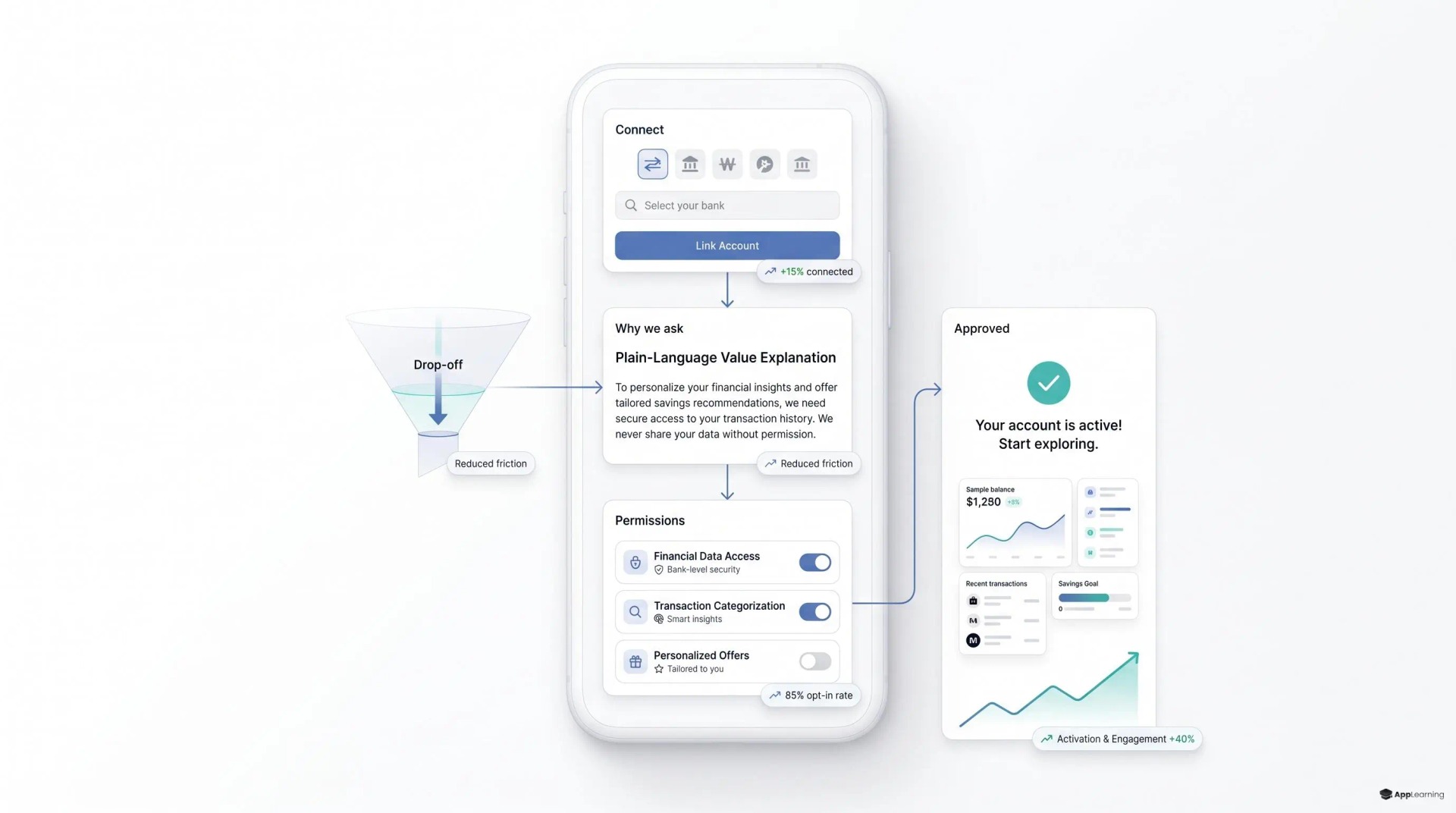
This is where many growth teams underbuild. They add a help link or a legal paragraph and call it education. Effective consent education is shorter and more operational than that. It shows the payoff before the ask, names the specific data categories in plain language, explains how long access lasts, and makes revocation feel real rather than theoretical. Those are not just compliance ideas. They are the ingredients of a credible value exchange. (consumerfinance.gov)
- Lead with the outcome such as faster approval, instant funding, or an auto-filled financial profile.
- Match the explanation to the user’s job to be done instead of describing open finance abstractly.
- Keep brand continuity across pre-consent, provider redirect, and return states.
- Warn users before redirects so the bank handoff feels expected.
- Confirm what changed after consent so the user sees immediate progress.
The pattern is already visible in the tools teams use. Plaid supports co-branded consent panes and data transparency messaging, while TrueLayer recommends building consent and reconfirmation screens inside the app because it can have a positive impact on conversion. The design lesson is consistent across providers: do not outsource comprehension to the connector. Own it in your product. (plaid.com)
Good to know
Who should own consent UX in a fintech organization?
Growth should co-own it with product, design, compliance, and legal because the consent step directly shapes onboarding conversion and the commercial upside of permissioned data.
What needs to be explained before a user links an account?
Explain the product benefit, the data categories being accessed, how long access lasts, and how revocation works. Those elements line up with CFPB authorization disclosure requirements and with consent UX guidance from open-finance providers.
Will more education slow onboarding down?
Not if the education removes ambiguity instead of adding noise. Plaid says expectation-setting before account linking improves conversion, and TrueLayer says in-app consent explanation can positively affect conversion on reconfirmation journeys.
Which KPI should a growth team watch first?
Start with paired metrics: consent-step completion, redirect return rate, and first-value activation. If consent completion rises but funded accounts or approved users do not, the message is clearer but the value exchange is still weak.
Measure consent quality not just funnel speed
Once education is embedded, the measurement model has to change too. A fast funnel is not a good funnel if users consent blindly, fail to return from bank auth, or never reach first value. Growth teams should pair consent-step completion with activation and approval metrics so they can see whether better explanation is improving business outcomes instead of just screen completion. (mastercard.com)
- Consent-screen view to completion rate
- Redirect return rate by institution
- Linked-data path selection versus manual fallback
- Approval or eligibility rate after successful consent
- Time to first funded account, first budget view, or first approved offer
- Reauthorization and revocation rates
- Support contacts tied to linking or data-sharing confusion
See how App-Learning can improve complex onboarding conversion.
See demoApp-Learning makes consent teachable
For complex fintech products, one tooltip will not fix the trust gap. The better model is a small education system inside onboarding: short modules before consent, contextual prompts during bank connection, and follow-up explanations when new data unlocks a result. That lets growth teams test message order, benefit framing, and depth of explanation by use case instead of shipping one static permission screen to every user.
This is where App-Learning fits. It gives teams a way to treat education as product infrastructure: reusable onboarding lessons, segmented flows for lending or personal finance, and measurement tied to completion, activation, and retention. In practice, that turns consent from a legal checkpoint into a conversion surface.
Open-finance infrastructure does not create conversion on its own. The lift appears when users understand the bargain, believe they stay in control, and see a fast payoff after they say yes. The fintechs that win this cycle will not be the ones with the most permissioned-data plumbing. They will be the ones that make permission legible enough for users to act on it. (mastercard.com)