
Key takeaways
- Soft-skill underperformance is also a workplace practice problem, not only a hiring issue.
- Role-based practice improves communication and judgment faster than awareness content alone.
- Onboarding and manager reinforcement turn soft skills into applied behaviour.
- Readiness metrics should track application evidence, not only completions or scores.
The hiring screen sees only part of the job
The HR Magazine item from 9 June 2025 frames the problem sharply: 75% of UK employers said they had hired technically strong candidates who later underperformed because of soft skills and cultural alignment. That is not a reason to ignore hiring quality. It is a reason to stop treating hiring as the final control point.
The underlying TestGorilla report surveyed 1,076 job seekers and 1,084 hiring decision-makers in the UK and US in April 2025. It found that employers still struggle to identify soft skills, even as skills-based hiring grows. The operational lesson is simple. A screen can reduce risk. It cannot create workplace behaviour.
Soft skills break at the point of use
Communication, judgment, collaboration, escalation, and adaptability are not abstract traits. They are choices made under pressure. In a finance or crypto company, that pressure may be a customer complaint, a suspicious transaction, a product-risk trade-off, or a policy exception. The employee does not need another definition of stakeholder management. They need practice choosing what to say, when to escalate, and how to document the decision.
This is why soft skills training at work often disappoints. A systematic scoping review on soft-skills transfer describes the core problem as transfer: people may understand the concept in training but fail to apply it on the job. The gap is usually not intent. It is missing opportunity, feedback, reinforcement, and context.
Practice loops beat awareness modules
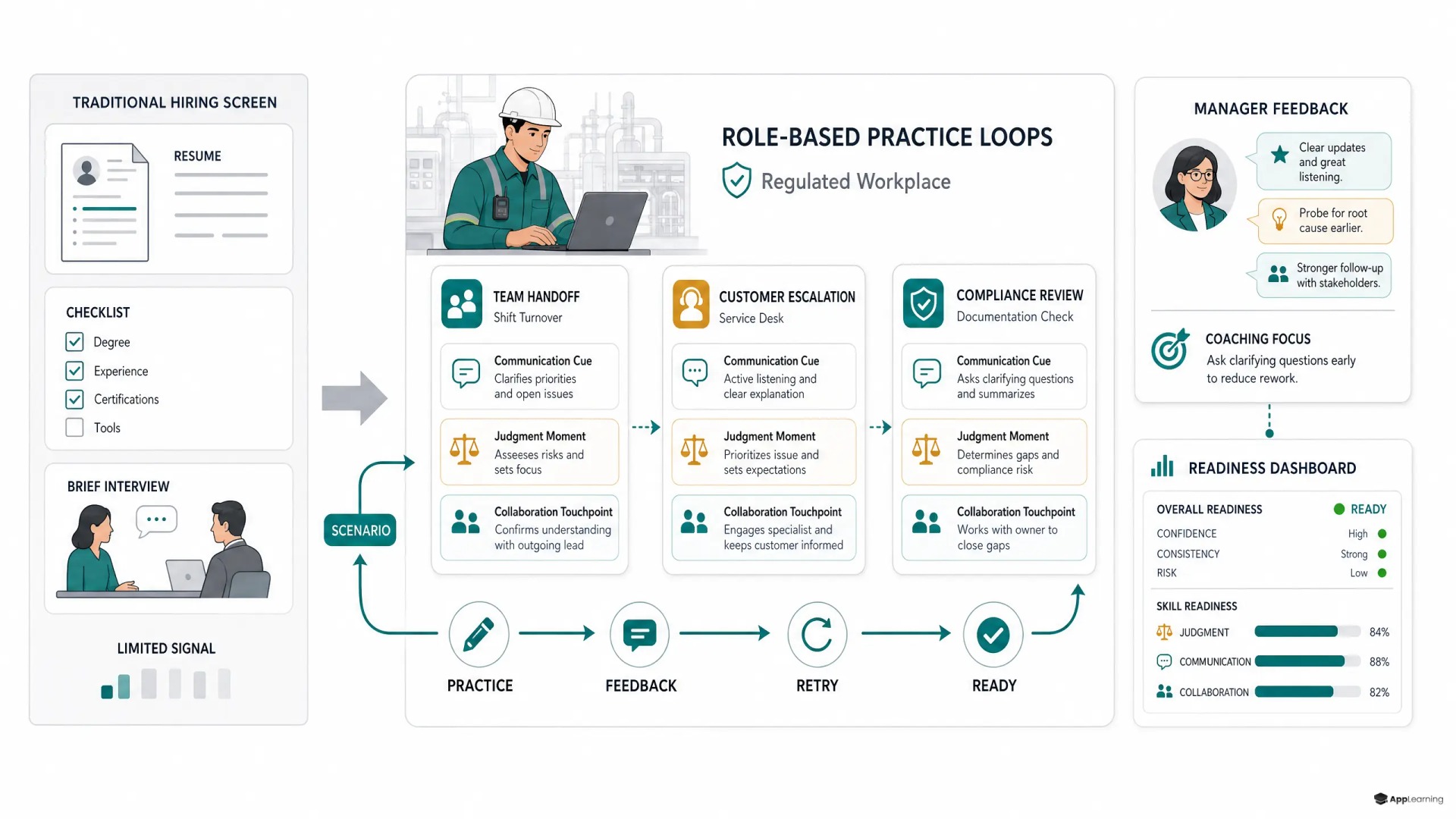
Role-based soft skills training starts with the job, not the competency label. A payments analyst, relationship manager, compliance reviewer, and customer support lead may all need judgment. They do not need the same scenario. The practice loop should mirror the decision environment closely enough that the learner recognises the moment later at work.
- A real trigger from the role
- A short scenario with a decision point
- A response that forces prioritisation
- Feedback tied to the expected standard
- A record of readiness evidence
The loop should begin in onboarding, then repeat after people meet the work. Managers matter here. A meta-analysis of training transfer found that supportive work environments are linked to transfer, especially for open skills such as leadership and judgment. That means managers need prompts, observation cues, and language for feedback, not a vague request to reinforce training.
Good to know
Should employers still assess soft skills during hiring?
Yes. Assessment can reduce hiring risk, but it should feed onboarding and practice design rather than end the development process.
What makes role-based soft skills training different?
It uses scenarios, decisions, feedback, and evidence from the employee’s actual role instead of generic communication or leadership content.
How should finance and crypto teams measure soft-skill readiness?
Track applied evidence such as scenario performance, escalation quality, manager validation, error patterns, and time to proficiency.
Readiness needs evidence, not course traffic
Measuring soft skills development is weak when the metric is only completion. A course completion says the employee was exposed to content. It does not say they can handle a tense client call, challenge a risky assumption, explain a compliance rule without creating fear, or collaborate across product and legal when guidance changes. Workforce readiness needs evidence of applied behaviour.
For regulated teams, that evidence can be practical: scenario scores by role, confidence before and after practice, manager validation, escalation quality, repeat errors, time to proficiency, and readiness by cohort. The OECD’s adult learning work also points to the importance of learning through work experience, colleagues, and supervisors. That is where L&D measurement has to move.
Build soft-skill practice into real work.
StartThe execution layer has to fit the work
This is where the learning stack matters. A static LMS can host content, but soft skills need short loops, fast updates, role segmentation, practice prompts, and visibility. App-Learning supports this operating model through role-based learning paths, micro-lessons, quizzes, certificates, gamified mechanics, and analytics such as completions, drop-off points, learner activity, and time spent. The point is not to make soft skills playful. The point is to make practice frequent, contextual, and measurable.
Soft skills become business assets only when they leave the interview room and enter daily work. Employers cannot interview their way out of every communication, judgment, or collaboration gap. They need a system that makes good behaviour easier to practise, observe, reinforce, and prove.