

Key takeaways
- Completion is an activity metric, not proof of open-source capability.
- Projects, pull requests and mentor relationships reveal contributor conversion.
- A staged pathway turns technical learning into sustained Bitcoin FOSS participation.
- Pipeline metrics give funders and ecosystem partners evidence beyond attendance.
Developer education is ecosystem infrastructure
Bitcoin developer education is often treated as a content problem. Build a curriculum, recruit a cohort, run lessons, issue certificates. That model misses the scarce resource the ecosystem actually needs: people who can work in public repositories, collaborate with maintainers, and keep contributing after the program ends.
The funded models in Btrust’s first 2026 education round point to a stronger standard. They combine technical foundations with projects, mentorship, fellowships, grants and routes into paid work. For a Bitcoin company, this matters beyond philanthropy. A healthier contributor base improves the tools, libraries, wallets and infrastructure that product teams depend on. Bitcoin open source training should therefore be designed as capability infrastructure, not as an isolated course library.
Completion does not prove contribution
Completion can show that learners reached the end of a sequence. It cannot show that they can navigate an unfamiliar codebase, scope a useful task, respond to review, or produce work that another team can use. Those are the practical conditions of open-source participation. The Bitcoin Core contribution guide makes this visible: contributors must work through a fork, create a pull request, explain the change and accept that review is demanding.
This changes the outcome definition. A learner who finishes every module but never builds in public may have gained knowledge. A learner who submits a repository-backed project, opens a first pull request and stays in contact with a mentor has begun a contributor pathway. The second outcome is more valuable to maintainers, funders and hiring partners.
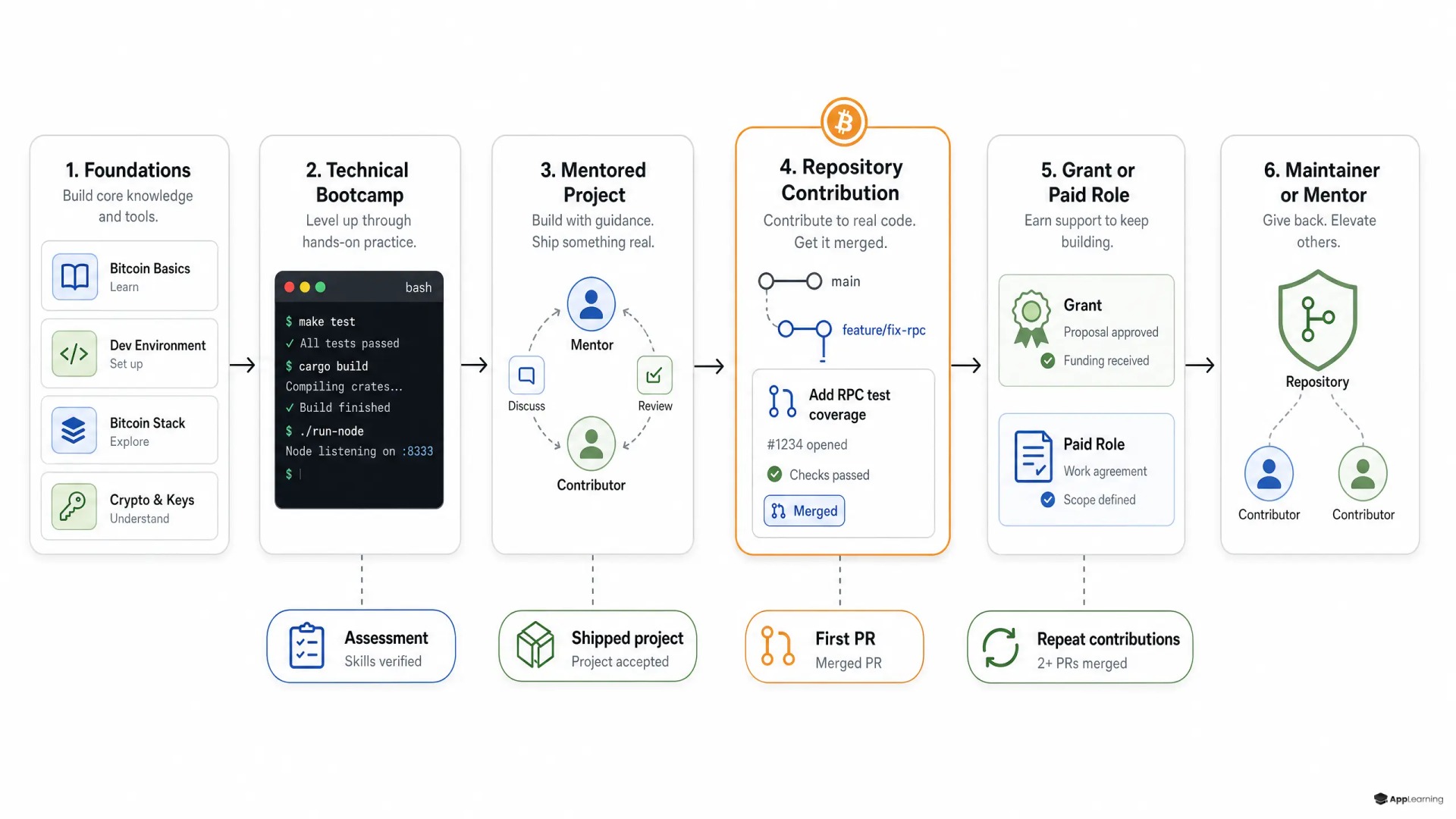
The contributor-conversion funnel
A useful academy separates the journey into observable stages rather than treating every enrolled learner as equally successful.
- Learner: completes prerequisites and demonstrates core Bitcoin, Git and tooling knowledge.
- Builder: ships a scoped project with a public repository, documentation and working evidence.
- Contributor: opens a pull request, issue, review or other traceable contribution in a relevant project.
- Grantee or paid contributor: earns a fellowship, starter grant, contract or role connected to open-source work.
- Maintainer or mentor: takes recurring responsibility and helps new contributors enter the system.
The stages are not a prestige ladder. They are handoffs. Each stage should have a clear entry condition, a practical checkpoint and a next destination. Learners who do not yet progress need useful feedback and a route to try again, not a dead end after a final quiz.
Good to know
What counts as contributor conversion?
Contributor conversion begins when a learner moves from course activity into traceable work, such as a public project, pull request, issue, review, grant or recurring open-source role.
Which developer academy metrics belong on the main dashboard?
Track conversion between learner, builder and contributor stages, then add mentor engagement and 90- or 180-day contribution retention.
Can an academy measure outcomes without owning the repositories?
Yes. Learners can submit repository links and project evidence, while operators collect consent-based self-reported outcomes for grants, jobs and ongoing contribution.
Metrics that expose pipeline health
Developer academy metrics should connect learning records to work evidence and post-program outcomes. Track cohorts over time, not only during the final week. The key is to measure conversion between stages, then inspect where capable people stall.
- Foundation readiness: prerequisite pass rate, practical assessment results and time to competence.
- Build evidence: project submissions, repository links, demo quality and mentor approval.
- Contribution evidence: first pull request, accepted changes, issue triage, code review and documentation work.
- Relationship strength: mentor matches, feedback cycles, repeat interactions and project-team handoffs.
- Durability: active contributions after 90 and 180 days, grants, paid FOSS work, jobs and later mentorship.
Do not reduce the system to merged pull requests. Review capacity varies, and many legitimate contributions are research, testing, design, documentation or community support. The academy should record contribution quality, effort and progression while still using public artifacts wherever appropriate. It should also obtain consent before connecting learner records with public profiles or employer outcomes.
Make your academy’s contributor pipeline visible.
DiscussThe structured layer around open-source work
Open-source communities should not be forced to become learning-management systems. Their scarce time belongs in technical direction, code review and mentorship. App-Learning can provide the structured layer around that work: staged prerequisites, practical checkpoints, project submissions, portfolio evidence, mentor handoffs and cohort analytics. This gives program operators a view of contributor conversion without turning a public repository into a classroom dashboard.
The same system can support product-led Bitcoin companies that want to build local developer communities or technical academies alongside their customer education. Modular journeys make it easier to prepare developers for a specific stack, document practical proof of work and identify the people ready for deeper access, mentorship or paid collaboration.
The standard for Bitcoin FOSS education should be simple. Do not ask only whether people finished learning. Ask whether the program helped them enter useful work, remain in it and eventually create capacity for the next cohort. That is the difference between distributing knowledge and building an ecosystem.