

Key takeaways
- Consumer-facing AI needs product education, not just disclaimers.
- Advice-boundary literacy reduces support, compliance, and trust risk.
- AI workflows need escalation logic that users and staff understand.
- Financial AI literacy must be measured inside the journey.
The risk has moved into the journey
AI assistants in finance are no longer a research topic. They sit in onboarding, support, savings guidance, investment education, credit explanations, and complaint handling. The Cambridge Centre for Alternative Finance found that 81% of surveyed financial-services firms are adopting AI at some level, with AI-powered customer support already the leading front-office use case.
That shift changes the product risk. Model accuracy still matters, but it is not enough. A correct answer can still create harm if the user thinks it is protected advice, if the interface makes a generic explanation feel personal, or if the next step is unclear. The product has to teach the boundary at the moment of use.
The boundary is now a product surface
The advice-boundary problem is simple to describe and hard to operate. A customer asks a financial question. The AI gives a clear answer. The answer may be education, guidance, targeted support, or AI financial advice depending on the facts, the product, the jurisdiction, and how the system uses customer data. Users do not parse those categories while trying to make a money decision.
The UK has already been working on this tension through the Advice Guidance Boundary Review, which examines the line between financial advice and other forms of support. AI raises the stakes because the interface is conversational, adaptive, and often more persuasive than static content.
Reuters reported on July 6, 2026, that Sheldon Mills’ FCA review found more than a quarter of UK consumers trust major chatbots for financial advice despite limited awareness that regulated-financial-services protections do not extend to those services, and that chatbot recommendations may blur the boundary between generic guidance and regulated advice.
Disclaimers cannot carry the whole load
Most AI boundary controls still look like legal text. A disclaimer appears before the chat starts. The user accepts it. Then the conversation proceeds as if the warning never existed. That is weak design. It asks a one-time disclosure to control a dynamic interaction.
FCA research on LLM pilots in consumer guidance found that outcomes such as comprehension and engagement depend on how the model is embedded in the customer journey, including content design and delivery. That finding is operationally important. The education layer cannot be separated from the AI flow.
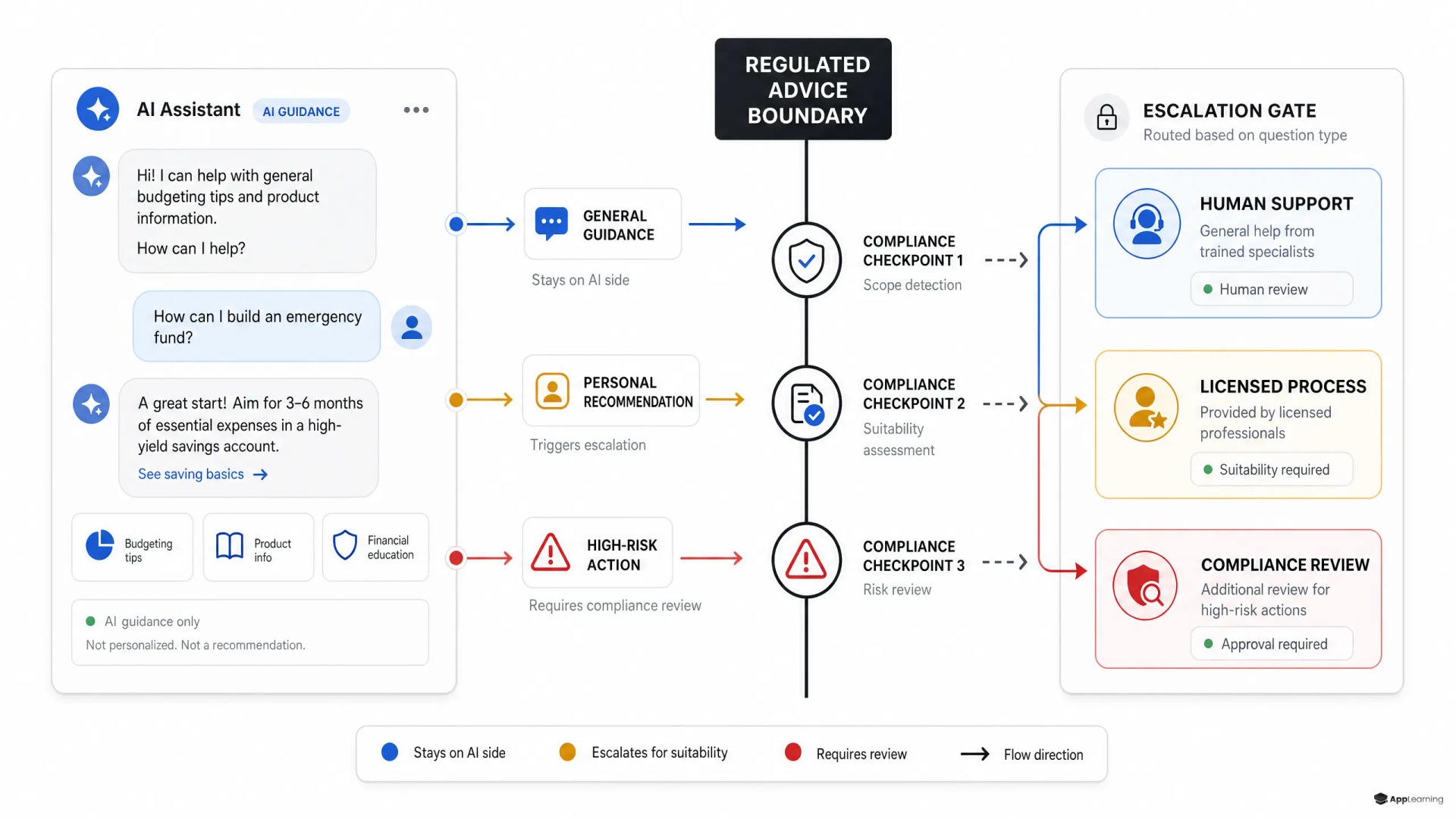
Customers need short, repeated, contextual signals that explain what is happening now. A fintech customer education layer should make these points visible before the user acts:
- Whether the output is educational, generic guidance, targeted support, or a personal recommendation.
- What customer data the assistant used and what it did not use.
- Which decisions remain the user’s responsibility.
- Which risks, protections, and exclusions apply to the next step.
- When the journey must escalate to a human, adviser, or licensed process.
Teams need rehearsal not policy pages
Advice-boundary education is not only for customers. Support, product, compliance, and content teams need the same operating model. The FCA’s consumer understanding guidance points firms toward testing, comprehension checks, chat transcripts, drop-off data, complaints, and clear ownership rather than cosmetic communication changes.
That is where AI compliance training becomes practical. Staff should practise the cases that cause boundary failures: a user asks what to buy, a chatbot gives an overly specific answer, a support agent restates it, and the escalation path is missed. The training should not only explain policy. It should rehearse judgment.
- Classify user intents by risk level and advice proximity.
- Identify language that turns education into recommendation.
- Use approved handoff scripts without sounding evasive.
- Document escalation decisions in a way compliance can review.
- Feed recurring confusion back into product and content design.
Good to know
What is advice-boundary education in financial AI?
It is the in-product and staff-facing education that explains where general information ends, where regulated or licensed advice may begin, and when a user should be moved to a human or approved process.
Why are disclaimers not enough for AI financial assistants?
A disclaimer is usually static, while an AI conversation changes with each prompt. Users need contextual cues, comprehension checks, and clear handoff points inside the actual journey.
Who should own AI advice-boundary readiness?
Ownership should be shared across product, compliance, support, and content. Product owns the journey, compliance owns the boundary logic, support owns escalation behaviour, and content turns the rules into understandable learning.
How can fintechs measure financial AI literacy?
They can track quiz results, misunderstood prompts, repeated support questions, drop-off points, escalation accuracy, and whether users can correctly identify when a response is not personal advice.
Embedded education becomes the control
The FCA says its AI approach remains outcomes-focused and relies on existing frameworks such as Consumer Duty, governance, and accountability rather than separate AI rules. The FCA’s AI approach places the burden back on firms to communicate in ways that meet customer information needs and provide support that fits customer needs.
For a product lead, the practical response is not another PDF in the help centre. It is an embedded readiness path. App-Learning can turn advice boundaries into mobile-first micro-lessons, in-flow explanations, quizzes, staff simulations, and analytics that show where users and teams still misunderstand the line.
This creates a better control loop. Product sees which AI prompts create confusion. Compliance sees whether users understood the boundary. Support sees fewer repeated questions. Content teams can localise the same structure across markets without rebuilding every learning journey from scratch. Financial AI literacy becomes measurable instead of assumed.
Map your AI advice boundaries before users do.
AssessThe product should teach the limit before the limit is crossed
AI assistants will keep moving closer to financial decisions because that is where users feel the most friction. The firms that handle this well will not be the ones with the longest disclaimer. They will be the ones that make the boundary visible, test whether users understand it, train staff to protect it, and escalate at the right moment. In regulated finance, education is not a wrapper around the product. It is part of the product’s safety system.