Key takeaways
- Skills rankings are useful context, but weak proxies for business readiness.
- Learning creates value when tied to role-specific application, not exposure alone.
- Manager reinforcement and short practice loops close the proficiency-to-performance gap.
- Readiness metrics should show whether people can use skills at work.
A ranking is not readiness
The 4 June 2025 HR Magazine report gives HR teams a positive signal: the UK ranked 22nd out of 109 countries for skills proficiency and moved up from 45th in 2024. Coursera also reports strong AI momentum, with GenAI enrollments on its platform up 195% year over year in its 2025 Global Skills Report launch. That is useful context. It is not proof of workforce readiness inside a bank, fintech, or crypto company.
The weak link sits inside the role
A national skills score aggregates people. Work does not. A fraud analyst, customer support lead, treasury operator, and compliance officer apply the same AI or data skill in different risk conditions. Skills application at work is therefore a local design problem. The question is not whether people have taken a course. It is whether they can make the right decision, with the right controls, in the workflow where the risk appears.
Completion metrics hide the transfer gap
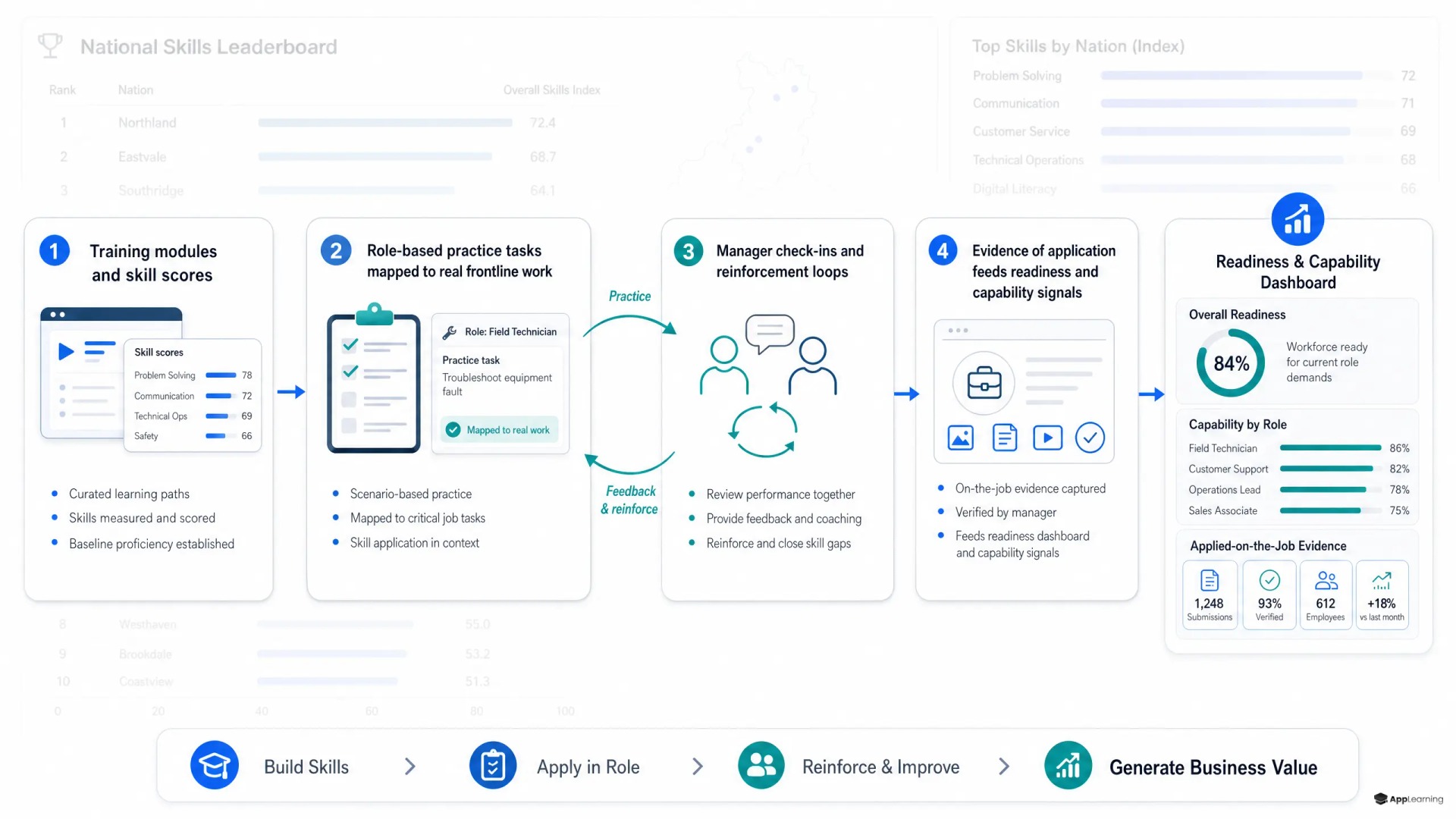
Many teams still measure the easiest signals: enrollments, completions, quiz scores, and confidence. These signals matter for governance, but they can hide the transfer gap. An LMS can show that a sanctions module was completed. It cannot, by itself, show that a payments specialist can spot a risky counterparty, escalate correctly, and explain the decision under policy. Measuring training effectiveness needs a second layer: evidence that the skill changed work.
- Scenario decisions tied to real role risks
- Manager observations against a behavior checklist
- Practice attempts that show improvement over time
- Workflow evidence such as corrected prompts, escalations, or audit notes
Short loops beat large curricula
The World Economic Forum’s Future of Jobs Report 2025 says 39% of workers’ existing skill sets may be transformed or outdated by 2030, while 85% of employers plan to prioritize upskilling. That pace makes annual course refreshes too slow. L&D needs short loops: learn the rule, practise the role decision, get manager feedback, apply it on the job, then adjust the next module.
- Keep modules short enough for the working day
- Use scenarios from current products, policies, and incidents
- Give managers one observable behavior to reinforce
- Review evidence weekly, not at year end
Regulated teams need proof, not volume
This matters more in finance and crypto because errors have external consequences. AI can speed up analysis, communication, and investigation, but it can also create policy, privacy, and conduct risk. The WEF workforce strategy chapter reports especially high expected AI exposure in financial services, with 97% of employers expecting AI and information processing technologies to transform their business by 2030. AI workforce readiness therefore means safe use in role, not broad AI awareness.
Good to know
Should HR teams ignore skills rankings?
No. Use them as market context, then validate readiness against your own roles, risks, and workflows.
What is a better readiness metric than completion?
Track applied evidence: scenario performance, manager-observed behavior, task quality, escalation accuracy, and safe tool use.
Where should AI training start in finance?
Start with high-risk workflows where AI is already used or likely to appear, then define safe role-specific actions.
Execution turns skills into capability
App-Learning fits at this execution layer. Its learning platform is built around microlearning, role-specific learning paths, compliance training, admin rollout, and progress visibility. In practice, policy, product knowledge, and expert know-how can become short mobile journeys with practice moments and analytics. For regulated teams, the point is not more content. It is faster conversion from required knowledge to observable behavior.
Modernize regulated learning with measurable role-based enablement.
TalkCapability is a used skill
Skills rankings help leaders see the weather. They do not tell them whether their own people can fly the plane. Business value comes when learning is close to the role, reinforced by managers, and measured through evidence of application. That is the real operating model for workforce readiness: fewer assumptions, shorter loops, and clearer proof that people can use what they know.