
Key takeaways
- Cost pressure is shifting attention from hiring volume to productive deployment.
- AI tools need role-level readiness before they change performance.
- Legal change makes manager guidance a training priority.
- Short learning loops expose gaps faster than course completions.
- Regulated teams need audit-ready evidence of applied capability.
Cost pressure is now the planning frame
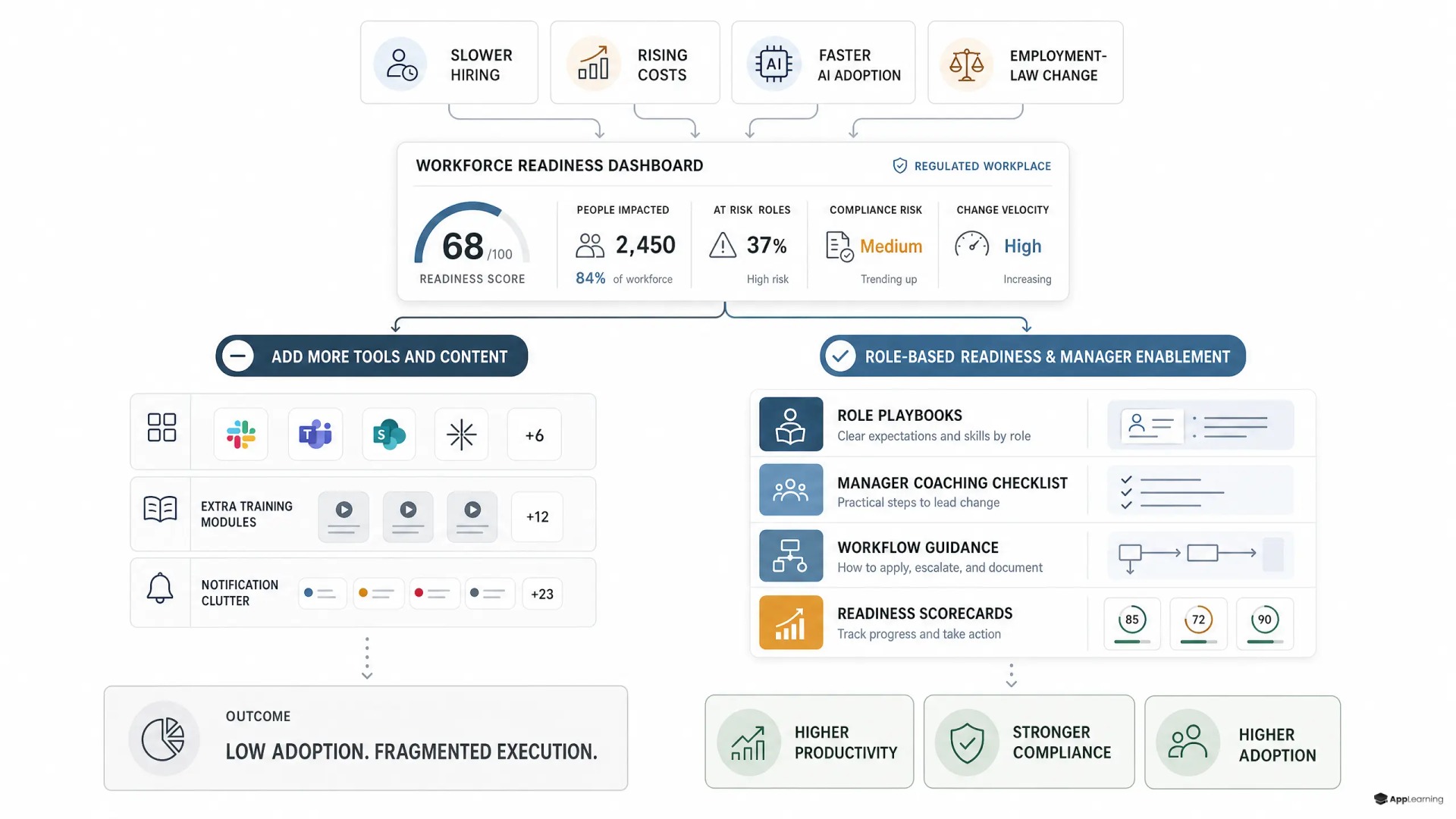
The latest UK labour market data is not a normal hiring signal. It shows employers trying to protect margin, control headcount, and still raise output. For HR and L&D leaders, that changes the brief. Learning can no longer sit beside workforce planning. It has to help answer where work changes, which roles need support, and which managers can execute the change without adding risk.
The earlier CIPD Winter 2025/26 report gives the pressure behind the shift. Employers named higher National Insurance contributions as the biggest financial impact in 2025, and 72% expected the April 2026 National Living Wage rise for adults 21 and over to increase employment costs. That is a difficult setting for broad content programmes with weak business connection.
AI spend does not create readiness by itself
AI adds urgency, but not clarity. CIPD’s November 2025 labour market data found that one in six employers expected AI to shrink headcount over the following year, with exposure highest in early-career and lower-level professional roles and in sectors including finance and insurance, IT, and administrative services. The same CIPD analysis on AI and workforce planning argues for stronger workforce planning and investment in skills, not just technology adoption.
That is the core problem with many AI programmes. They start with tools, licences, and generic prompt training. They often arrive before the business has defined the role impact. A serious skills strategy for AI adoption asks sharper questions.
- Which decisions can AI support in this role
- Which tasks should stay human because judgement, conduct, or client impact matters
- Which controls change when employees use AI in live work
- Which managers can coach safe application rather than police tool usage
- Which evidence proves workforce readiness beyond attendance
Workforce planning and AI training should be designed as one system. If they are split, L&D distributes content while managers absorb the execution risk.
Employment law puts managers in the critical path
For UK employers, Employment Rights Act 2025 training now needs a rollout plan, not a single legal briefing. The Act became law on 18 December 2025, and the Acas implementation summary shows changes running through 2026 and 2027, including holiday record duties, the Fair Work Agency, October 2026 harassment and tribunal changes, and January 2027 unfair dismissal changes.
The government has also said the reforms will be delivered in phases so employers, businesses, and workers have time to plan and prepare through the Plan to Make Work Pay timeline. That planning time is only useful if managers receive clear operating guidance. Policy teams can interpret the law. Managers have to run absence conversations, probation reviews, documentation, escalation, and employee questions under pressure.
This is where compliance training often fails. It tells people what changed. It does not build the behaviour needed to handle a live case correctly.
Short loops beat content libraries
When costs tighten and regulation moves, broad awareness modules are too slow. HR and L&D need short, role-based learning loops that connect policy, scenario practice, manager guidance, and measurement.
- Map the change to affected roles and decisions.
- Define the behaviour the employee or manager must show.
- Build five-minute scenarios from approved policy and legal guidance.
- Test judgement with realistic choices, not recall alone.
- Use analytics to find weak teams, unclear topics, and repeat errors.
This model works because it treats learning as an operating control. The loop starts with a real decision and ends with evidence that people can make that decision better. It also lets HR update fast when guidance changes, without rebuilding an entire course catalogue.
Good to know
How should HR and L&D prioritise AI training under cost pressure?
Start with the roles most affected by AI, then define the decisions, controls, and behaviours each role needs. Tool training should follow role design, not replace it.
What makes manager enablement different from standard compliance training?
Manager enablement focuses on live decisions such as absence, probation, escalation, documentation, and employee conversations. It trains judgement and consistency, not only policy recall.
Where does Employment Rights Act 2025 training fit in the learning plan?
It should run as a phased manager and HR enablement programme. The goal is to translate legal change into clear actions, scenarios, and evidence of understanding.
How can finance and crypto companies measure workforce readiness?
They should combine completions with scenario scores, confidence data, manager dashboards, refresh cycles, and exportable evidence for audit or governance reviews.
Finance and crypto need evidence of application
In a bank, fintech, or crypto company, workforce readiness is not a soft metric. A policy misunderstanding can become a conduct issue, audit finding, client harm, fraud exposure, or regulatory breach. Completions matter, but they are a weak proxy for capability.
A better readiness view combines several signals.
- Completion for mandatory coverage
- Scenario scores for applied judgement
- Confidence checks before and after training
- Manager dashboards by role, team, and location
- Refresh cycles for high-risk topics
- Evidence exports for audit and governance
The point is not to make measurement heavier. It is to make it useful. L&D should be able to tell leaders which teams are ready, which controls need reinforcement, and which managers need support before a mistake appears in production.
Build a readiness layer your managers can actually use.
PlanThe learning stack becomes an execution layer
The practical build is simple but demanding. Approved source material has to become short lessons, quizzes, scenarios, certificates, reminders, and dashboards without losing version control. App-Learning fits here as a controlled mobile academy layer for regulated teams. Its platform material describes role, team, region, and seniority tracks, micro-lessons, quizzes, certificates, and admin reporting for completions, drop-off points, time spent, and exports.
That matters because the execution layer is where strategy becomes behaviour. A workforce plan without measurable learning loops is a spreadsheet. An AI rollout without role readiness is a tool push. A legal update without manager enablement is an incident waiting for a calendar invite. The point is not to spend less on AI. It is to sequence the work. Buy tools when the roles, decisions, policies, and measures are clear. Until then, skills plans matter more than spend because readiness is what turns change into controlled execution.