

Key takeaways
- Stablecoin adoption creates product-education demand.
- Payment users need different education than crypto traders.
- Redemption, reserves, and wallet safety must be explained inside the product.
- Learning analytics can show where users misunderstand money movement.
Stablecoins are moving into the payment layer
Stablecoins started as settlement tools for crypto markets. They are now being designed as payment infrastructure. On June 30, 2026, Open Standard announced Open USD as a stablecoin for global money movement, with partner governance, no mint or redeem fees, and reserve earnings shared with participating businesses. Reuters described the same launch as a consortium including Visa, Mastercard, and Coinbase that aims to broaden stablecoin adoption beyond existing crypto use cases.
The UK rulebook points in the same direction. The FCA's 2026 stablecoin policy statement says stablecoin payments are expected to be brought into future payment regulations alongside other tokenised payments, while the Bank of England and FCA state that the FCA will regulate UK-issued qualifying stablecoins and, in due course, their use in retail payments. Access is getting easier. Understanding is not.
The next bottleneck is user interpretation
A payment user does not think like a crypto trader. They do not start with peg mechanics, liquidity pools, or chain selection. They ask simpler questions: did the money arrive, can I reverse it, what fee did I pay, who holds the reserves, and what happens if I send it to the wrong address.
That is where stablecoin onboarding breaks. If a product says “send dollars instantly” but the user is holding a token in a wallet, the user may map the experience to a bank transfer or card payment. That mental model is wrong in several important moments. The FCA found that stablecoin awareness among cryptoasset users reached 58% in 2025, yet only 51% correctly identified the definition of a stablecoin, and lack of knowledge remained the top reason for not buying one in the same research.
Disclosures do not teach money movement
Legal disclosures are necessary. They are not a learning system. A help-center article is useful after a motivated user searches for help. Stablecoin education has to appear before the user makes the mistake: when they receive funds, choose a network, send to a wallet, redeem into fiat, or cross a jurisdictional boundary.
The education layer must cover the points where money movement becomes ambiguous. The BIS notes that stablecoin arrangements depend on reserve composition, redemption conditions, access to backstops, and the regulatory framework around them, and that redemption frictions are common. Product teams should translate those issues into plain user decisions.
- Redemption means who can convert the token, at what price, through which route, and on what timeline.
- Reserves mean what backs the token, where that backing sits, and how assurance is shown.
- Wallet safety means custody model, recovery process, address checks, and phishing resistance.
- Transfer finality means what cannot be reversed once the transaction is confirmed.
- Fees mean network costs, platform fees, spreads, and off-ramp charges.
- Jurisdictional limits mean who can use, hold, redeem, or receive the stablecoin.
- Payment use cases mean when stablecoins are useful and when a bank rail is still better.
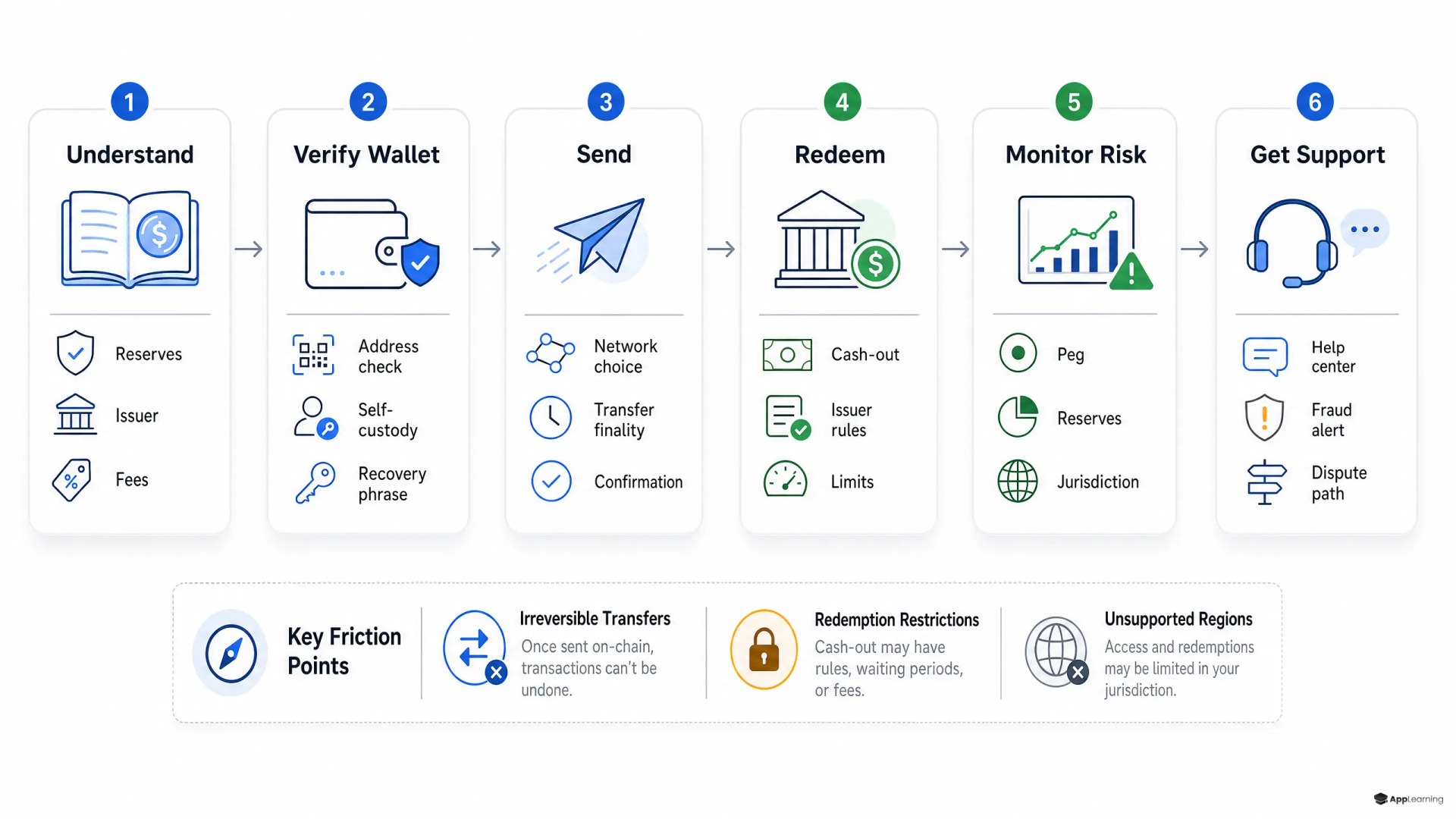
Education belongs inside the transaction path
The right unit is not a course library. It is a decision. Customer education for stablecoins works best as short, contextual learning inside the flow. A user should not have to leave the product to understand whether a transfer is reversible or why a redemption option is unavailable.
This is where fintech education becomes product design. The interface should teach at the moment of intent, then check comprehension only where the consequence is material. A two-question knowledge check before the first external wallet transfer is more useful than a ten-page article about blockchain basics. A guided first redemption teaches more than a generic FAQ about reserves.
- Before the first balance, explain what a stablecoin is and is not.
- Before the first send, show network, address, finality, and test-transfer guidance.
- Before redemption, explain issuer access, bank rail timing, fees, and eligibility.
- Before merchant use, clarify settlement, refunds, disputes, FX, and reporting prompts.
- After each action, show status, receipt, expected timing, and next safe step.
Good to know
How is stablecoin education different from general crypto education?
Stablecoin education is about money movement, redemption, reserves, fees, finality, and payments. General crypto education often focuses on trading, volatility, wallets, and investment risk.
Where should stablecoin education sit in the product?
It should sit inside onboarding, wallet setup, first send, first receive, redemption, and payment flows. The strongest education appears before the user takes an action with financial consequences.
Is a help center enough for stablecoin onboarding?
No. Help centers support users who already know what to search for. Stablecoin onboarding needs embedded prompts, guided flows, short checks, and clear transaction-state explanations.
Which metrics show whether users understand stablecoins?
Useful signals include lesson completion, quiz accuracy, first-transfer completion, redemption completion, support-ticket topics, address-entry errors, fee-page revisits, and drop-off before irreversible actions.
Learning data becomes product data
Good crypto product education reduces support load because repeated confusion is handled once, inside the product, before it becomes a ticket. It also gives product teams a new signal. Quiz misses, abandoned sends, failed address checks, redemption confusion, and repeated fee-page visits show where the product's money model is not clear enough.
Those signals can be tied to activation and retention. If users who fail the “finality” question abandon external transfers, the next release needs clearer send-state design. If users in one language market misunderstand redemption, the issue may be localisation, not demand. Learning analytics turn education from static content into an operating layer for growth.
Build stablecoin confidence directly inside your product.
Learn moreA stablecoin learning path with operational teeth
A practical stablecoin learning path should be short, sequenced, and tied to real actions. Start with the concept. Move into custody and wallet safety. Guide the first low-value transfer. Then teach redemption, fees, limits, and use cases. For business users, add modules for treasury, contractor payouts, merchant settlement, remittances, and reconciliation.
For multi-market fintech teams, the same path must be mobile-first, brand-consistent, and localised without creating a content bottleneck. This is the App-Learning angle: embed learning into the product, instrument it, and update it as the rulebook, payment flows, and user segments change.
Stablecoin scale will not be won by access alone. The products that win will make the user confident at the exact moment money moves. Teams that hide complexity in disclosures will inherit support tickets, failed activation, and mistrust. Teams that teach the mental model inside the product will give stablecoins a real chance to become payment infrastructure, not just another balance users do not fully understand.