

Key takeaways
- AI support quality depends on structured product context.
- Education content should serve users, support teams and AI agents.
- Human review and evaluation loops matter before production rollout.
- Product education analytics reveal confusion before it becomes support volume.
Support automation is becoming an operating priority
AI support agents are no longer a side experiment. They are moving into core customer operations because teams need faster answers, lower support load and better coverage across markets, languages and channels. For mid-market teams that need fast deployment, the goal is not simply to launch an agent sooner. It is to give that agent reviewed product education from day one.
But the main constraint is not the model. It is the quality of product knowledge the model can use. A fintech product often includes eligibility rules, account limits, fees, settlement timing, security flows, risk checks, KYC steps and local regulatory constraints. If those explanations live across release notes, FAQs, Notion pages and old tickets, the agent will learn the organisation’s confusion and repeat it at scale.
The bottleneck shifts from automation to product knowledge
A support agent without structured product context can still sound fluent. That is the risk. It may answer a question about a declined transaction with a generic card explanation. It may describe an outdated fee. It may miss the difference between a user who needs education and a user who needs escalation.
This breaks the support system in predictable ways. Human agents spend time correcting AI drafts. Customers receive plausible but incomplete answers. Product teams lose sight of the real confusion topics. Support deflection looks strong for a few weeks, then satisfaction drops because containment has replaced resolution.
A product education layer gives agents something safe to use
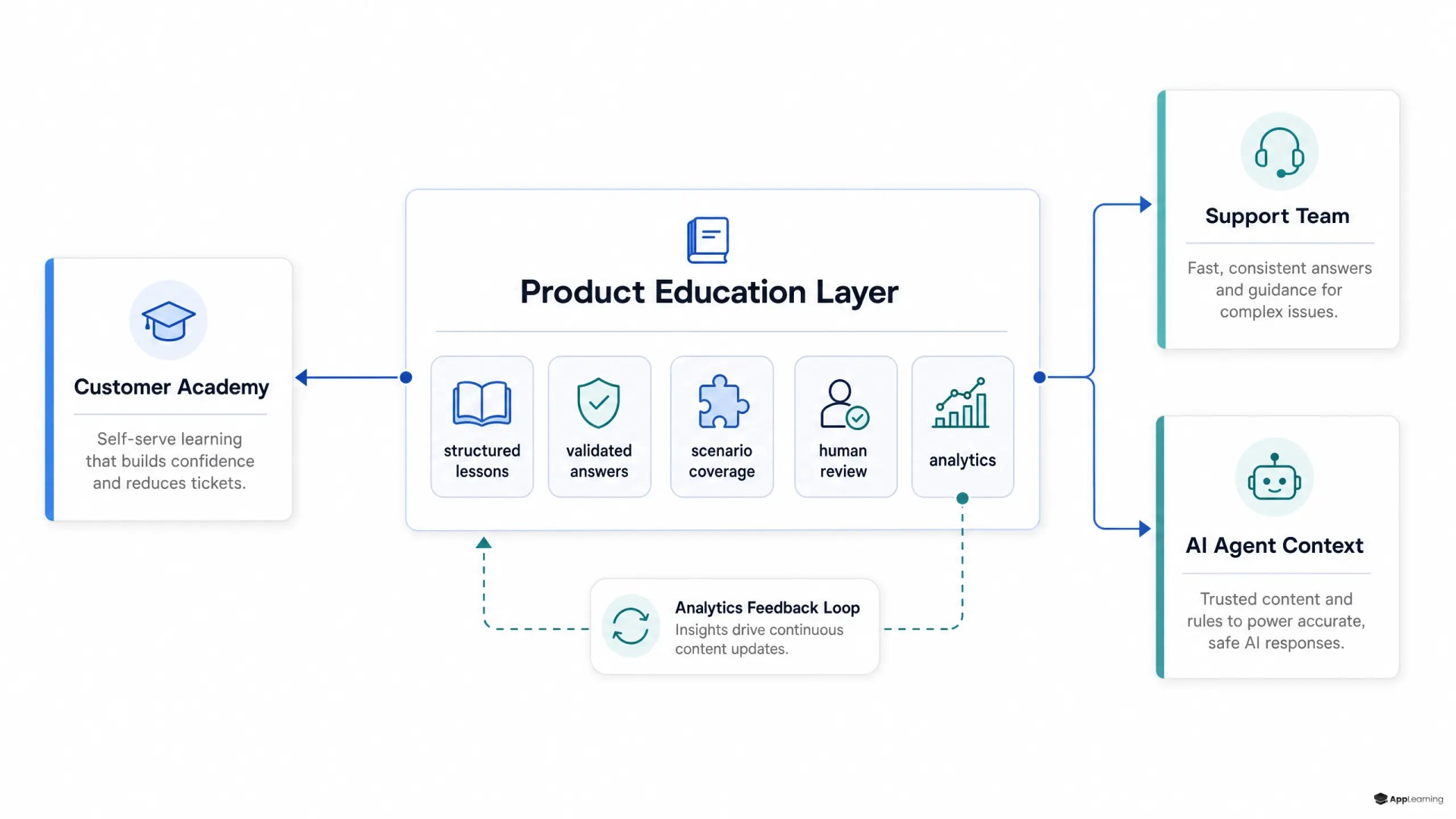
A product education layer is the structured middle layer between product complexity and customer understanding. It should serve customer education, support enablement and AI customer support training from the same source of truth. For a mid-market team, that shared foundation reduces duplicate content work: one reviewed explanation can support customer learning, human support and AI-agent education without three separate rollouts.
- Canonical product explanations with owners, review dates and version history
- Scenario coverage for common, rare and high-risk customer questions
- Concrete examples that show what the answer means in real product situations
- Escalation rules for regulated, emotional, ambiguous or account-specific cases
- Short quizzes and checks that validate whether users and support teams understand the topic
- Multilingual variants that preserve meaning rather than only translating words
This is different from a help center. A help center is often written for search. A product education layer is written for operation. It gives users guided learning, gives support teams approved language and gives AI support agents bounded context they can retrieve, quote, adapt and escalate from.
Evaluation turns knowledge into a production system
Nubank’s June 2026 paper on building customer support AI agents at 100M-user scale is useful because it treats support agents as an evaluated operating system, not a prompt project. The framework combines structured context engineering, human-in-the-loop prompt iteration, LLM judge evaluation with measured agreement and validation from idea to production.
Evaluation-pipeline quality directly determines iteration velocity.
That logic applies directly to fintech customer education. If the educational content is modular, reviewed and measurable, it becomes easier to test whether an AI agent explains a product correctly. If the content is unstructured, every agent improvement becomes a manual argument about what the product means.
One education system should feed users, support and agents
The practical move is to stop treating customer education, support scripts and AI context as separate content streams. The same explanation that helps a user activate a feature inside the app should also help a support agent explain it and help an AI agent retrieve the correct framing.
For a product lead, this changes the workflow. Product defines the feature logic and boundaries. Education turns that logic into mobile-first learning flows, examples and checks. Support tags real customer intents and failure cases. Compliance or risk reviews sensitive wording. The AI agent retrieves approved modules and escalates when the situation leaves the covered scenario.
This is where App-Learning’s approach fits naturally. Embedded lessons, quizzes, gamified flows and learning analytics are not only adoption tools. They can become the structured education substrate behind support deflection, onboarding, advanced feature adoption and AI-agent context.
Good to know
What is a product education layer for AI support agents?
It is a structured set of validated explanations, examples, scenarios, escalation rules and learning checks that can serve users, support teams and AI agents from one source of truth.
How is this different from a help center?
A help center is usually designed for customer search. A product education layer is designed for operational reuse across onboarding, support enablement, AI-agent context and analytics.
Which metrics should fintech teams track first?
Start with self-service rate, AI satisfaction, escalation rate, confusion topics and education-to-support deflection. Add quiz and learning analytics when education is embedded in the product.
Where should the human review loop sit?
Human review should happen before production rollout, after major product changes and whenever analytics show repeated confusion, low satisfaction or risky escalation patterns.
Metrics must show learning, not only containment
Containment alone is a weak target. It can hide poor answers. Nubank’s framework uses online metrics such as self-service rate and transactional NPS in production evaluation, but a product education layer should add knowledge signals around the support journey.
- Self-service rate by intent and customer segment
- AI satisfaction after resolved and escalated conversations
- Top confusion topics before and after educational interventions
- Education-to-support deflection by module, market and product area
- Escalation quality, including whether the human agent receives the full context
- Quiz failure patterns that predict future tickets
These metrics give product teams a better loop. If many users fail a quiz about withdrawal timing, the issue is not only a support issue. It may be an onboarding issue, a UX issue, a pricing issue or a product-language issue. The education layer makes that visible before it becomes recurring ticket volume.
Build the education layer your agents can trust.
TalkThe agent is the last mile of understanding
AI support agents will make weak product knowledge more visible. They will not fix it by themselves. If the education layer is fragmented, the agent becomes a faster way to distribute ambiguity. If the layer is structured, reviewed and measured, the same system helps users learn, helps support teams explain and helps AI agents act within clear boundaries. For complex financial products, that is the difference between automation and trust.