

Key takeaways
- Skills without transferability become local signals with limited market value.
- Portability improves recruiting, internal mobility, and redeployment speed.
- Digital credentials matter when they carry verified outcomes and shared standards.
- Disconnected qualification systems force employers to re-assess skills they should already be able to trust.
Leaders rarely have a learning supply problem. They have a transfer problem. People complete programs, earn certificates, and build experience, yet hiring managers still cannot tell what those capabilities mean outside the system where they were earned.
That is the shift the OECD Skills Outlook 2025 captures when it argues that transparent frameworks for skills assessment, recognition, and credential portability improve job mobility and better use of talent. Learning only becomes economic value when its evidence survives a change of role, employer, platform, or country.
Skills are the core currency for articulating, developing, and recognising capabilities across the labour market.
Portability is the missing layer between learning and work
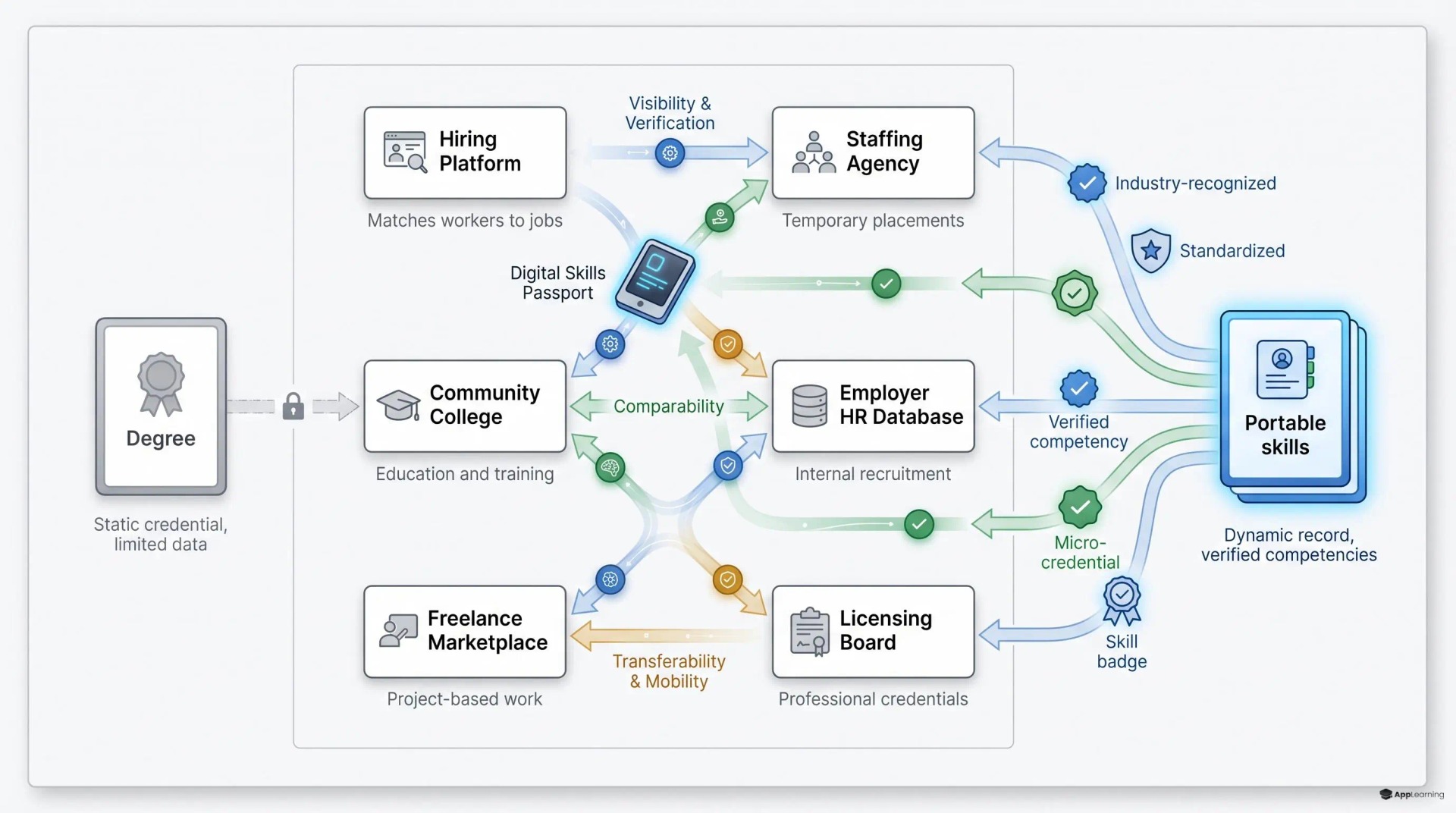
Skills portability is the ability to take a capability signal earned in one context and have it retain meaning in another. The receiving side can understand the skill, compare it to other signals, and trust enough of the evidence to make a decision.
A degree can still do useful work here, but it does so at a high level. It tells the market that someone completed a broad program. Portability works at a finer resolution. It shows which skills were demonstrated, how they were assessed, when they were earned, and whether they map to a shared framework.
Fragmentation turns real capability into local currency
The biggest waste in learning systems is not low completion. It is stranded capability. UNESCO’s Global Convention on Higher Education exists because recognition across borders is still a structural problem, and its scope explicitly includes prior learning, partial studies, and learning completed remotely or across borders. The European Commission’s Union of Skills now includes a Skills Portability Initiative for the same reason: skills lose value when they cannot travel.
- Internal mobility slows because managers do not trust evidence from other units or prior roles.
- External hiring costs rise because recruiters fall back to pedigree proxies instead of capability signals.
- Workers repeat training to re-prove skills they already have.
- Cross-border growth gets harder when qualifications cannot be compared quickly.
Digital evidence changes the economics of trust
Portability is not a PDF problem. It is a data problem. Europass European Digital Credentials were designed so institutions can create, issue, share, and verify learning credentials, including outcomes linked to shared skills taxonomies such as ESCO or DigComp. Comparability improves when the skill description travels with the evidence instead of sitting in a recruiter’s guesswork.
The technical layer is also maturing. The W3C Verifiable Credentials Data Model v2.0 gives digital credentials a common trust model, and 1EdTech’s Open Badges 3.0 adds a badge format built for stronger interoperability, security, and mobility. Standards do not create labor mobility by themselves, but they lower the translation cost between learning systems, wallets, HR platforms, and employers.
Static credentials weaken as skill demand speeds up
This is why portability can matter more than another degree. The OECD’s 2025 skills-first work argues that people who build skills through work, self-learning, or microcredentials are often overlooked by degree-centric hiring. The issue is not that degrees have no value. The issue is that they are blunt instruments in markets that increasingly need precise capability matching.
For leadership teams, that changes the investment question. Funding more learning without redesigning the evidence layer produces more content consumption, not necessarily more mobility. App Learning is useful here when it acts as the bridge between modular content, assessment events, and portable skill evidence so capability does not disappear at the edge of the platform.
See how App Learning connects content, assessment, and portable skill evidence.
ExploreLeadership can design for transfer instead of accumulation
The operating model is straightforward.
- Start with a shared skill language for priority roles.
- Tie learning modules to observable performance, not attendance.
- Issue credentials at the outcome level with issuer, evidence, and renewal data.
- Choose formats other systems can verify and ingest.
- Accept equivalent external evidence so portability works both ways.
The real constraint is no longer only whether people can learn more. It is whether what they learned can be used somewhere else. In a fragmented labor market, the organizations that win will not be the ones that issue the most credentials. They will be the ones that make capability visible, comparable, and transferable across teams, employers, and borders.
Good to know
Do degrees still matter for leadership teams?
Yes. Degrees remain useful signals for broad preparation, regulated professions, and long-cycle development. The problem is treating them as the only or best proxy for current job-ready capability.
What makes a skill signal portable?
A portable signal carries clear outcomes, verified assessment, issuer identity, time context, and a format another system can interpret. If the receiving side cannot compare or verify it, portability breaks.
Where should companies start?
Start with one role family where mobility matters and build one end-to-end flow from learning activity to assessed evidence to reusable credential. Once that signal is trusted internally, expand it across adjacent roles and external hiring.