

Key takeaways
- AI education procurement now includes model and platform dependency risk.
- Content, assessments and learner records should remain portable.
- The knowledge layer should be separated from the model layer.
- A vendor-neutral academy protects prior learning investment when providers change.
AI education procurement is no longer just a choice between an LMS and a chatbot. Foundation-model providers are moving into the learning stack itself. For a growing company, that raises a practical question: if the provider changes its prices, policies, model access or product direction, does your onboarding and capability-building system still work?
AI labs are moving into the learning stack
The market shift is already visible. OpenAI sells ChatGPT Edu to universities, Anthropic offers Claude for Education as an institution-wide plan, and Google has brought Gemini into Workspace for Education. These are not generic APIs sold only to developers. They combine assistant interfaces, administration, knowledge access and learning workflows in one provider environment.
That can be useful. A direct provider offer may bring strong models, rapid product improvement and simpler initial rollout. But the buying decision now reaches beyond the current feature set. It determines where course structure, assessment logic, learner evidence and internal knowledge will live.
Lock-in has moved beyond the LMS
Traditional EdTech vendor lock-in was often about course formats and user records. AI adds deeper dependencies. Teams can build onboarding around provider-specific assistants, prompt flows, knowledge spaces, retrieval settings and model behaviours. Once those components become the academy, replacing the provider becomes an operational redesign rather than a technical migration.
Model dependency is also real infrastructure risk. Google’s Gemini deprecation documentation defines shutdown as the point at which a model endpoint is no longer available and publishes replacement paths for retiring models. A learning operation should expect this kind of change and design for it.
- Content lock-in when lessons, media and learning paths exist only inside a provider workspace.
- Assessment lock-in when questions, scoring rules and attempt data cannot be exported in usable form.
- Knowledge lock-in when source documents, chunks, embeddings and retrieval rules are inseparable from one model service.
- Workflow lock-in when prompts, automations and tutor behaviours have no model-independent specification.
- Analytics lock-in when completion, practice and competence evidence remains in a proprietary dashboard.
Portability is a system design requirement
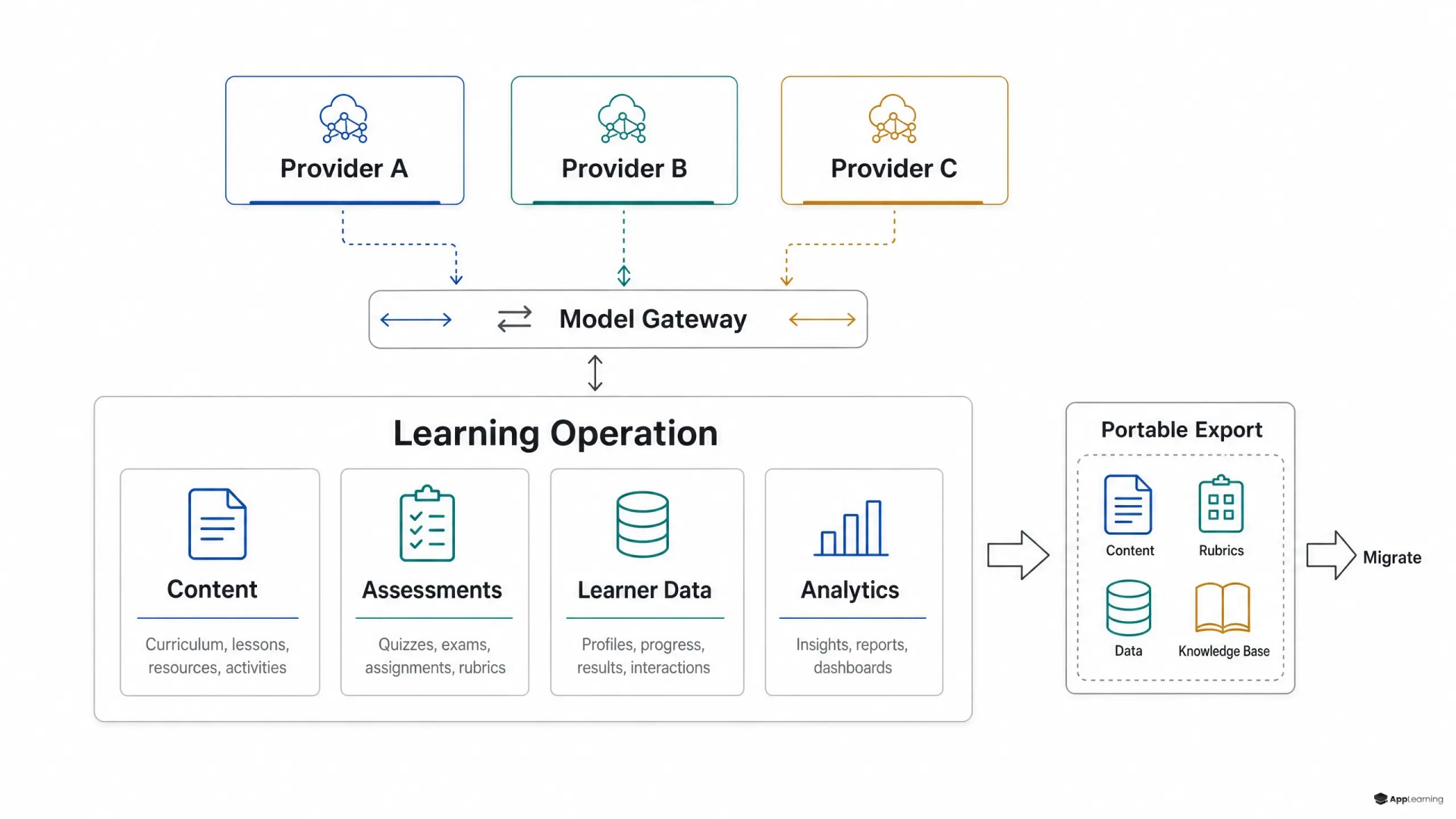
AI learning platform portability does not mean that every feature will transfer without effort. It means the institution retains the assets and records needed to continue learning with another provider. The academy must remain the system of record; the model should remain a replaceable capability.
A portability plan should cover five layers:
- Structured content: exportable lessons, media, metadata, learning paths, versions and ownership rights.
- Assessments: item banks, scoring logic, feedback rules, attempts and results. The QTI standard exists specifically to package and move questions, tests, usage data and results between conformant applications.
- Learner data: identities, enrolments, completion, proficiency evidence, credentials and consent records in documented formats.
- Knowledge sources: original files, source links, access policies, chunking rules, citations and evaluation sets, not only a provider-managed vector index.
- Model dependencies: prompt templates, tool definitions, routing rules, safety constraints and test cases that allow a new model to be evaluated before it reaches learners.
Good to know
Is portability only relevant for large institutions?
No. Smaller companies have fewer people to absorb a failed migration. Once onboarding paths and product knowledge are embedded in one tool, switching costs rise quickly.
What should be exportable first?
Start with structured content, assessment items and results, learner records, source knowledge and the configuration that shapes AI behaviour. These are the assets that preserve prior learning investment.
Procurement needs exit criteria
A sensible AI LMS strategy treats portability as an acceptance criterion, not a promise in a sales call. Ask vendors to demonstrate the exit path with a sample export and a migration scenario.
- Can we export all authored content, including structure, metadata and revision history?
- Can we retrieve assessment items, scoring logic, responses and learner results in a documented format?
- Who owns generated content, prompt configurations and knowledge-base assets?
- Can we export learner records at tenant level, not only one user at a time?
- Can our own source documents and access rules be moved without rebuilding the knowledge layer?
- Which model identifiers, preview features and provider services does the solution depend on?
- What happens to access, retention and export rights at contract end?
- Can another tool connect through standards such as LTI, which supports standard integration between learning platforms and remote tools?
Keep your academy stable while AI providers evolve.
Talk to usA stable academy can outlast the model cycle
For a startup with 50 or more employees, this is not abstract governance work. Every new hire needs a dependable route to product knowledge, operating practices and role capability. If that route changes whenever an AI provider changes direction, managers return to ad hoc onboarding and undocumented tribal knowledge.
App-Learning is designed as the vendor-neutral learning platform in that architecture. Structured academies, governed company content and learner analytics belong in a stable learning layer. AI can support authoring, practice, search and feedback, while the organisation keeps control of its learning operation and can change model providers when the economics, policy or performance case changes.
The strongest AI learning system is not the one that binds an organisation most tightly to today’s model. It is the one that compounds knowledge, assessment evidence and onboarding quality over time while keeping the model layer open to change.