

Key takeaways
- One clean text lesson tests prose generation, not a full authoring workflow.
- Conceptual and calculation-heavy units expose different authoring limitations.
- Sequence context reveals whether prerequisites and narrative logic survive generation.
- Measure revision effort and editability alongside time to first draft.
A polished demo can hide a weak workflow
A single, text-heavy lesson is the most forgiving test an AI authoring tool can receive. It can produce fluent copy, a few factual questions and a neat visual layout while avoiding the harder work of instructional design. The demo may look complete, yet reveal nothing about whether the tool can preserve prerequisite knowledge, explain a difficult distinction, structure a calculation, specify a diagram or create feedback for a meaningful learner decision.
That is a problem in finance and crypto learning. A weak explanation of a control, product mechanism or risk concept will not become reliable because it appears in a polished interface. It still has to survive subject-matter review, compliance review, visual production and later updates. NIST’s AI Risk Management Framework places evaluation within the design, development and use of AI systems, which is the right mindset for an AI course creation pilot: test the real workflow, not its easiest output.
A benchmark needs varied cognitive work
Different learning demands create different design problems. The What Works Clearinghouse recommends combining worked examples with problem solving, graphics with verbal explanation, and abstract with concrete representations. An AI authoring benchmark should therefore include work that requires those combinations rather than treating a text summary as a proxy for learning design quality.
- A concept-heavy unit that distinguishes two related ideas and corrects a common misconception.
- A calculation-heavy unit with a formula, defined inputs, an explained solution path and an applied decision.
- A technical diagram or process visual whose labels, order and explanatory text must align.
- An interaction that tests judgment and provides useful feedback for plausible wrong choices.
- Surrounding units that expose prerequisites, recurring terms and the intended narrative sequence.
- Repeated edits to text, quizzes, visual explanations and interactions after expert review.
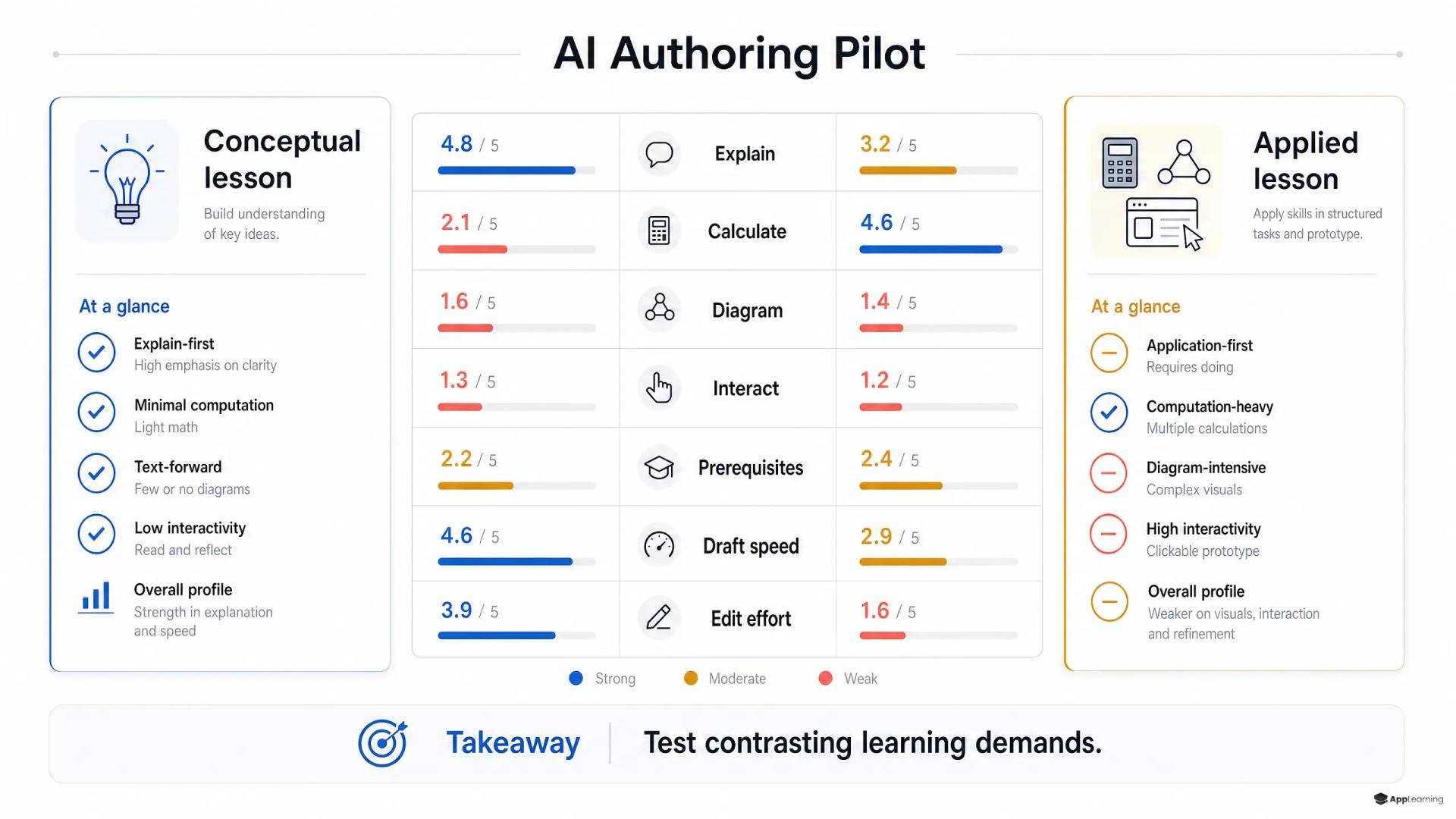
Two units expose the gaps
A practical benchmark can stay small. Select two contrasting units from the same technical module and design each for roughly eight to ten minutes of learning. The first should require a clear conceptual distinction and a visual interaction. The second should require a formula, a calculation workflow, a technical diagram and a decision that applies the result. Supply the adjacent units as context rather than isolating the test content.
This pairing makes weak spots visible quickly. The concept unit tests whether the system can explain without flattening important nuance. The applied unit tests whether it can keep numbers, labels, visual logic and learner feedback consistent. The surrounding sequence tests prerequisite awareness. A tool that performs well on one unit and fails on the other has not failed the pilot. The pilot has done its job by making the boundary clear.
Good to know
Why is one lesson not enough for an AI authoring benchmark?
One lesson usually tests only a narrow task, such as explanation or quiz writing. A credible benchmark needs contrasting units that test reasoning, calculation, visuals, interactions, sequence awareness and revision.
Does an AI course creation pilot need a large content library?
No. Two deliberately different units from one module can produce a useful signal when they include adjacent-unit context and pass through the full expert review cycle.
Which metric matters most in an authoring pilot?
Track time to an approved, editable draft. Fast generation has little value if reviewers must rebuild the interaction, correct the calculation or rewrite the explanation.
Measure the revision system
Generation speed is only one measure, and often the least useful one. The useful metric is time to a draft that an instructional designer and subject-matter expert can realistically approve, adapt and publish. That shifts the evaluation from impressive first output to the quality of the editable learning content and the cost of making it trustworthy.
- Time from source concept to a usable first draft after an initial quality check.
- Accuracy and completeness of explanations, calculations, answers and feedback.
- Quality of interactions, including whether choices represent realistic learner errors.
- Editing effort across copy, question logic, visuals, media briefs and activity flow.
- Ability to preserve approved terminology, style rules and source references through revisions.
- Traceability of changes so reviewers can see what the AI created and what people corrected.
Test your AI authoring workflow against work that resembles the real curriculum.
Plan pilotPilot for handover rather than theatre
App-Learning structures realistic AI authoring pilots around representative work. We start with source concepts, audience constraints, compliance requirements and existing design standards. We then turn the selected material into editable learning units with text, quizzes, visual explanations and applied interactions. The point is not to prove that generated prose is possible. It is to establish where AI training content helps the team move faster, where expert review remains essential and what a safe operating model looks like.
A valid instructional design evaluation produces more than a demo. It produces a benchmark, a review rubric, a record of revision effort and a clear decision about which parts of authoring can scale. That is the difference between buying an impressive output and building a learning system that can keep pace with a regulated business.