
Key takeaways
- Knowledge scope is an architecture decision, not a prompt-writing detail.
- Platform guidance, company standards and course sources need different owners.
- Layer separation reduces accidental cross-course contamination.
- Governed knowledge can still support fast, reusable authoring workflows.
AI Authoring Needs Three Separate Knowledge Layers
An enterprise AI authoring tool fails when it treats every uploaded file, policy and prompt as one shared knowledge pool. That model seems simple. It also makes ownership vague, reuse unpredictable and review difficult. A sales-onboarding deck can influence a compliance course. A temporary course brief can become an invisible default. A retired policy can remain active because nobody knows where it is being retrieved.
The real design decision is knowledge scope. A sound learning knowledge architecture separates rules that apply to every output, standards that belong to one organization and evidence that belongs only to a defined curriculum or authoring session. This is not a prompt-writing detail. It is the control system behind reliable enterprise learning authoring.
The false comfort of one knowledge pool
A single pool creates two opposite problems. Make it broadly accessible and authors risk using irrelevant, outdated or confidential material. Lock it down tightly and each team rebuilds the same instructions, terminology and quality checks. Neither model gives L&D a clear answer to a basic review question: why did the AI produce this lesson?
For regulated teams, traceability cannot be an afterthought. NIST’s Generative AI Profile treats governance and content provenance as central considerations for managing generative-AI risk. In learning, that means knowing which knowledge shaped a learning objective, scenario, assessment item or feedback message.
A layered model makes that answer operational. Each layer has a purpose, an owner, access rules, a review cycle and a clear boundary for reuse.
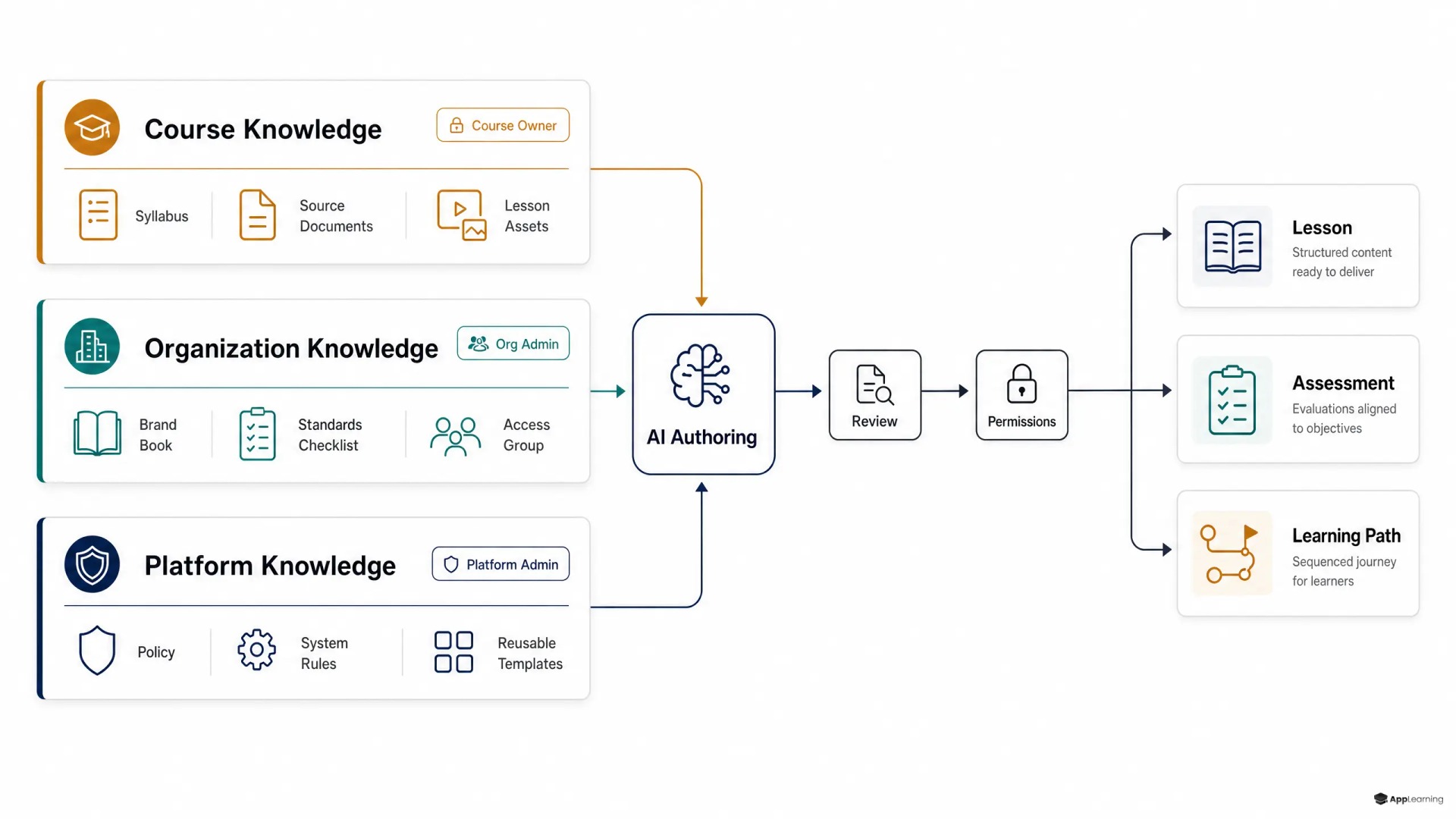
The platform layer holds the method
The first layer contains platform-level instructional methods and product rules. It should hold reusable patterns such as learning-objective formats, assessment design rules, accessibility requirements, interaction templates, tone controls and structural constraints for lessons.
Platform staff own this layer. Authors can use it but should not casually rewrite it for a single course. This creates a dependable baseline: every output follows the same instructional logic, while the platform team can improve that logic once and apply it across the system.
This is where an AI course generator should know how to build learning. It should not decide what a specific organization is allowed to say.
The organization layer holds the operating standard
The second layer belongs to the customer organization. It contains approved terminology, brand and writing guidance, internal control language, role definitions, legal requirements, product context and organization-wide quality standards. It lets a bank, fintech or crypto company make AI-generated learning sound and behave like its own operating environment.
Ownership here is shared but explicit. L&D manages learning standards. Legal and Compliance approve controlled statements. Design governs visual and language conventions. Subject-matter experts validate business accuracy. In the EU, Article 4 of the AI Act also requires providers and deployers to take measures for sufficient AI literacy among people operating or using AI systems on their behalf. That makes role-specific guidance and review workflows part of deployment, not optional documentation.
Organization knowledge should be reusable across curricula, but versioned. When a policy changes, the system should show which courses used the previous version and which outputs need review.
Good to know
What makes a knowledge layer different from a folder structure?
A folder organizes files. A knowledge layer defines scope, ownership, permissions, retrieval priority, versioning and review responsibility. Those controls determine whether content can influence one course, one organization or every output.
Can course-specific material become reusable later?
Yes, but it should move through an explicit approval process. A designated owner should validate the material, define its new scope and place it in the organization layer rather than leaving it as an accidental default.
Who should approve AI-generated learning in a regulated company?
Approval should follow the content type. Subject-matter experts validate accuracy, L&D validates instructional quality, Legal or Compliance approves controlled claims, and Design checks brand and experience standards.
The course layer protects the evidence
The third layer contains course-specific source material: a new product manual, a policy update, a risk case, interview notes, reference media or a subject-matter expert brief. It is available only to the relevant curriculum, course or controlled authoring session.
This boundary matters. Course material is evidence, not a new enterprise standard. A source uploaded for anti-money-laundering training must not silently influence a leadership programme or a customer-support module. The default should be isolation. Reuse should require a deliberate promotion process, owner approval and a new destination in the organization layer.
The course owner and assigned reviewers control this layer. They also need source-level visibility: which files informed a lesson, which claims require validation and what has changed since the last review.
See how App-Learning can operationalize governed AI authoring.
ExploreFrom governed inputs to usable learning products
Layer separation does not slow authoring. It removes repeated setup work. At generation time, the system can apply platform methods first, organization standards second and course evidence third. The author then directs the task rather than restating every guardrail in a prompt.
App-Learning can act as the technology layer that turns these governed inputs into structured curricula, lessons, practice interactions and assessments. The useful output is not merely generated copy. It is a reviewable learning product with defined sources, controlled permissions and reusable building blocks.
That is the difference between a convincing demo and governed AI content creation that can operate at enterprise scale. When knowledge has clear scope, AI can move faster without becoming a new source of policy drift, content leakage or untraceable learning decisions.