

Key takeaways
- Faster coding raises the cost of ambiguous product decisions.
- Discovery should test real learning workflows, not collect feature preferences.
- Acceptance criteria connect learner needs, governance rules, and implementation work.
- AI-assisted software delivery works best after product boundaries are understood.
The bottleneck has moved upstream
AI coding changes the economics of building software. A team can now produce screens, integrations, data models, and test scaffolding far faster than before. But speed at the keyboard does not create product clarity. It simply lets a team turn unclear decisions into working software sooner.
For a growing company, that is a real risk. An onboarding app can be polished, connected to the LMS, and filled with AI-generated content while still failing new hires. Perhaps it teaches company facts but not the tasks people must perform in week one. Perhaps it gives managers no way to verify progress. Perhaps it exposes sensitive knowledge through the wrong workflow. Faster delivery does not reduce the cost of these mistakes. It can compound them.
The constraint therefore moves upstream into AI coding product discovery. Teams need sharper definitions of the learner, the job to be done, the moment of use, the content owner, and the evidence that a workflow works. The Scrum Guide defines a Product Goal as the future state that guides planning for a reason: implementation choices need a clear target.
Vision creates options but not boundaries
Broad product visions are useful at the start. “Build an AI authoring product” or “create a modern onboarding platform” can open the right conversation. They are not instructions an implementation team or coding agent can safely execute.
A broad vision can contain dozens of hidden decisions. Should managers import existing slide decks, policies, videos, or SCORM packages? Which interaction types suit a safety procedure versus a sales playbook? Can employees ask an AI assistant questions about unpublished company information? Which learning records must flow into an LMS? Who approves generated content, and what happens when the source material changes?
Without boundaries, the backlog becomes a catalogue of plausible features. That is not LMS product strategy. It is a delayed decision system. Each feature may sound reasonable in isolation, but the combined product becomes expensive to govern, difficult to explain, and weak at the moments where learners need it most.
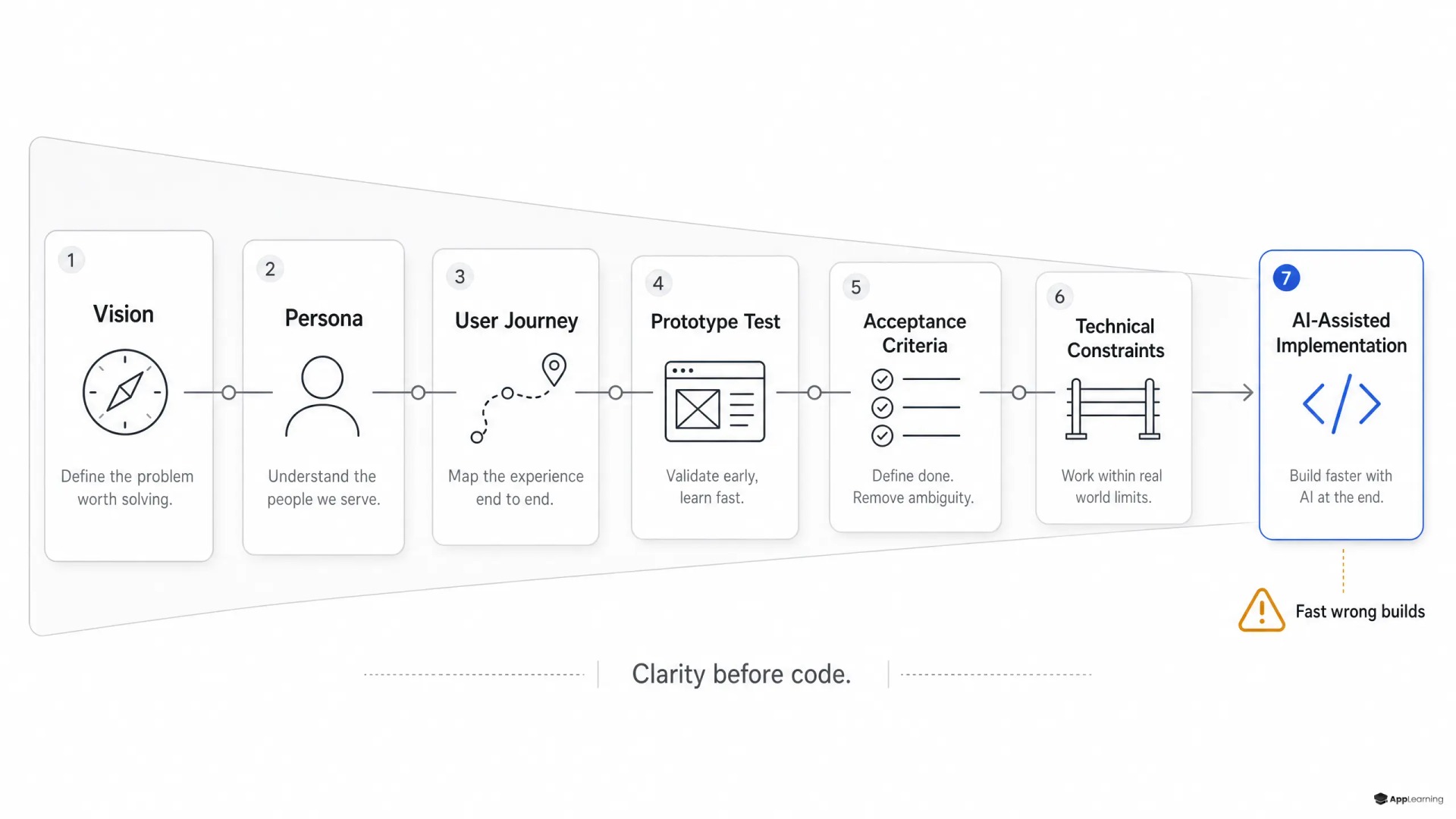
Discovery must test work, not preferences
The practical answer is a short, disciplined discovery loop before architecture hardens. The goal is not to collect opinions about features. It is to reduce the uncertainty that would otherwise be encoded into the product.
- State one product assumption in operational terms. For example, a new account executive needs a five-minute guided workflow before running a first customer discovery call.
- Interview the people who perform, manage, or support that task. Ask for the current process, failure points, source materials, and proof of competent completion.
- Turn the workflow into a simple mockup. Show the decision points, content format, feedback loop, permissions, and handoff to a manager or system.
- Run task-based tests. Give users a realistic scenario and observe whether they can complete the job, not whether they say they like the concept.
- Record validated requirements, rejected requirements, open risks, and the next assumption to test. Then repeat.
Two or three cycles are often enough to establish a credible first boundary. The exit is concrete: a primary persona, a prioritized MVP, tested core journeys, documented technical risks, and learning technology requirements that a delivery team can act on. This is especially important for startups where onboarding quality cannot depend on whichever manager has time to explain the company that week.
Good to know
What should acceptance criteria cover in a learning product?
Cover the user role, task, expected outcome, permissions, source content, feedback, reporting, edge cases, and constraints such as privacy or accessibility. A criterion should make it possible to verify that the workflow works in practice.
Can AI replace product discovery for an onboarding platform?
No. AI can help create prototypes, summarize research, draft content, and implement defined work. It cannot determine which onboarding moments matter most without evidence from employees, managers, and operational data.
When should a team begin AI-assisted implementation?
Begin once the primary persona, MVP scope, core journeys, technical risks, and feature-level acceptance criteria are clear enough to guide build and test decisions. Discovery can continue, but the first product boundary should be explicit.
Acceptance criteria become the control layer
Acceptance criteria AI development turns product intent into a checkable contract. They tell a developer or agent what must be true when the work is complete. They also expose what the team has not decided.
Weak criterion: “Users can create AI learning content.” Stronger criterion: “A learning manager can create a three-step onboarding module from an approved policy document, edit every generated section before publication, assign the module to a named cohort, and see completion status without exposing the source document to learners outside that cohort.”
The stronger version defines the user, the workflow, the content source, the human control point, the permission boundary, and the measurable outcome. It gives AI-assisted software delivery useful constraints. It also makes testing possible. The NIST Generative AI Profile notes that generative AI may require added human review, documentation, and management oversight, which is precisely why governance cannot be left as a vague future concern.
For agentic development, criteria should cover more than the happy path. Include roles and permissions, empty states, error handling, audit needs, content versioning, data retention, accessibility, integration failures, and the conditions under which the feature must not act. An agent can generate many implementation paths. Acceptance criteria narrow those paths to the one the product can responsibly support.
Define the learning workflow before accelerating the build.
Talk to usDefinition and delivery belong in one system
App-Learning starts before the build request. We define personas, learning workflows, content formats, technical constraints, and measurable acceptance criteria with the product team. Only then do we use AI where it improves delivery speed: prototyping, implementation, test creation, content operations, and iteration.
That sequence matters because a learning product is not a collection of screens. It is an operating system for capability: what people need to know, do, practise, prove, and revisit while the company changes. A clear definition protects the business from building a fast but irrelevant tool. It also gives engineers and AI agents the context needed to deliver reliable value rather than plausible output.
The teams that benefit most from AI coding will not be those that write the longest prompts. They will be the teams that make fewer unresolved product decisions, test their learning workflows early, and define done before software generation begins.