

Key takeaways
- Europe is building a cross-border skills operating system, not just funding more courses.
- Skills policy is now tied directly to competitiveness, productivity, and industrial transition.
- Portable, measurable, and shared skill signals matter more than isolated learning activity.
- Leadership teams need learning infrastructure that can map policy goals to workforce execution.
Leadership teams across Europe are reading the same signals from different angles: talent shortages, slower hiring, uneven digital capability, green transition pressure, and a policy environment that suddenly treats skills as a hard economic variable. The important shift is not that governments want more training. It is that the European Commission’s Union of Skills reframes skills as infrastructure for competitiveness, labor market function, and mobility across the single market.
That matters because infrastructure changes operating models. Once skills move into the same frame as the Competitiveness Compass, the question for employers is no longer whether learning is valuable. The question is whether the organization can make skills visible, portable, measurable, and usable across hiring, deployment, and capability building.
Skills have moved from support function to economic system
The old model treated skills as a mix of education policy, employer training, and labor-market repair. The new model connects them to growth, industrial resilience, and workforce availability. In the Commission’s current framing, the Union of Skills is designed to reinforce the Competitiveness Compass, the Clean Industrial Deal, and broader preparedness strategy.
This is why the shift feels larger than a new initiative. Skills policy is being pulled into the machinery of economic coordination. The Commission has proposed a recommendation on human capital in the European Semester, which means workforce capability is being positioned closer to fiscal, productivity, and reform discussions rather than sitting only inside education ministries or HR teams.
The strategic pressure behind this move is straightforward. On the Commission’s own Union of Skills page, key figures show that one in five adults struggle with reading and writing, one in four 15-year-olds falls short in reading, maths and science, and nearly four in five SMEs cannot find the talent they need. When those numbers are tied to competitiveness policy, learning stops being a cultural nice-to-have and becomes a capacity constraint.
The Union of Skills is a new architecture, not a single program
Europe is not replacing one training scheme with another. It is building a multi-layer architecture that connects schooling, vocational pathways, adult reskilling, mobility, and governance. The Union of Skills framework is built around five practical blocks that together look much more like an operating system than a funding announcement.
- Basic and advanced skill formation, including stronger foundations in literacy, numeracy, science, digital capability, and STEM pathways.
- Regular upskilling and reskilling through mechanisms such as micro-credentials, sector partnerships, skills guarantees, and academies linked to strategic transitions.
- Cross-border skills mobility through portability of skills and qualifications, a European degree track, and a new European VET diploma.
- Talent attraction and retention through EU-level recruitment channels, visa simplification, and science-focused talent measures.
- Governance through shared skills intelligence, a high-level board, and closer integration with European economic coordination.
Each block solves a different failure point. Basic skills address pipeline quality. Reskilling addresses transition speed. Portability addresses labor allocation across borders. Talent measures address shortages. Governance addresses fragmentation. Put together, they show a policy system trying to make skills legible and actionable at European scale.
The five building blocks change what employers should measure
For employers, the biggest mistake would be to read this as background policy. If Europe is moving toward micro-credentials, skills portability, common intelligence, and stronger vocational interoperability, then firms that still run learning as disconnected content libraries will increasingly sit outside the direction of travel.
The operational implication is that capability systems need to answer four questions well. What skills matter by role and market. How current capability is evidenced. Which learning interventions change performance. And how those signals can travel across recruitment, internal mobility, and external partnerships.
That logic is reinforced by existing EU targets. The Commission’s social and digital agendas already point to 60% of adults participating in training every year and 80% of adults having at least basic digital skills by 2030. The policy direction is clear even if national implementation remains uneven: participation alone is not enough unless capability can be demonstrated and used.
Learning infrastructure is becoming a competitiveness layer
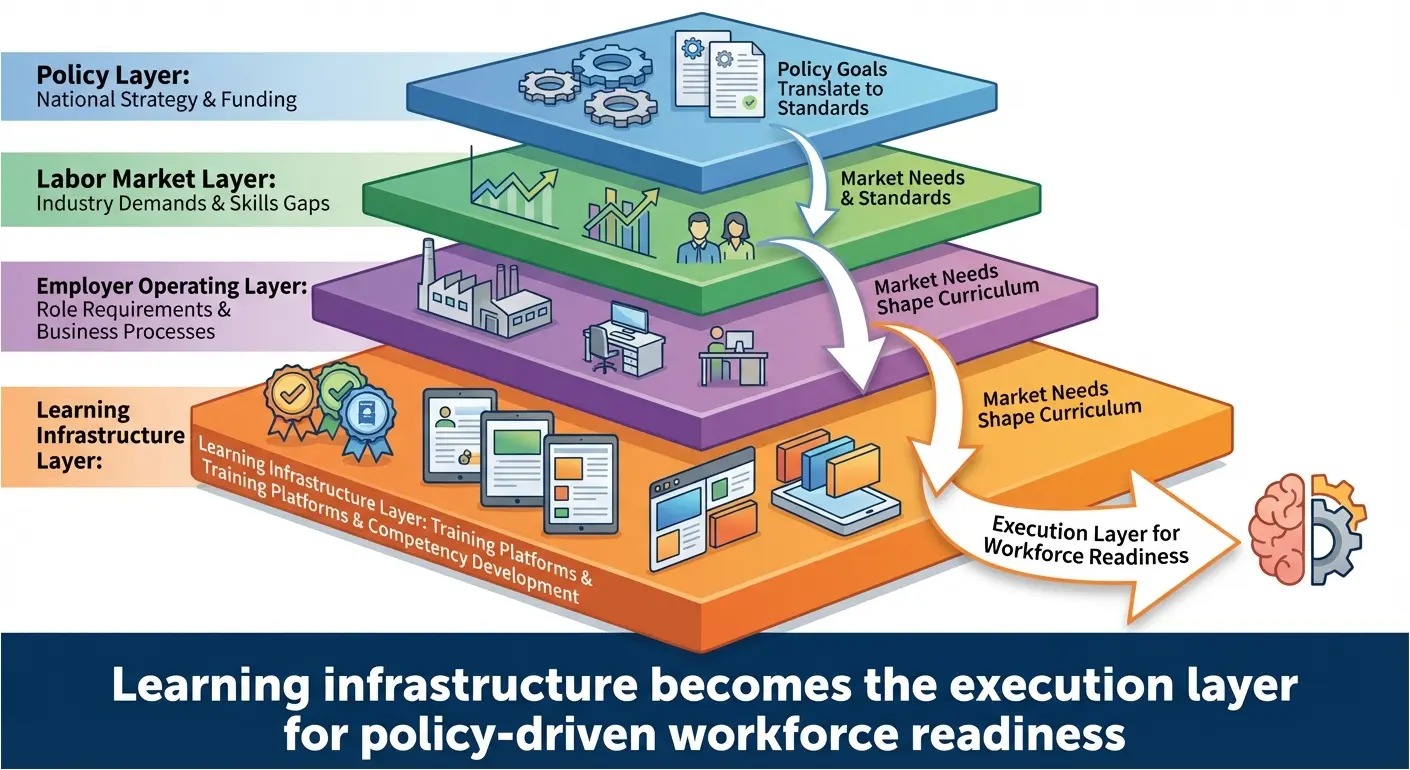
This is where many organizations still underinvest. They buy content, launch campaigns, and report completions, but they do not build the infrastructure that makes skills operational. Europe’s new architecture points in the opposite direction. It favors systems that can map skills to roles, connect evidence to progression, support modular learning, and translate local training activity into portable capability signals.
The Pact for Skills offers a useful clue. Its recent milestone of 4,000 members shows how strongly the EU is pushing collective workforce development in strategic sectors. That model rewards employers that can work with shared taxonomies, external partnerships, and measurable training outcomes, not just internal course catalogs.
The new European skills agenda is not asking whether companies train. It is asking whether their capability systems can plug into a larger economic architecture.
For App-Learning, the opportunity is not to comment on policy from the sidelines. It is to act as the operational layer between policy intent and workforce execution: skill maps, role-based pathways, assessment loops, portable evidence, manager visibility, and enablement systems that scale across markets. That is the practical bridge between a European strategy document and day-to-day workforce readiness.
See how App Learning turns skills strategy into operating infrastructure.
Explore the platformLeadership teams need a skills operating model, not another learning initiative
The next move for leadership is not to launch one more academy and call it transformation. It is to decide what the firm’s skills architecture needs to look like in a European market where portability, comparability, and strategic capability matter more each year. That means common skill definitions, stronger evidence models, integration with hiring and mobility, and governance that treats learning data as business infrastructure.
Europe has started to build a new skills operating system. Companies that recognize the shift early can align learning, hiring, and workforce strategy to it. Companies that do not will keep producing training activity while missing the deeper requirement: a measurable capability layer that can move with the labor market, support competitiveness, and hold up under cross-border complexity.
Good to know
What is actually new about Europe’s skills agenda?
The main change is structural. The Union of Skills connects education, adult learning, mobility, talent attraction, and governance to Europe’s competitiveness agenda rather than treating them as separate policy areas.
Why should company leadership care now?
Because the direction of policy is moving toward portable skills, stronger evidence, and tighter links between capability and economic performance. The Competitiveness Compass places skills inside the EU’s growth model, which raises the stakes for workforce strategy.
What does this mean for learning systems?
Learning systems need to function as capability infrastructure. That means role-skill mapping, evidence of skill acquisition, modular pathways, manager visibility, and outputs that support hiring, redeployment, and cross-border mobility rather than just course completion.