
Key takeaways
- AI roles attract adjacent talent, but most moves still happen across companies.
- Internal AI mobility needs role clarity, skill mapping, and practical reskilling paths.
- Generic AI awareness does not prepare employees for new AI responsibilities.
- Measurable learning journeys make AI reskilling easier to track and reinforce.
The AI talent gap is a mobility gap
Employers say they need AI talent, but the labor market signal is more specific. In June 2026, Revelio Labs reported that about 38.5% of workers switching jobs were changing job categories, up from 35% in 2019, and that AI project coordinator was the fastest-growing destination role for career switchers.
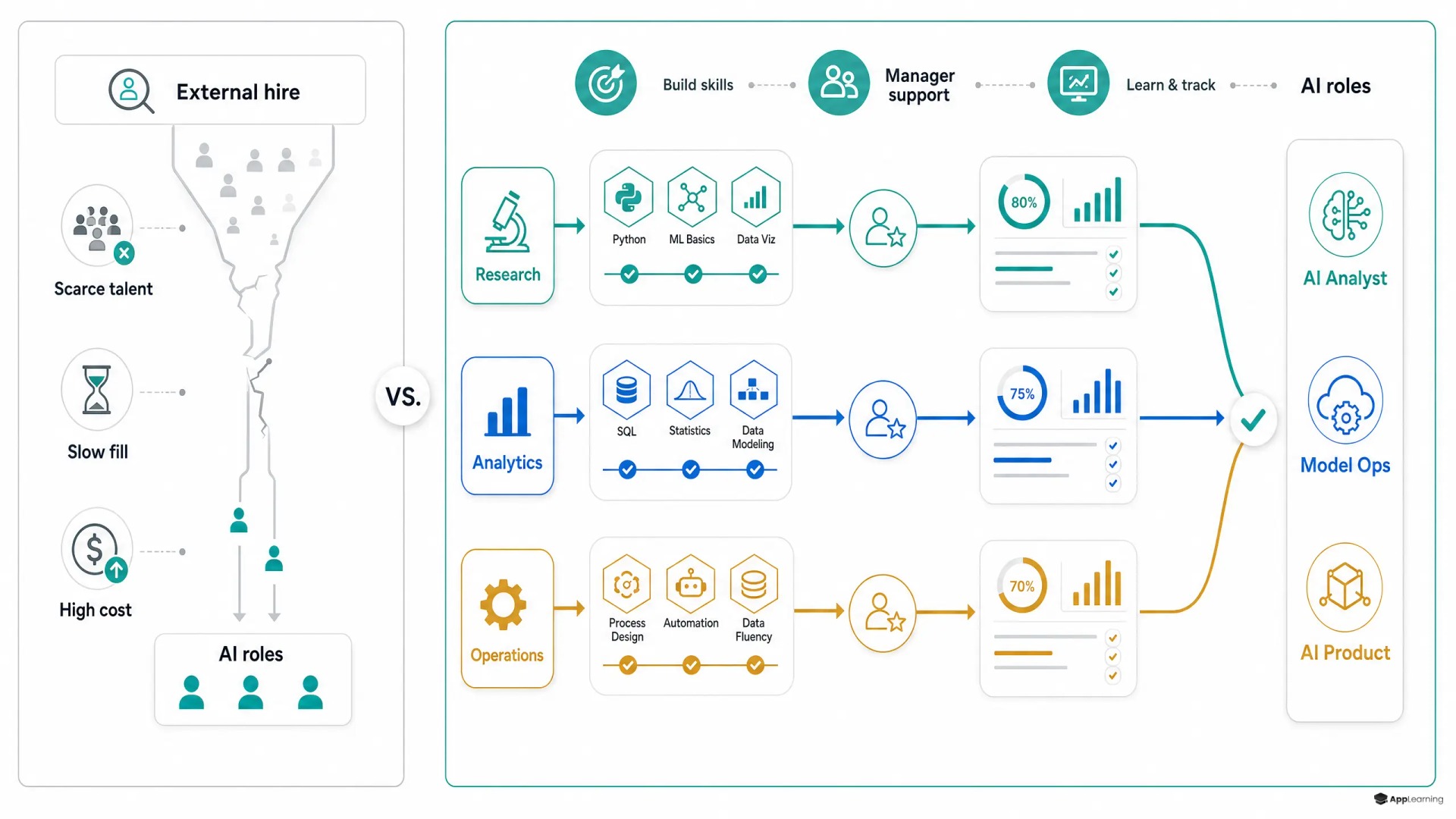
The weak point is internal movement. Revelio found that career changes into AI roles are less likely to happen inside the same company than career changes overall. That gap should worry HR and L&D teams more than a shortage headline, because it shows that many firms are buying AI capability from the market while underusing people who already understand their products, controls, customers, and risk language.
External hiring is a brittle default
External hiring has a place, especially for deep technical roles. It becomes brittle when it is the main strategy. In finance and crypto, AI work is rarely just model work. It touches fraud signals, onboarding flows, transaction monitoring, customer communication, product governance, audit trails, and escalation rules.
A new hire may bring AI expertise but still need months to learn the operating context. An internal employee may already understand the context but need a structured bridge into the new AI responsibility. Internal AI talent development is the work of building that bridge.
Adjacent skills need translation
Revelio’s analysis shows that common source roles for AI transitions include academia and research, data analysis, manufacturing engineering, consulting, and marketing. The common thread is not a generic interest in AI. It is transferable work activity, including computational modeling, data analysis, project coordination, stakeholder translation, and implementation discipline.
For a regulated finance or crypto company, that translation can be concrete:
- A data analyst can move toward AI model evaluation or AI reporting.
- A risk analyst can become an AI control and policy owner.
- A compliance specialist can support AI monitoring, documentation, and review routines.
- An operations lead can own AI workflow adoption and exception handling.
- A product manager can become the link between AI use cases, customer impact, and governance.
This is where many AI reskilling pathways fail. They start with tools, not roles. They teach prompts before they define decisions. They measure attendance before they test whether someone can use AI safely in the workflow that matters.
Role-based pathways beat AI awareness
AI awareness is a floor, not a mobility system. In Europe, the AI Act’s Article 4 obligation to ensure AI literacy entered into application on 2 February 2025, which makes general literacy relevant for many organisations. But readiness for an AI-adjacent role needs more than basic literacy.
A role-based pathway should define the target work first. What decisions will this person support? Which AI systems will they use or oversee? What risks must they recognise? What evidence must they produce? Once the role is clear, learning can be short, practical, and measurable.
- Define the target role and the work outputs it owns.
- Map current skills to missing skills and risk knowledge.
- Build microlearning modules around the actual workflow.
- Use scenarios, cases, and decision exercises instead of passive content.
- Add manager observation and feedback at key checkpoints.
- Require a work sample before the employee is marked ready.
Good to know
Why should AI hiring be treated as an internal mobility challenge?
Because many employees already have adjacent skills, domain context, and control knowledge. A structured mobility path can convert that experience into AI-adjacent capability faster than relying only on external hiring.
What makes an AI reskilling pathway role-based?
It starts with the target role, work outputs, decisions, tools, risks, and evidence requirements. Training then maps directly to what the employee must do in the new context.
Why is generic AI training not enough?
Generic training can build basic awareness, but it does not prove that someone can apply AI in a regulated workflow, handle exceptions, document decisions, or escalate risk correctly.
What should HR and L&D measure beyond completions?
They should measure scenario performance, quiz results by risk topic, applied work samples, manager feedback, pathway progress, and readiness to perform defined role tasks.
Readiness needs evidence from work
Completions and certificates show exposure. They do not prove workforce readiness for AI. The World Economic Forum’s 2025 Future of Jobs Report pointed to fast-rising demand for AI, big data, cybersecurity, technological literacy, analytical thinking, resilience, leadership, and collaboration. That mix is operational. It requires judgement under constraints.
Useful readiness evidence should include pathway progress, quiz results by risk topic, scenario performance, submitted work samples, manager sign-off, and re-checks after the employee has applied the skill in context. For regulated teams, each evidence point should connect to a role, a system, a use case, a control, or an escalation rule.
Build measurable AI pathways your teams can trust.
TalkThe internal pathway becomes the hiring system
HR and L&D do not need to redesign the whole organisation at once. Start with three AI-adjacent roles where demand is rising and context matters. Build one pathway for each. Keep the modules short. Add practice. Track gaps. Let managers see who is ready for shadowing, project work, or a formal move.
This is the App-Learning angle. App-Learning supports role-based learning paths, microlearning modules, quizzes, certificates, and analytics for employee academies, while its content workflow helps teams turn existing policies, decks, process documents, and expert input into structured training. For finance and crypto companies, that matters because AI capability must be engaging enough to finish and controlled enough to audit.
AI hiring will not be solved by job postings alone. The sustainable answer is a mobility system that makes adjacent talent visible, gives employees a practical route into new responsibilities, and gives leaders evidence that people can apply AI safely where the business actually runs.