Key takeaways
- Europe is treating skills as competitiveness infrastructure, not only education policy.
- Industrial transition depends on moving workers into new role profiles faster.
- Traditional course-heavy training models are too slow for live workforce shifts.
- Operational learning systems matter more than content libraries alone.
The transformation bottleneck is often misdiagnosed. Leaders talk about capital expenditure, AI adoption, clean-tech deployment, or industrial strategy. But the harder constraint is usually time to capability. A company can buy equipment, license software, or announce a transition plan much faster than it can help thousands of workers become effective in new roles.
That is why reskilling is moving out of the soft category of learning initiatives and into the harder category of economic coordination. For HR and L&D teams, this changes the brief. The question is no longer whether learning supports transformation. The question is whether the organization can turn workforce movement into an operational system.
Skills policy is being folded into competitiveness policy
The European Commission has made that shift explicit. Its Union of Skills, proposed on March 5, 2025, is framed as an instrument that reinforces the Competitiveness Compass and the Clean Industrial Deal rather than as a standalone education agenda.
The logic became even clearer in the Clean Industrial Deal launched on February 26, 2025. The document treats workforce capability as part of industrial execution, stating that Europe needs skills in clean technologies, digitalization, and entrepreneurship if the low-carbon transition is going to happen at production level rather than remain a policy ambition.
This is now embedded deeper in economic governance. On March 9, 2026, the Council of the EU adopted a recommendation on human capital inside the European Semester framework, explicitly linking labour and skills shortages to competitiveness. That matters because it moves skills from a supportive discussion into the machinery that coordinates economic reform priorities across member states.
For employers, the signal is straightforward. Reskilling is no longer being treated as a nice complement to industrial change. It is being treated as a precondition for industrial change.
Europe’s transition problem is a people movement problem
Europe is trying to decarbonize heavy industry, scale digital capability, expand strategic production, and offset demographic pressure at the same time. Those goals create demand for new skill combinations across manufacturing, energy, logistics, construction, software, maintenance, and technical operations. The constraint is not simply a shortage of workers in the abstract. It is the mismatch between existing role profiles and emerging ones.
That mismatch is visible in the data. The European Labour Authority’s labour shortages reporting continues to show structural shortages in key sectors, while Eurostat reported that only 56% of people in the EU had at least basic digital skills in 2023. Europe is not starting from a workforce base that can absorb industrial and digital transition frictionlessly.
This is why reskilling matters strategically. If workers cannot move from declining tasks into adjacent higher-value ones quickly enough, companies do not just face a learning gap. They face delayed transformation, rising external hiring costs, slower technology adoption, and more political resistance to change.
The old training model breaks under transition speed
Most corporate training systems were designed for incremental development. They work reasonably well when the goal is broad awareness, annual compliance, or generic leadership content. They work poorly when the real requirement is to shift large populations into new task capability under time pressure.
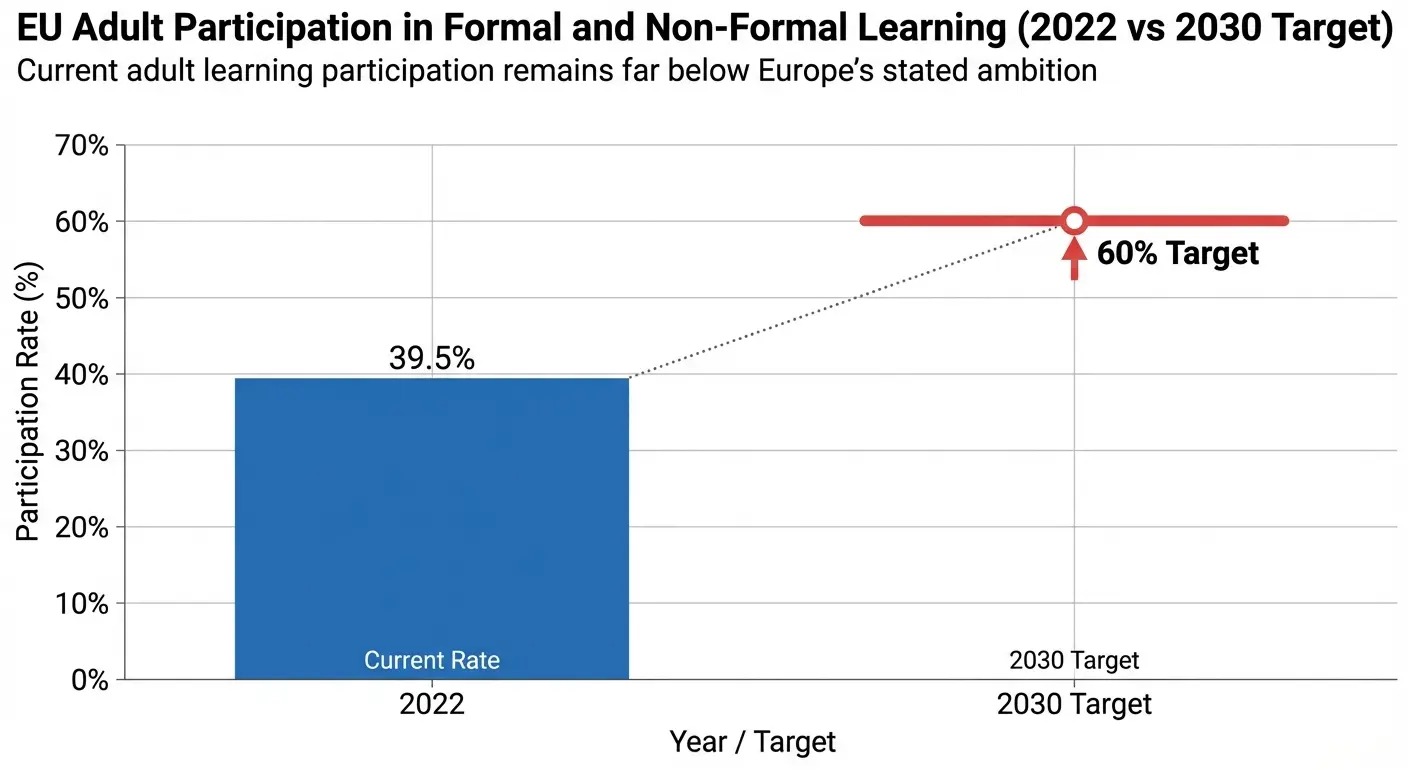
The participation data explains part of the problem. According to the Commission’s ESDE review based on Eurostat data, 39.5% of adults aged 25 to 64 participated in formal or non-formal learning in the previous 12 months in 2022 when guided on-the-job training is excluded, still well below the EU target of 60% by 2030. The same review shows that training schedules are a major barrier for adults who want more learning. Traditional formats are still colliding with real work conditions.
This is the operational flaw in many reskilling plans. They assume workers will step out of production, attend enough courses, retain enough theory, and later re-enter changed roles. That sequence is too slow for live transition environments. It also overloads employees with content before they have a clear use case for it.
- Course catalogs optimize availability, not role conversion.
- Long-format programs create delay between learning and application.
- Detached training struggles to prove readiness at task level.
- Managers rarely get visibility into whether capability is actually moving.
When transformation is urgent, the winning learning model is not the one with the biggest content library. It is the one that shortens the path from current role to productive performance in the next role.
Operational reskilling is built around role transition systems
A workable reskilling system starts with role architecture, not content. The organization needs to know which roles are shrinking, which are emerging, which adjacent moves are realistic, and which capabilities actually determine readiness. Only then does learning design become useful.
From there, the learning system has to behave more like workforce infrastructure. That means short learning units mapped to real tasks, manager-visible progression, practice inside the flow of work, and evidence of applied capability rather than passive completion. This is where the App Learning approach becomes practical: microlearning and embedded learning paths are valuable because they reduce coordination cost and let learning happen inside operational time, not outside it.
- Map skill shifts to concrete job families and transition pathways.
- Break target capability into applied behaviors, not abstract topics.
- Deliver short learning sequences near the moment of work.
- Use managers and team leads as capability validators, not just sponsors.
- Track transition readiness, not only enrollments and completions.
This is also where microcredentials and smaller verified learning units become useful in Europe’s broader policy direction. Institutions such as Cedefop have been studying microcredentials because labour market transition increasingly requires modular proof of capability rather than waiting for full formal qualification cycles.
See how App Learning turns reskilling into an operational system.
Explore the platformThe mandate for L&D is moving closer to workforce planning
For L&D leaders, the implication is structural. If reskilling is becoming part of industrial policy, then internal learning teams cannot stay organized as content service functions alone. They need tighter links to workforce planning, business transformation, operations, and talent mobility.
That changes what good looks like. The strongest L&D teams will spend less time debating course formats in isolation and more time answering operator-level questions: which populations need to move, into which roles, over what timeframe, with what evidence of readiness, under which line constraints.
It also changes executive language. Instead of asking for more training volume, leaders should ask for shorter time to proficiency, lower transition risk, higher internal fill rates for strategic roles, and clearer visibility into capability bottlenecks. Once the conversation moves there, reskilling stops looking like a support function and starts looking like execution capacity.
Europe’s policy direction is making one point hard to ignore: industrial transition is now inseparable from workforce transition. Companies that still treat reskilling as a library, a campaign, or an annual initiative will move too slowly. Companies that build transition systems around role mobility, embedded practice, and measurable readiness will be better positioned to convert strategy into operating reality.
Good to know
Why is reskilling being discussed as industrial policy rather than just HR policy?
Because Europe is linking competitiveness, decarbonization, and digital transition to workforce capability. Recent initiatives such as the Union of Skills and the Clean Industrial Deal treat skills as execution infrastructure for sector change.
Why are traditional training formats often too slow for reskilling?
They usually separate learning from work, delay application, and measure attendance more easily than readiness. In transition settings, organizations need shorter feedback loops between learning, task practice, and productive performance.
What should HR and L&D leaders measure in a reskilling program?
Focus on role conversion metrics such as time to proficiency, internal fill rate for strategic roles, manager-validated readiness, and transition completion by job family. Those measures show whether learning is actually moving workforce capacity.