Key takeaways
- L&D may need to close its own AI capability gap before training the business.
- AI readiness depends on governance, data fluency, and workflow design, not tool access.
- Role-based checks prove capability better than generic AI awareness modules.
- Regulated teams need measurable readiness signals before scaling AI enablement.
The readiness gap sits inside L&D
The uncomfortable part of enterprise AI training is that the function asked to lead it may not yet be ready. The LPI research coverage published on 20 May 2026 describes two linked studies: one based on 692 learning, talent, and people leaders, and another using self-assessment data from 3,575 L&D professionals across 1,874 organisations. The pattern is clear. The L&D AI capability gap is not only about prompt writing. It includes governance, data readiness, workflow integration, analytics, and strategic impact.
Access to tools is not the same as readiness.
For a finance or crypto learning leader, this gap has direct consequences. If L&D cannot define safe AI use, test role-specific skill, or explain what good evidence looks like, then company-wide AI training becomes another completion exercise. People finish a module. The dashboard turns green. Risk remains in the workflow.
Tool access creates false confidence
Many organisations start AI enablement by giving teams a tool and announcing guidelines. That is not AI readiness for L&D. In regulated environments, readiness means people know when AI is useful, when it is unsafe, what data must not enter a system, who approves new use cases, and how outputs are checked. The European Commission guidance on AI literacy says Article 4 of the EU AI Act entered application on 2 February 2025 and requires providers and deployers to take measures that ensure sufficient AI literacy, with role, experience, context, and risk taken into account.
Even outside the EU, the operating logic is similar. The NIST AI Risk Management Framework Core frames AI risk management around govern, map, measure, and manage. That is a useful test for L&D. If a learning team cannot govern its own AI use, map learning workflows, measure output quality, and manage misuse, it should not scale AI governance training to the whole business.
Four capabilities before scale
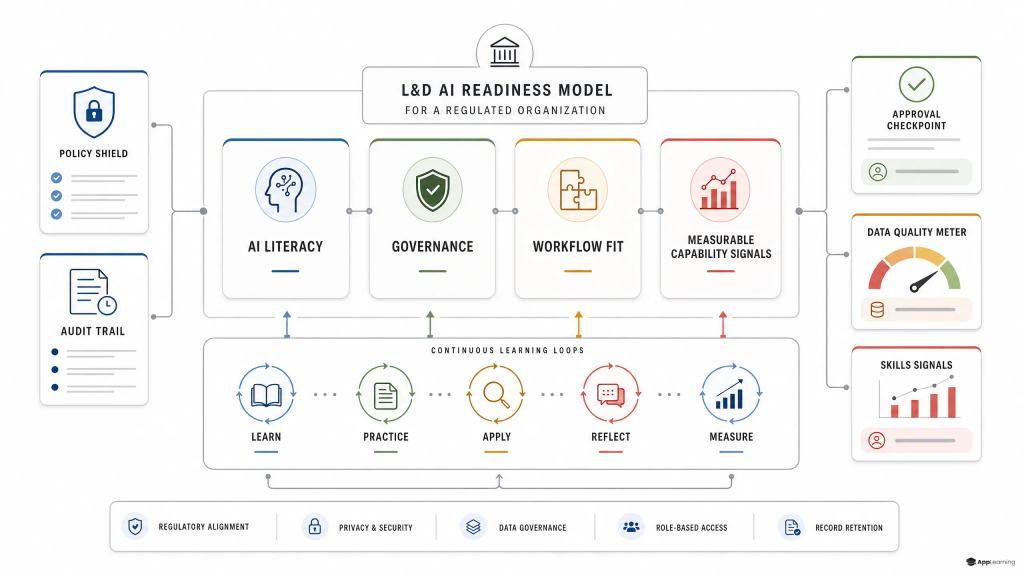
A practical readiness model starts with four capabilities. They should be assessed inside L&D before the function trains product, compliance, operations, or customer teams.
- AI literacy for learning teams means understanding model limits, hallucination, bias, privacy exposure, and human oversight.
- AI governance training means knowing approval paths, policy boundaries, audit needs, and escalation rules.
- Data fluency means reading learning analytics, spotting weak evidence, and connecting training data to capability signals.
- Workflow integration means redesigning real learning production tasks, not adding AI as a side tool.
These capabilities change how L&D operates. Course designers need source-control habits for AI-generated content. Compliance learning owners need review checkpoints. Learning analysts need cleaner taxonomies and better measures than completions. HR business partners need enough AI literacy to challenge weak vendor claims. The model should make those expectations visible.
Proof comes from role work
Generic awareness modules are easy to distribute and hard to trust. They tell you who watched, clicked, or passed a quiz. They do not show whether a learning designer can turn a policy into a safe prompt workflow, whether an onboarding owner can review AI-generated scenarios, or whether an L&D analyst can explain why a dashboard is misleading.
Readiness assessment should use role-based tasks. Ask an instructional designer to improve a compliance scenario with AI and document the review trail. Ask a learning operations manager to classify AI use cases by risk. Ask a people analytics partner to interpret noisy learning data and state what cannot be concluded. These tasks create evidence leaders can inspect.
Good to know
Where should an L&D team start with AI readiness?
Start with the roles that already touch AI risk. For most regulated teams, that means content design, compliance learning, learning operations, HR operations, and learning analytics.
Is AI literacy enough for learning teams?
No. AI literacy is the baseline. L&D also needs governance routines, data fluency, workflow design, and measurable proof that people can apply judgement in real tasks.
How can regulated teams measure AI readiness without slowing delivery?
Use short role-based checks inside normal work. Measure decisions, review quality, escalation behaviour, and the ability to explain risk, not only course completion.
What makes role-based AI training better than broad awareness training?
Role-based training connects AI use to actual decisions, data exposure, policy boundaries, and business consequences. It creates evidence that managers and compliance teams can inspect.
Short loops beat policy sessions
One-off AI policy sessions create awareness. They rarely create operating discipline. Regulated learning teams need short loops that combine practice, feedback, correction, and measurement. A useful loop can run in ten to fifteen minutes and still produce evidence.
- One scenario tied to a real L&D workflow.
- One decision point with a governance implication.
- One output that can be reviewed by a peer or manager.
- One measurable signal that shows progress or risk.
This is where App-Learning fits best. Start with a small internal pilot, not a platform transformation. Map four L&D roles. Build microlearning around the actual AI decisions those roles make. Add checks that test judgement, not recall. Use analytics to show where confidence is rising, where governance is weak, and where workflow design still breaks.
Pilot measurable AI readiness with your L&D team first.
PilotPilot before platform promises
A good pilot should be narrow enough to ship fast and serious enough to matter. In a finance or crypto company, that might mean AI readiness for compliance content owners, onboarding designers, HR operations, and learning analytics. Each role gets different tasks, different risks, and different proof. The output is not a certificate. It is a readiness view that leaders can use before scaling AI enablement company-wide.
The real risk is not that L&D moves too slowly on AI. The real risk is that it moves loudly without evidence. Regulated organisations do not need more AI enthusiasm. They need learning teams that can prove capability, protect the business, and build confidence through disciplined loops. AI readiness has to start with the people responsible for teaching it.