
Key takeaways
- Separate task automation from the development of independent judgment.
- Map starter tasks by the learning exposure they once created.
- Replace lost exposure with simulations, AI critiques and escalation drills.
- Verify decisions performed without prompts after training.
- Track time-to-proficiency and review errors alongside completion rates.
Routine work was never just routine
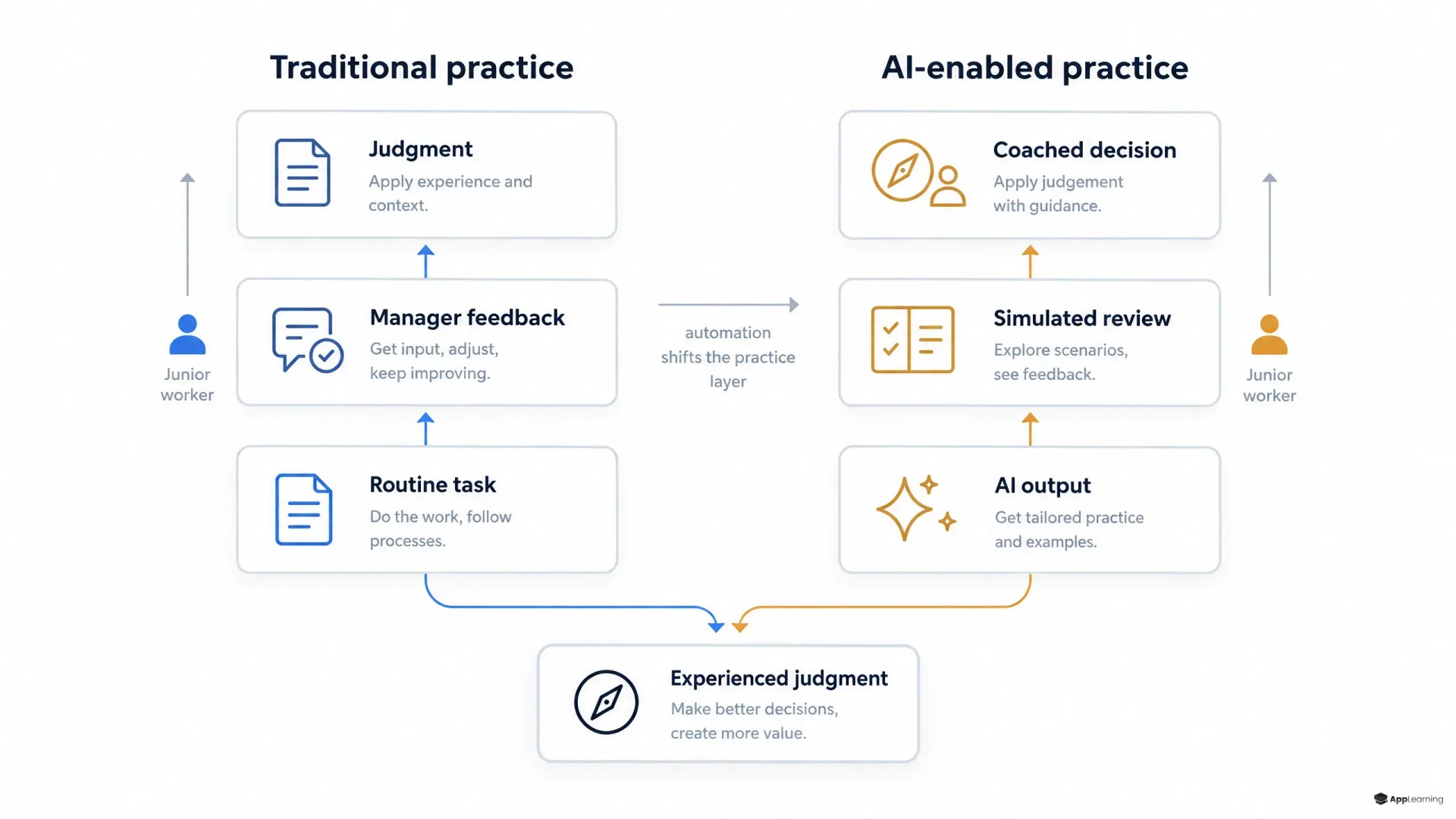
Junior analysts, operations staff and compliance hires have long learned through work that looked basic from the outside. They reconciled exceptions, checked documents, drafted cases, routed alerts and prepared reviews. The value was not the repetition itself. It was the sequence around it: comparing evidence, spotting uncertainty, escalating a problem and receiving correction from someone more experienced.
When AI completes a first draft, classifies a case or summarizes a file, throughput may improve. But a company can also remove the practice volume through which new people built pattern recognition. That is the core risk in the apprenticeship in AI era. It is a capability design problem, not evidence that every entry-level role will disappear.
Exposure is not a job-loss forecast
The debate needs more discipline than headline claims allow. The IMF’s January 2026 assessment notes that entry-level jobs have higher exposure to AI-driven change, while its underlying analysis separates potential displacement from potential complementarity. A task can be automated, accelerated or redesigned without eliminating the role that contains it.
The empirical picture is still incomplete. A randomized study across 66 firms found time savings from workplace generative AI but did not detect changes in the quantity or composition of workers’ tasks during its six-month observation period. That evidence from knowledge workers is a useful limit on sweeping claims about universal displacement. Hiring patterns also reflect demand, interest rates, remote-work structures, graduate supply and firm-specific operating models.
There is also evidence for a different outcome. In a field study of customer-support agents, access to an AI assistant raised productivity most strongly for newer and lower-skilled workers, suggesting that tools can transfer elements of expert practice when the workflow makes that practice visible. The study of 5,179 agents does not prove that AI preserves apprenticeship, but it shows that design choices matter.
AI-first operations can break the feedback loop
The failure mode is simple. A junior accepts an agent output, a senior reviews only the final exception, and the system records completion. The learner may become faster without learning why the output was sound, weak or unsafe. Over time, the organization loses visibility into who can act when the model is uncertain, the evidence conflicts or an unusual case appears.
For AI entry-level workforce training, separate production assistance from deliberate practice. Do not assume that use of a copilot equals competence. Require learners to inspect the output, state the evidence they would seek, identify the escalation threshold and defend a decision before they see the approved answer.
Finance onboarding needs designed exposure
In banking, fintech and crypto operations, starter work often carries exactly the judgment signals that matter later. A KYC analyst learns from mismatched ownership records. A transaction-monitoring analyst learns from alerts that look plausible but lack context. A payments operations hire learns when a reconciliation break is a timing issue and when it points to a control failure. A graduate in compliance learns that a well-written case summary can still omit the fact that changes the decision.
If an AI layer absorbs the clean cases, retain the hard learning cases deliberately. Finance graduate onboarding should include a controlled stream of representative exceptions, including incomplete evidence, conflicting data, false-positive signals and ambiguous policy boundaries. Use sanitized historical patterns where permitted, then vary the facts so learners cannot memorize an answer key.
Practice must resemble the decision path
A workable architecture combines microlearning simulations, agent-output critique and human review. Microlearning supplies the policy rule or product concept. A timed scenario then requires action under realistic constraints. The learner critiques an AI-generated recommendation, records a rationale and chooses whether to approve, investigate or escalate. A mentor reviews selected decisions, especially the reasoning behind wrong answers and near misses.
- Map each junior task to the judgment, evidence and escalation behavior it used to develop.
- Build short scenarios around high-frequency exceptions and high-consequence edge cases.
- Show imperfect AI outputs, not only ideal ones, and require specific corrections.
- Route a small sample of learner decisions to mentors for calibrated feedback.
- Release production permissions in stages after demonstrated independent performance.
This is where App-Learning fits best: as a workflow-embedded practice and assessment layer that connects training with the decisions people must make, rather than as another generic AI literacy course.
Good to know
Which junior tasks should L&D map first?
Start with high-volume tasks that previously exposed hires to evidence review, exceptions, policy interpretation and escalation decisions. Prioritize tasks where AI now handles clean cases or produces a first recommendation.
How can teams avoid turning simulations into compliance theatre?
Use realistic constraints, imperfect information and varied case facts. Score the learner’s rationale, evidence choice and escalation decision, not only whether they selected the approved final answer.
What should managers review after training?
Review a sample of independent production decisions, the rework created by reviewers and the quality of escalations. These signals show whether learning transferred beyond the training environment.
Completion data cannot prove readiness
Completion, prompt activity and quiz scores are weak proxies for operational readiness. L&D leaders should track time-to-proficiency, decision accuracy by scenario type, escalation quality, reviewer rework and error recurrence after release to production. Segment results by role, tenure and case complexity. If AI reduces live-case exposure, those measures reveal whether simulations and mentoring are restoring it.
The key test is independent performance. Can a learner recognize when the agent is wrong, incomplete or operating outside the policy boundary? Can they explain the decision trail to a reviewer? If not, the company has automated the visible task while leaving the capability gap intact.
Design a practice layer that keeps junior judgment growing alongside AI.
TalkThe talent ladder needs active maintenance
AI does not remove the need for experienced operators. It changes how organizations produce them. The firms that benefit most will not merely automate junior throughput. They will inventory the learning value embedded in junior work, recreate lost exposure through practice, and verify judgment before responsibility expands. That is how faster operations and a durable talent pipeline can coexist.