
Key takeaways
- AI video can reduce production cost but increases review complexity.
- Scenes, narration, and assessments need one shared learning-objective contract.
- Adaptive quizzes should test the concept shown, not visual-detail recall.
- Scene-level learner data enables targeted revisions instead of full-course rewrites.
The production unit shifts from lessons to scenes
AI video learning changes the economics of internal education. A team can now produce a polished onboarding sequence without booking a studio, coordinating presenters, or waiting on a long editing cycle. Models are also becoming more controllable: the Seedance 2.0 launch note describes generation and editing across text, images, audio, and video, including multi-shot output.
That speed changes the unit that learning teams must govern. The lesson is no longer the smallest practical content asset. It is the scene: a short visual and narration sequence with one teaching purpose. A generated five-minute lesson may contain ten scenes, each with its own factual claims, visual cues, examples, and risks of confusion.
For a growing startup, this matters because a manager can quickly turn tribal knowledge into AI-generated course content. But a fluent video does not make undocumented knowledge reliable. The company still needs to verify what new hires are being taught before that content becomes the standard operating model.
Cinematic quality can hide instructional failure
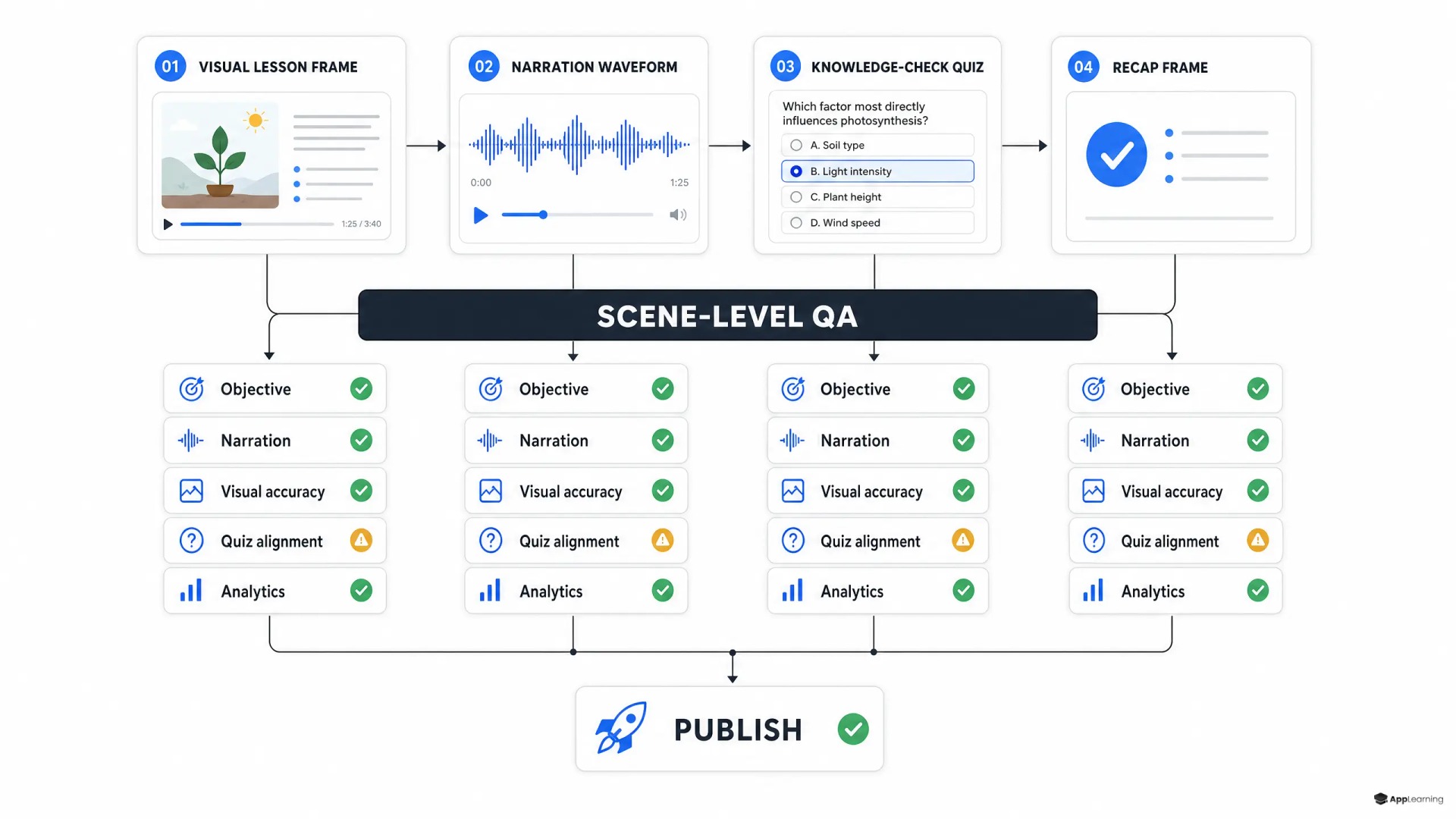
A conventional review often asks whether a lesson looks professional, sounds clear, and covers the planned topic. Those checks matter, but they are too coarse for generated media. A scene can look credible while showing an outdated product screen. Its narration can state a rule that the visual does not demonstrate. A quiz can appear after the scene yet test an unrelated detail.
Learning content QA needs a different standard. Every scene should carry a learning-objective contract that makes its instructional job explicit. The contract turns creative output into a reviewable learning component rather than a clip that merely fits the script.
- Objective ID and the observable decision, action, or explanation the learner should master
- Narration claim and the approved knowledge source behind it
- Visual evidence that demonstrates the claim without contradicting it
- Expected learner misconception and the feedback needed to correct it
- Linked assessment item, answer rationale, owner, and version ID
This is where AI instructional design becomes operational. Subject-matter reviewers can validate the knowledge. Learning reviewers can validate the teaching move. Neither team has to infer the intended outcome from a finished video.
Assessment must share the scene contract
An adaptive quiz is not useful because it interrupts a video. It is useful when it tests whether the learner can apply the concept the scene just introduced. In an AAAI-26 demonstration paper, PAL shows a practical model for inserting questions during video playback and adjusting difficulty from learner responses. That is a useful system pattern, even though a demonstration is not proof that every implementation improves learning outcomes.
The assessment design should therefore begin with the scene, not with a generic question bank. A strong item asks the learner to choose the next action, identify the relevant policy, or distinguish two similar cases. It should not reward remembering a background object, a phrase, or a presenter’s expression.
- Map every question to one scene objective
- Test application before recall where the task allows it
- Tag wrong answers to a specific misconception
- Adapt difficulty only within the same concept boundary
- Show corrective feedback that points back to the relevant scene or knowledge source
Learner behavior becomes a revision backlog
Adaptive video learning produces a more useful signal than course completion alone. At scene level, teams can see where learners replay a segment, abandon the flow, answer confidently but incorrectly, or need repeated hints. These patterns do not automatically prove that a scene is poor. They create a focused diagnostic queue.
For example, low quiz performance after a scene may indicate an unclear explanation, a misleading visual, a question that exceeds what was taught, or a real knowledge gap in the learner group. The remedy differs in each case. Scene-level data lets a team revise one explanation, swap one visual, or adjust one question instead of rebuilding an entire onboarding course.
Good to know
What is scene-level learning QA?
It is a review process that validates each scene’s objective, factual accuracy, visual evidence, narration, linked question, feedback, and version before release.
How granular should a scene be?
A scene should usually teach one coherent idea or decision. If it contains several concepts, split it into smaller assets with separate objectives and assessments.
Do small startups need a dedicated L&D team for this model?
No. They need clear ownership, reusable review rules, and a platform that keeps knowledge, learning objectives, questions, versions, and learner data connected.
Governance protects the speed advantage
The practical workflow is simple in principle. It needs discipline more than a large learning-and-development department.
- Define the role-specific outcome before generation, such as handling a customer escalation or completing a security check.
- Break the outcome into scene-level objectives and write the learning-objective contract for each scene.
- Generate and review scenes as separate assets, retaining prompts, source material, approvals, and version history.
- Run factual and instructional review before release, then validate that every question maps to a scene objective.
- Monitor scene performance, revise the weak component, and keep the assessment and knowledge base aligned with the new version.
This workflow prevents a common failure mode: publishing a new video quickly, then losing track of which narration, screen capture, and quiz item represent the current company process. Speed without traceability creates an expensive maintenance problem.
Build governed onboarding from every generated scene.
StartApp-Learning turns generated media into a learning system
App-Learning can provide the structured layer around AI media generation: role-based learning paths, objective mapping, scene review, adaptive questions, versioned content, and performance analytics in one operational flow. That gives founders a way to professionalize onboarding and internal training without building a separate L&D function around a growing library of videos.
Generative video will not fail because it looks synthetic. It will fail when polished scenes teach inconsistent processes, assessments reward the wrong behavior, and nobody can trace a weak result back to the content that caused it. Scene-level governance keeps generated speed connected to reliable capability building.