

Key takeaways
- Procurement compatibility gives specialist education a stronger B2B distribution path.
- Corporate Bitcoin training needs outcomes, evidence, reporting and credentials.
- Workshops create momentum but digital pathways sustain learning and application.
- Design for employer development budgets before optimizing consumer reach.
Good Content Still Misses the Buying System
Bitcoin expertise is not scarce. The hard part is turning it into something an employer can approve, fund and account for. Many strong sessions remain dependent on a founder, a live audience and a single event date. They may build interest, but they do not create a repeatable corporate Bitcoin training product.
A past Luma event listing marketed BTC Education Hub’s August 14, 2026 programme in Penang as an HRDF-claimable seat. The page also called it Malaysia’s first HRDF-claimable Bitcoin course, which should be treated as provider marketing rather than independently verified fact. Its more useful signal is the packaging: a defined one-day format, a professional audience, a delivery agenda and a route into employer-funded training.
For a Bitcoin company, this matters beyond internal learning. A product team cannot expect users, partners or corporate clients to become confident through scattered articles alone. Clear pathways, proof of completion and measured understanding make education easier to distribute through both company budgets and product journeys.
Procurement Is a Product Requirement
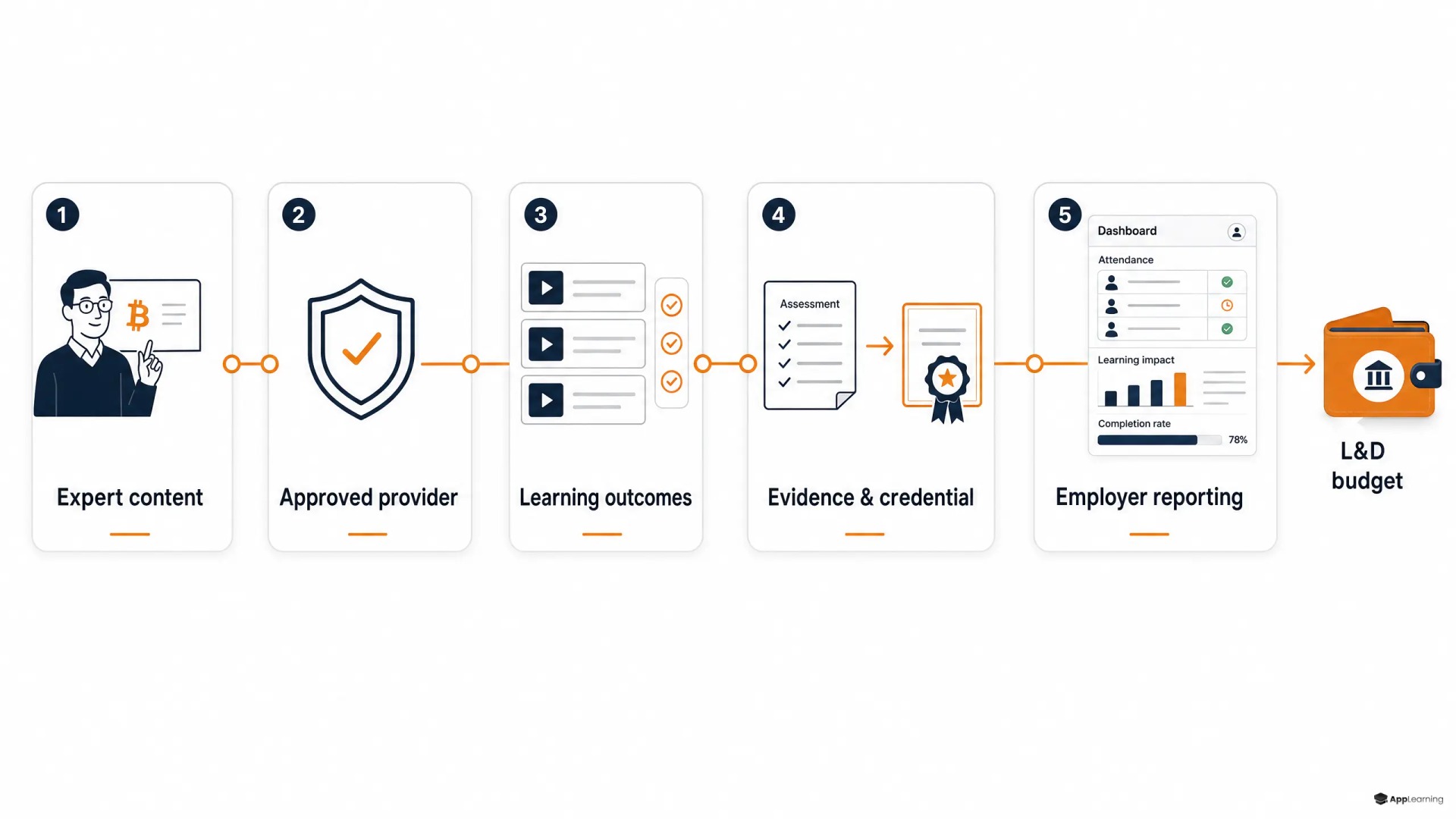
Procurement-ready training translates subject expertise into the evidence an employer already uses to compare providers. Under HRD Corp’s application process, employers submit course content, trainer profiles and pricing documentation before a grant decision. That is not administrative overhead added after the course. It is part of the product.
- A defined audience and practical learning outcomes
- A modular curriculum with duration, delivery method and trainer roles
- Assessments that show whether participants understood the material
- Attendance records and completion evidence that stand up to review
- Certificates with clear completion criteria and a credentialing policy
- Employer reporting on enrolment, progress, scores and completion
The underlying lesson is simple. Procurement does not buy expertise in the abstract. It buys a scoped service with a price, evidence, ownership and a predictable delivery process. Bitcoin education for companies must meet that standard before it can move beyond innovation teams and individual enthusiasts.
Claimability Changes the Delivery Plan
Reimbursable training schemes can reduce budget friction, but they also make the delivery design more disciplined. HRD Corp’s claimable-courses scheme covers several formats, including public training, e-learning, blended learning, mobile learning and remote online learning. It also requires employers to apply before training starts, with timing rules that vary by delivery type.
A HRD claimable Bitcoin course is therefore not simply a Bitcoin workshop with a funding label. It needs a registered-provider route, eligible programme setup, documentary evidence and an operating calendar that allows employers time to secure approval. Providers should validate current eligibility and grant conditions for each programme rather than promise reimbursement as a default.
Workshops Start the Work
A live workshop is useful when it creates shared language, addresses concerns and gives leaders space to discuss scenarios. It is weak as the entire learning system. People forget details, new hires miss the session and managers cannot see whether the knowledge changed decisions or behaviour.
The stronger model combines a facilitated kickoff with a persistent Bitcoin academy platform. Participants complete short pre-work before the session, apply concepts through scenario-based activities, then continue with mobile-first modules, checkpoints and refreshers. The workshop becomes the moment of alignment. The academy becomes the system of record.
For Bitcoin fintech product teams, the same learning architecture can also support user education. The corporate pathway should focus on business context, risk, governance and product understanding. Customer modules should focus on onboarding, security habits and feature confidence. They can share a competency model without forcing the same curriculum on every audience.
Good to know
What makes corporate Bitcoin training procurement-ready?
It has a defined provider, audience, outcomes, course structure, price, attendance process, assessment method, certificate policy and employer reporting. Procurement needs a service it can evaluate and administer, not only a compelling subject expert.
Can a workshop be enough for Bitcoin education for companies?
A workshop can create initial understanding and alignment, but it rarely supports long-term retention or scalable onboarding. Pair it with a digital pathway that reinforces key concepts, records progress and supports new cohorts.
Does an HRD claimable Bitcoin course receive funding automatically?
No. Employers must apply before training begins, and the programme must follow the relevant scheme requirements. HRD Corp’s guidance makes clear that provider registration, programme selection and supporting documents are part of the process.
Evidence Lets HR Close the Loop
A completion certificate alone is not a learning outcome. HR teams need a usable record: who enrolled, who attended, what they completed, where they struggled and whether they passed an assessment. Finance teams need the programme, supplier and cost data to reconcile spend. Managers need a view of capability by team or location.
This reporting also improves the education product itself. Low quiz performance shows where the explanation failed. Drop-off after a module signals excessive cognitive load or poor sequencing. Repeated questions reveal what needs better in-app guidance, not another support-script update. Reporting is both procurement evidence and a content feedback loop.
Build the Bitcoin academy your employer customers can fund.
TalkApp-Learning Turns Expertise Into a System
App-Learning can help Bitcoin firms productize specialist knowledge as an employer-ready academy rather than a sequence of one-off events. That means structured pathways, scenario-based assessments, certificates, mobile delivery, localization and reporting built around the operational needs of HR and finance.
The goal is not to make Bitcoin sound simpler than it is. It is to make learning dependable: clear enough for newcomers, rigorous enough for professionals and documented well enough for the people who control training budgets. When education fits the buying system, Bitcoin expertise can move from a niche event into a repeatable capability programme.