

Key takeaways
- The learning objective determines whether motion adds value.
- Frame-level review covers order, labels, numbers and prohibited shortcuts.
- Visuals and translations need the same source version.
- Static sequences and text descriptions belong in the release package.
- Comprehension checks establish value more clearly than animation preferences.
A Six-Frame Animation Can Teach the Wrong Transaction Flow
A buyer clicks, tokens move, and a green tick appears. The visual looks finished. But if it skips a required check, it teaches the wrong process. For onboarding, that is the failure to prevent—not imperfect artwork.
Images 2.6 shortens production, not validation
OpenAI’s 4 November 2026 release introduced faster generation, GIF creation, API image markup and SVG exports. Images 2.6 is available across ChatGPT and Codex subscription tiers, with Flare and Sunburst models in the API.
The API reference specifies that GIF output requires preview access. Educational GIF generation therefore needs an access check before it becomes a production dependency.
OpenAI’s business terms assign output ownership between OpenAI and the customer, subject to applicable law, while leaving input permissions and output evaluation with the customer. Rights review belongs before upload.
The objective comes before motion
For a growing team, the useful objective is a decision a new hire must make independently. Here, it is distinguishing a submitted instruction from completed settlement. Motion earns its place only if it clarifies that distinction better than a static diagram.
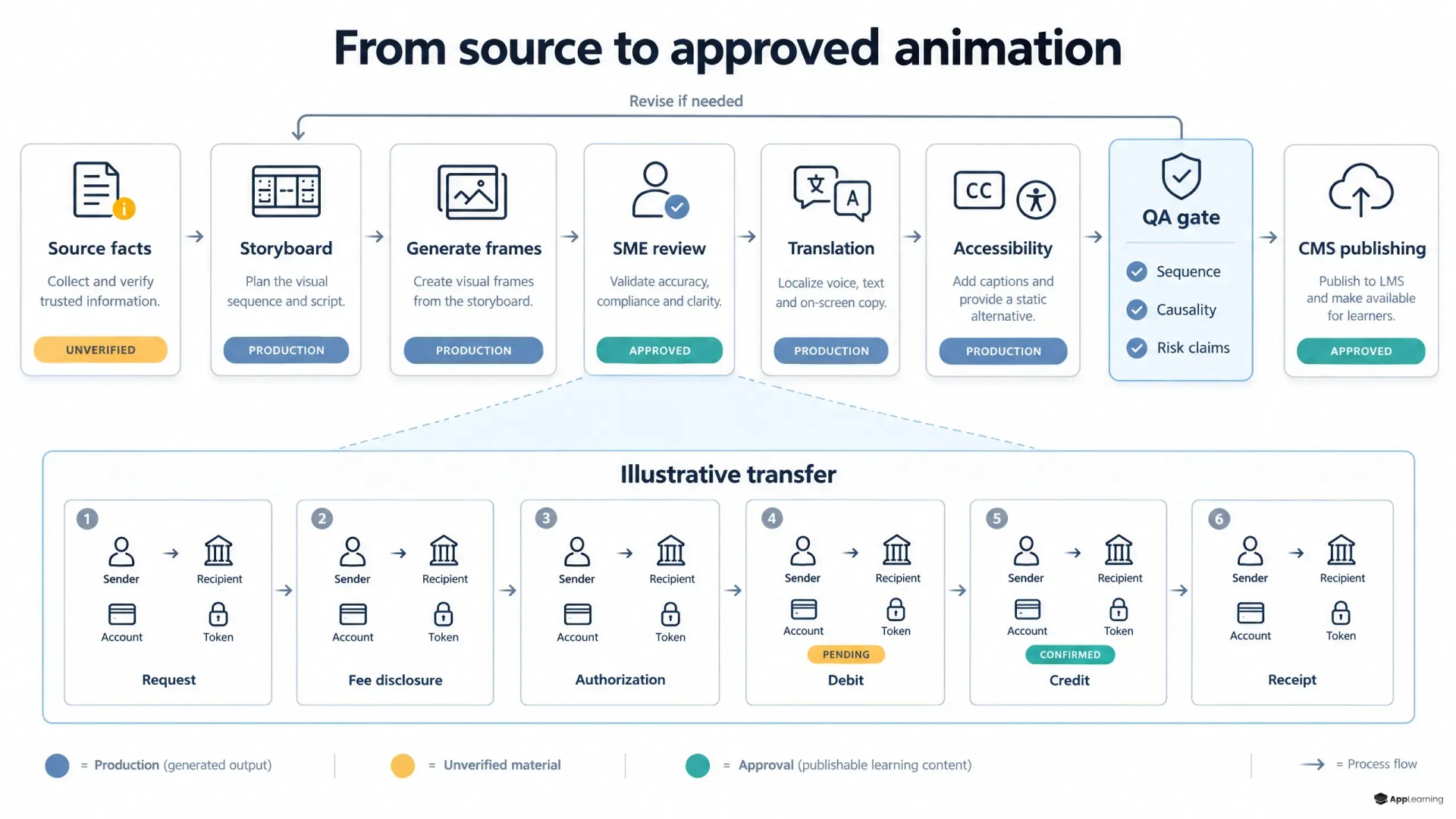
Six frames need explicit state transitions
Consider this fictional tokenized settlement sequence, labelled “Illustrative only—not a production transaction flow.” Its rules are invented for teaching, not financial guidance. An AI Content Studio workflow starts with a versioned source document and learning objective, then an approved storyboard defining each state.
- Buyer and seller agree to exchange ten asset units.
- The instruction is submitted, with settlement still pending.
- The fictional system checks permissions and available balances.
- Both legs are reserved, with ownership unchanged.
- The system commits both transfers together.
- Updated balances and a completion receipt appear.
A failed check leads to a separate exception explanation, never a success tick. Playback stops at completion; a seamless loop would imply that settlement reverses. The six-frame draft then goes to a subject-matter expert for factual annotations.
Five QA gates protect the explanation
The proposed release gate has five parts. Automated learning content QA flags mismatches; a named reviewer approves meaning.
- Factual review checks amounts, actors and claims against the approved source.
- Sequence review checks prerequisites, ownership changes and prohibited shortcuts.
- Typography review checks every label and number at LMS display size.
- Translation review checks terminology, number formats, reading direction and label fit.
- Accessibility review checks controls, reduced-motion behavior and equivalent static explanations.
Locale-specific labels should remain editable outside generated artwork. Multilingual course visuals then share one approved diagram rather than separate, untraceable illustrations.
W3C’s reduced-motion technique describes respecting user motion preferences. The proposed alternative is a numbered static sequence with a complete text explanation, not merely the final frame.
WCAG’s Pause, Stop, Hide criterion requires controls for non-essential movement that starts automatically, lasts over five seconds and appears alongside other content. A short loop is not a workaround.
The CMS holds the evidence chain
Strapi’s September 2026 MCP announcement describes agent access to content operations. That integration is plumbing, not approval.
In Strapi or an existing CMS, the proposed asset record links the source version, objective, storyboard, annotated draft, localized labels, static alternative and quiz version. It also records the model, generation settings, reviewer and approval date. Source changes mark affected derivatives for reapproval. Agents prepare drafts; publication remains gated.
Build a reviewable visual workflow with App-Learning.
DiscussComprehension decides whether animation stays
A lightweight A/B test compares animation with the equivalent static sequence. Both groups answer identical questions about ownership changes, failed checks and proof of completion. Random assignment and a later recall check make the comparison more useful; a small onboarding cohort provides directional evidence, not proof.
For App-Learning, AI content creation for LMS should produce a maintainable explanation, not an isolated file. The scalable unit is the source-linked asset package that survives review, translation and change. If motion cannot justify its maintenance cost through clearer understanding, the static version should win.