

Key takeaways
- External policy URLs are release dependencies and belong in the release manifest.
- Link acceptance covers HTTP responses, redirects, public access and the correct policy content.
- Store metadata and in-app links need independent checks.
- Canonical legal pages need a named maintainer through website migrations and domain changes.
- Automated gates catch endpoint failures but do not replace policy-content review.
The rejection exposed a missing release dependency
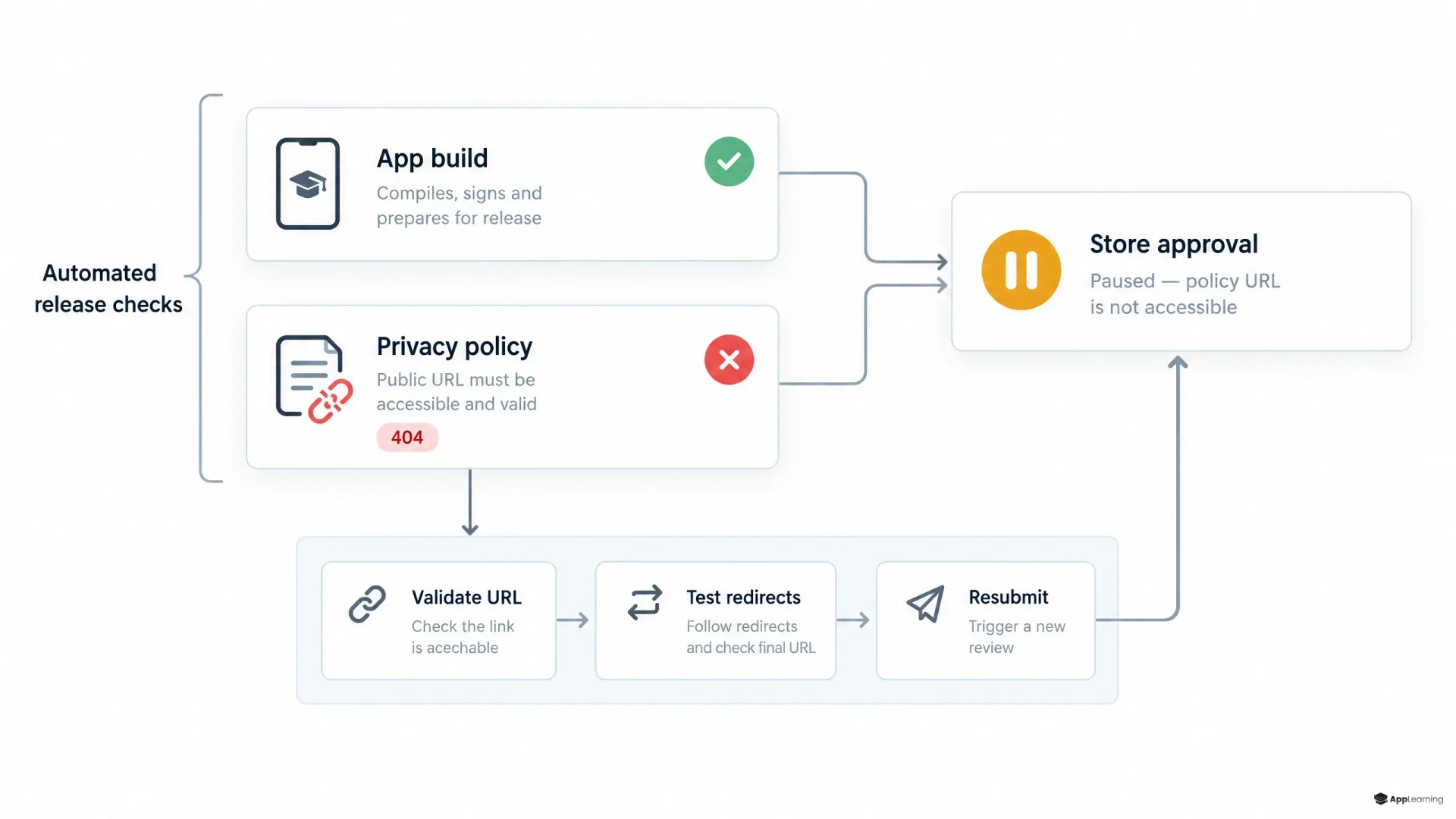
A mobile education app submission was rejected at review because its declared privacy-policy URL returned HTTP 404. The reported defect concerned a public resource, not the learner screens. A separately published version was unaffected.
Google Play distinguishes rejection from removal and states that a rejected update leaves the previously published version available. (support.google.com) This case illustrates a publishing failure, not evidence of wider security or privacy misconduct.
Release readiness extends beyond the binary
Google Play’s Developer Program Policy, effective October 29, 2026 unless otherwise stated, requires an active, publicly accessible, non-geofenced, non-editable privacy-policy URL, not a PDF. It also requires a link in Play Console and a policy link or text inside the app. (support.google.com) A valid build alone cannot satisfy those conditions.
For App-Learning’s branded web and mobile academies, the release boundary should cover builds, hosted lessons, identity, public compliance pages and distribution metadata. For a fintech product lead, that creates one readiness decision rather than separate assurances from teams testing different parts.
The release manifest should record each external URL alongside its app, store, locale, expected document and maintainer. LMS mobile compliance then becomes an explicit publishing workstream rather than an assumption attached to working code.
Policy links need content-level acceptance tests
HTTP defines HEAD as a request without response content, while GET retrieves the resource representation. (rfc-editor.org) The acceptance test should therefore inspect the document, not just its headers.
- Request the exact submitted URL over HTTPS using GET.
- Follow a bounded redirect chain and require a final HTTP 200 response.
- Test without authentication or existing cookies and from multiple regions.
- Confirm that the destination is a readable, read-only privacy page.
- Check the expected app or company identity and approved policy content.
Release gates should test production URLs
An HTTP 200 response can still carry an error page, a pattern Google documents as a soft 404. (developers.google.com) Availability checks therefore need content assertions, such as the policy heading and expected company name, alongside status checks.
The proposed release gate should run against production URLs before submission and on a schedule afterward. Store metadata and in-app links need independent checks against the manifest. Failures should block submission and notify the maintainer with the response status, redirect chain and failed assertion. Automation verifies delivery; a designated reviewer approves the policy itself.
Website changes need a named release owner
Google Play also requires Data safety declarations to remain accurate and consistent with privacy-policy disclosures. (support.google.com) Ownership must therefore cover both the page’s availability and its relationship to the app’s actual data handling.
A website migration should trigger checks of every registered policy route, redirect and locale. The web maintainer owns delivery, the privacy reviewer owns content approval, and the release owner confirms the submitted addresses. Domain changes should preserve old paths where feasible and verify every replacement.
Review your mobile academy’s release dependencies with App-Learning.
DiscussA publishing checklist closes the loop
A compact mobile app release checklist for learning app publishing should capture five decisions.
- The manifest contains every production policy URL.
- HTTP, redirect, access and content checks pass.
- Store fields and in-app destinations are verified separately.
- Policy content and disclosures have an accountable reviewer.
- Monitoring and migration rechecks have a named owner.
A Google Play privacy policy 404 belongs in release diagnostics, not just website maintenance. When a privacy policy URL is rejected, another build is not necessarily the remedy. Technology-partner responsibility means testing the full publishing path—including the dependencies outside the codebase.