
Key takeaways
- SCORM and microlearning solve different distribution and engagement problems.
- The source content model should be independent from the final delivery format.
- Shared ingestion, review, and versioning prevent duplicated maintenance.
- App-Learning can add enterprise microlearning without forcing an LMS replacement.
The format fight hides the real system problem
HR and L&D teams in finance and crypto face a specific tension. The LMS must still support assignments, records, audits, and SCORM-compatible courses. Employees, meanwhile, expect learning that works on mobile, reacts to change, and does not feel like another annual compliance click-through. Treating SCORM and microlearning as a replacement decision creates the wrong project.
SCORM remains valuable because it is a delivery contract between course content and an LMS. ADL describes SCORM as a set of standards for accessibility, reusability, interoperability, and durability, with content deliverable through a SCORM-conformant LMS using the same SCORM version. That is not the same job as learner engagement, habit formation, or mobile practice.
Standards-based WBT still earns its place
Classical WBT and SCORM-compatible courses still fit high-control use cases. They work well for mandatory training, formal onboarding, policy attestation, certification paths, and situations where the LMS is the system of record. In financial services, this matters because competence is not only a people-development topic. ESMA’s MiFID II guidance sets criteria for assessing staff knowledge and competence, and ESMA has also issued knowledge and competence guidelines under MiCA for crypto-asset service providers.
The limitation is clear. SCORM defines structure, packaging, sequencing, and LMS communication. It does not define a good learning experience. ADL’s LMS guidance states that SCORM neither dictates nor prevents any instructional, performance-support, or evaluation strategy. If teams ask SCORM to become the full experience layer, they get long courses inside an LMS shell.
Microlearning changes the learning surface
Enterprise microlearning solves a different problem. It is useful when employees need short practice loops, role-based updates, scenarios, nudges, and repeated checks over time. The evidence base does not say “short is always better.” It says that practice testing and distributed practice are strong learning techniques, as summarized by the Association for Psychological Science review. Microlearning becomes valuable when the product makes those techniques easy to run.
For finance and crypto teams, that means faster rollout of small, reviewed learning units. A sanctions update, fraud pattern, product change, or conduct-risk scenario can become a mobile interaction path instead of waiting for the next large course rebuild. Analytics can move beyond completions into attempts, confidence, misconceptions, retry behavior, and topic-level gaps.
One governed source with several outputs
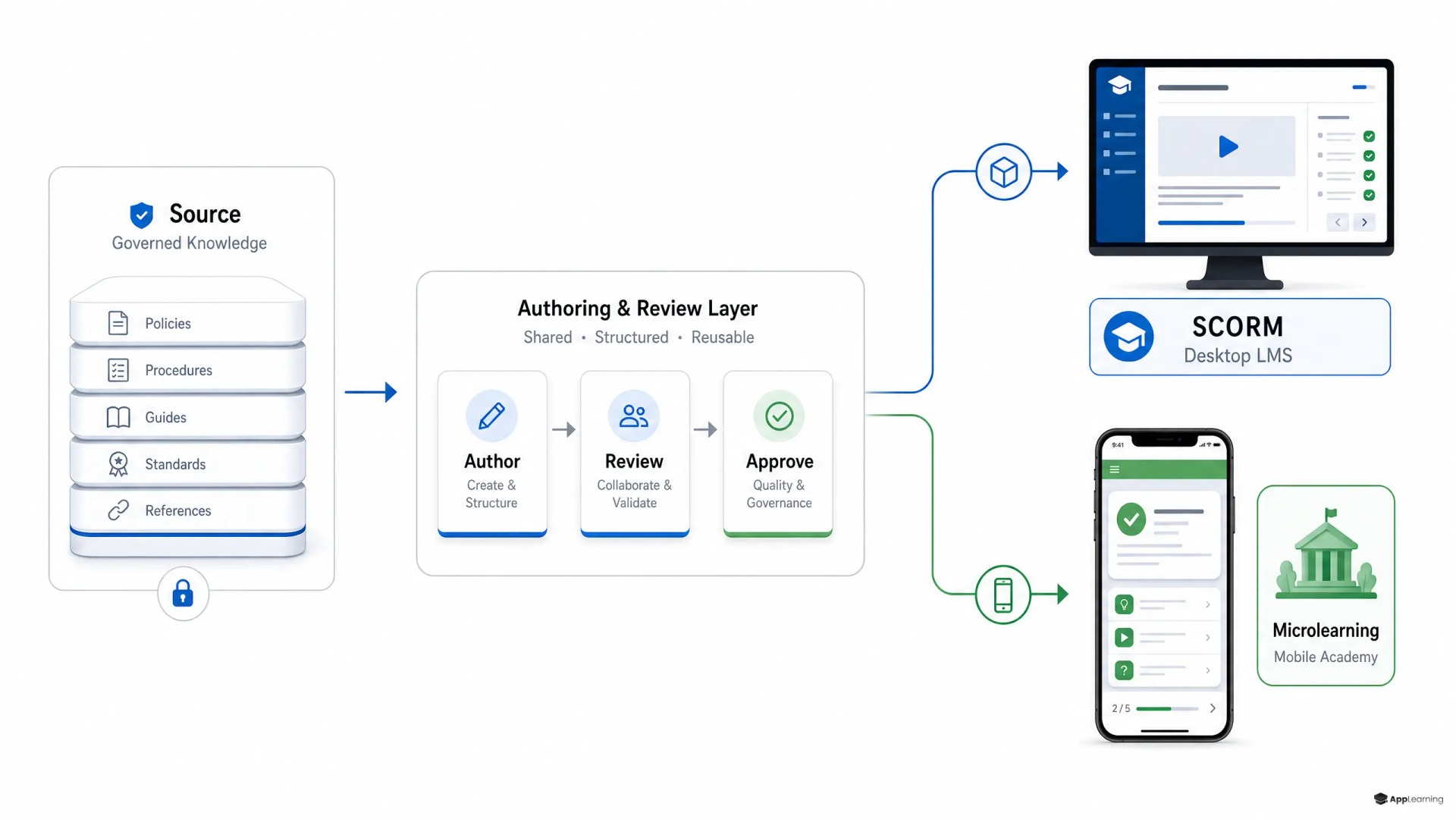
The architecture should separate source knowledge, instructional structure, and delivery format. In an anonymized App-Learning product workshop with an established learning-software provider, the same AI authoring architecture had to produce classical WBT and SCORM-compatible training while also creating interactive, mobile-first microlearning. The discovery was practical. Ingestion, curriculum structure, review logic, and versioning could be shared. Interaction components and renderers had to remain format-specific.
- Source layer with approved knowledge objects, policies, examples, and SME inputs
- Instruction layer with objectives, target roles, prerequisites, checks, and remediation rules
- Governance layer with review status, owner, risk level, jurisdiction, expiry, and version history
- Delivery layer with SCORM exporter, microlearning renderer, academy paths, and LMS integration
This is not a new content idea. OASIS DITA was designed to support authoring, managing, and processing reusable content. The same principle belongs in multi-format authoring for L&D. The source should not be a slide deck, a SCORM zip, or a mobile card. Those are outputs.
Good to know
Can microlearning replace SCORM?
Not in every case. SCORM remains useful when the LMS must manage formal assignments, completions, records, and compatible course delivery. Microlearning is better for practice, reinforcement, updates, and mobile engagement.
Does AI authoring create risk in regulated learning?
It creates risk if it bypasses governance. In a regulated setup, AI should support extraction, structuring, drafting, and variant creation, while human review, approval, versioning, and audit logic remain mandatory.
What should be shared across SCORM and microlearning outputs?
The shared layer should include source knowledge, objectives, audience mapping, metadata, review status, version history, and assessment intent. The final interaction components and renderers should stay format-specific.
Integration beats replacement
For regulated organizations, the safest modernization path is often not to rip out the LMS. Keep the LMS where it is strong. Use it for assignments, records, required SCORM delivery, and reporting workflows that auditors already understand. Add App-Learning as the interactive microlearning and academy layer through user sync, SSO, launch links, APIs, progress events, and export routes where needed.
This changes the roadmap. The first migration is not the platform. It is the content model. Each learning object needs ownership, metadata, approval state, audience mapping, and output rules. A WBT module can use desktop components and SCORM packaging. A mobile academy path can use cards, decisions, quizzes, challenges, and spaced repetition. When a rule changes, the team edits the source once, reviews it once, and publishes each format intentionally.
Modernize learning without replacing what still works.
TalkThe better decision
Enterprises should not have to choose between SCORM and microlearning. They should choose an authoring architecture that prevents content duplication. SCORM keeps compatibility with established LMS ecosystems. Microlearning improves practice, engagement, and speed of rollout. The operating model only works when knowledge, design, governance, and delivery are separate layers. That is the difference between modernizing learning and creating another fragmented stack.